Conjugating a cycle merely relabels its entries:Thus conjugate permutations have the same cycle type. Conversely, if and have the same cycle type, match the entries of each cycle of bijectively and in cyclic order with those of a cycle of of the same length. Extending these matches to a permutation gives .
Let be the centralizer of . Its -conjugacy class remains one -conjugacy class exactly when contains an odd permutation. Indeed, in that case has index two in , so the orbit-stabilizer theorem givesIf the centralizer contains only even permutations, the class has half the size and the class splits into two classes.
The even cycle types in areThe classes of the identity, a three-cycle, and a double transposition do not split: their centralizers contain an odd permutation. The centralizer of a five-cycle is its cyclic subgroup of order five, which lies in , so that class splits in two. Therefore
Every eigenvalue of an orthogonal matrix has modulus one. A real three-by-three matrix has at least one real eigenvalue, and nonreal eigenvalues occur in a complex conjugate pair. If has such a pair , their product is one, so the remaining eigenvalue is . If all three eigenvalues are real, each is and their product is one; an odd number of three signs with product one must include . Hence every element of has an eigenvector of eigenvalue one and represents a rotation in three dimensions about its span.
It is false that every element of is either a rotation or a plane reflection. For example,is an improper orthogonal transformation combining a rotation with a reflection. Its eigenvalues are and , whereas a plane reflection has eigenvalues and a rotation has determinant one.
For an arbitrary constant vector , the product rule for divergence givesThe divergence theorem therefore impliesSince this holds for every ,
For , . The ball of radius has volume , soOn the sphere, use , and the stated outward oriented surface element. The first component of the surface integral isand symmetry gives the same second component and a zero third component. The two sides agree.
On the simply connected domain , a continuously differentiable differential one-form is exact if its mixed partial derivatives agree, equivalently if its associated vector field has zero curl. Here one can verify exactness directly by observing thatsatisfiesThus . By the fundamental theorem for line integrals, its integral is path independent and equalsConsequently, for every path with the stated endpoints,
Suppose first that and are normal subgroups. For and , the commutatorlies in , because , and in , because . Since , , so and commute.
Conversely, suppose every element of commutes with every element of . Write an arbitrary as . For ,so . The symmetric calculation proves .
Cauchy's theorem for finite groups states that if a prime number divides the order of a finite group , then contains an element of order .
ConsiderThe first entries determine the last, so is divisible by . The cyclic group acts on by cyclically shifting the coordinates; the shifted tuple remains in because . Every orbit has size one or . The fixed points are exactly with . Their number is therefore divisible by . Since the identity is one fixed point, another exists; its order is .
Now let the abelian group have order for distinct primes . Cauchy's theorem supplies of orders . Their cyclic subgroups intersect trivially, and commutativity shows that has order . Thus is cyclic andThe corresponding assertion for order is false: is not isomorphic to , since the former has an element of order while every nonidentity element of the latter has order .
Lagrange's theorem for finite groups states that if and is finite, thenso divides . Indeed, the left cosets of partition , and multiplication by a coset representative is a bijection from to each coset.
In , an element has order dividing three exactly when its first coordinate is arbitrary and its second belongs to the unique subgroup of order three. There are such elements, and after removing the identity the answer is .
Write the dihedral group as . Every reflection has order two, so an element of order three must be a rotation. Such rotations exist exactly when , and then they are and . The answer is therefore
An element of order three in has cycle type or . There aresingle three-cycles. For two disjoint three-cycles, choose the two unordered three-element supports and an orientation on each:Hence contains elements of order three.
A three-cycle is an even permutation, as is a product of two disjoint three-cycles. Thus every element counted in part (c) lies in , and every order-three element of was already counted there. The answer remains .
The first isomorphism theorem for groups states that for a group homomorphism ,The map is well defined because two representatives differ by an element of the kernel; it is a surjective homomorphism onto the image and is injective because exactly when .
For and , normality of givesand . Hence is a subgroup. Also , since conjugation by preserves both and , and because .
If , then is a normal subgroup: it is a subgroup by the calculation above, and . Without normality a product need not be a subgroup. In , take and . The set has four elements, so it cannot be a subgroup of the six-element group by Lagrange's theorem for finite groups.
Represent a Möbius transformation by a matrix, with nonzero scalar multiples representing the same map. Matrix multiplication reproduces composition, so is a group homomorphism. Every Möbius map has a representing matrix ; multiplying by either square root of gives a matrix in representing the same map. Thus is surjective. A matrix in its kernel represents the identity and is therefore scalar; determinant one leaves
If a nonidentity Möbius map has two distinct fixed points, conjugate those points to and . The conjugated map fixes both and hence has the form with . If has one fixed point, conjugate it to . The resulting affine map has the form ; having no finite fixed point forces and , and conjugating by a scaling makes it .
Directly, the finite fixed points satisfyIncluding when appropriate, a nonidentity Möbius map consequently has one or two distinct fixed points.
Finally suppose has the unique fixed point . With the conjugacy above,Every finite point tends to on the Riemann sphere, while itself is fixed. Applying the continuous map shows thatfor every .
For the one-to-one transformation , the Jacobian determinant used in the stated formula isLocally, the derivative maps a small rectangular box of volume to a parallelepiped of volume . Partitioning the region into such boxes and passing to the Riemann integral gives the change of variables formula
In the plane , the region is inside the unit circle and on the right-hand side of the hyperbolaIt is nonempty exactly when ; it has positive area when . In , its boundaries are and . The minimum and maximum values are and , both at . The largest absolute occurs where the boundaries meet:
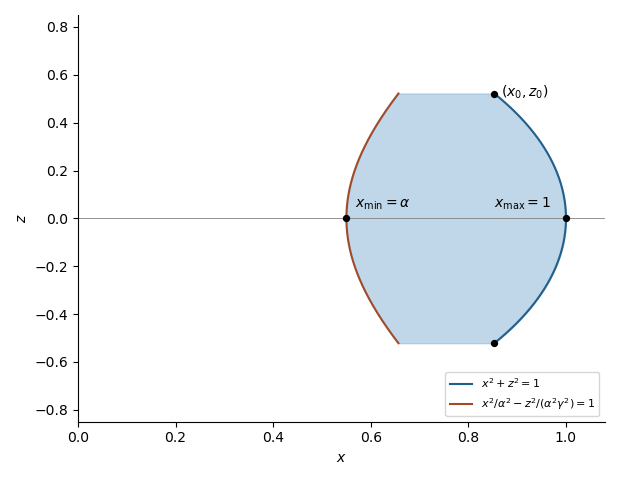
Cross-section of the integration region
. Now set , , and . The inverse Jacobian determinant is , and in cylindrical coordinates the transformed region isThus , and each horizontal cross-section is an annulus. Its volume isTherefore, for ,For the region has zero volume.
Under an orthogonal change of coordinates represented by , the component matrix changes byThus is similar to , so its characteristic polynomial, eigenvalues, and their algebraic multiplicities are unchanged.
If is symmetric, the spectral theorem for real symmetric matrices makes it diagonalizable, so algebraic and geometric multiplicities agree. Consequently the dimensions of its eigenspaces are also independent of the coordinate frame.
For the stated tensor, choose a unit eigenvector belonging to the simple eigenvalue . Its perpendicular plane is the eigenspace of , soHence
The unit sphere and the kernel are invariant under every rotation in three dimensions fixing . Therefore has the same axisymmetry, so part (a) gives
Choose spherical polar coordinates with polar axis and put . Since ,The tensor contraction giving the trace isSimilarly,At these expressions have the continuous limiting values and . Writing them as and gives
Using the Levi-Civita symbol and the epsilon-delta identity,ThereforeOne particularly simple vector potential for isDirect differentiation gives and .
Parametrize the curved cone byThe outward oriented surface element isSubstitution and integration over , give
Because , the divergence theorem predicts that the two outward fluxes sum to zero. On the top disk , and , so, with ,as predicted.
The outward orientation on induces the stated anticlockwise orientation on , whereas the outward orientation on induces the reverse orientation. Since , Stokes theorem predictsOn , put . Thenverifying both identities.
Green's first identity and the boundary condition giveThus , so is constant on each connected component of ; its zero boundary value forces .
Since on and , another application of Green's first identity givesConsequentlyExpanding and using the vanishing cross term yields the Dirichlet principle
For a spherically symmetric function , the Laplacian in spherical coordinates isIntegrating from zero to and using regularity at the origin gives
For the stated density, integration and the boundary condition giveThe two pieces and their first derivatives agree at . If another solution existed, its difference from would be harmonic with zero boundary data, so part (a) proves Uniqueness of the Dirichlet problem.
On the shell , normalize the outer radial part to obtain the harmonic functionBy the Dirichlet principle, this function minimizes the energy among all with the same boundary values. Sinceits energy isTherefore
Articles by others on the same topic
There are currently no matching articles.