Spectral radiance is radiance per unit frequency or wavelength interval. Its astronomical synonym specific intensity is usually written or ; this is a spectral radiance, distinct from the radiant intensity in radiometry. For positive small intervals,The two expressions refer to the same spectral slice, with the positive widths related through frequency and wavelength . For frequency measured in hertz, , the units are . For wavelength measured in metres, . Integrating over a spectral band gives its radiance, and then multiplying by the collecting projected area and accepted solid angle gives a small uniform beam's radiant flux. A spectral measurement therefore retains information that the band-integrated power alone loses.
For an ideal blackbody, Planck's law gives and at temperature , independent of outgoing direction. Its existing frequency and wavelength peaks of Planck's law illustrate why the coordinate matters. The simpler flat-band calculation below isolates that same change of variables without the thermal physics.
In vacuum, , where is the speed of light. Increasing wavelength decreases frequency, so the ordinary signed differentials satisfy . A spectral slice's positive contribution to radiance must be unchanged. The change of variables formula therefore gives the absolute Jacobian determinantThese formulas use per metre and per hertz. The factor has units , which converts the former density into the latter. If denotes the numerical density per nanometre in , its per-metre value is . Conversely, the per-nanometre value is times the per-metre value. Likewise, a density per terahertz is times its per-hertz value because .
For a concrete stipulated spectrum, let between and , and zero outside. This is exactly throughout the band. Using the exact International System of Units value , the corresponding frequency bounds areThe transformed spectral radiance is on this interval. At it is approximately , and at it is in the same units. These are respectively and per terahertz. Thus a flat wavelength density becomes a decreasing frequency density; relabelling the horizontal axis alone would miss both the shape and the units. [ref].
The equality of band radiances has a short exact proof:The reversed bounds and the Jacobian determinant preserve the same spectral measure. Each half-band, – and –, carries , although the corresponding frequency widths are about and .
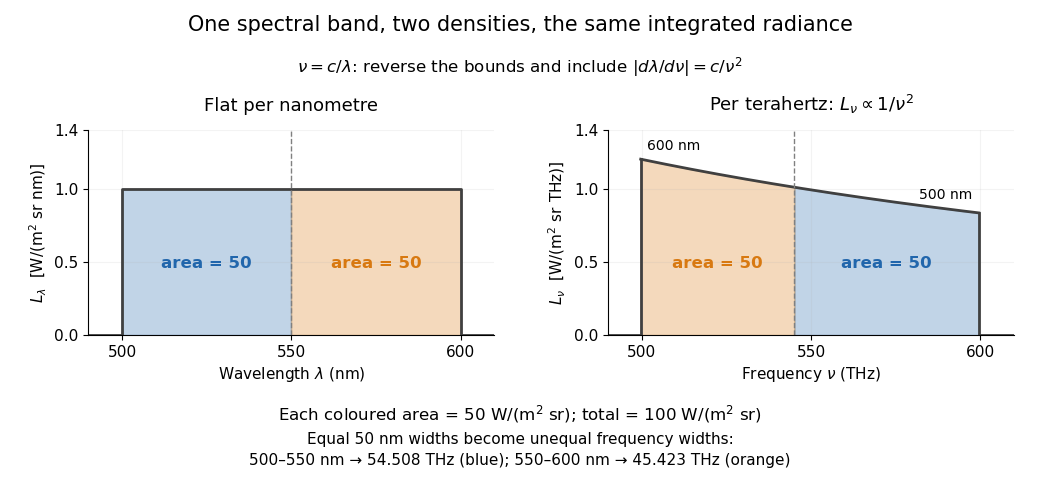

A spectrum's peak is consequently a statement about a particular density and coordinate. The frequency and wavelength peaks of Planck's law differ for precisely this reason. Integrated radiance over a specified physical band supplies a comparison that survives the change of variables.
In a transparent, stationary vacuum with Euclidean geometry and observers at rest in the same frame, the radiative transfer equation has zero absorption and emission, so along a light ray. The same specific intensity reaches the observer without geometric dilution. More generally, is a Lorentz invariant; collisionless propagation preserves this ratio along a ray even with gravitational or cosmological redshift, rather than preserving at shifted frequencies. [ref]
https://www.roe.ac.uk/japwww/teaching/ram5/ram5_2018.pdf#page=27. John Peacock, Radiation and Matter, 2018–2019, §4.1, Conservation of intensity and equation (140)
.The elementary geometry is instructive. Two facing surface elements separated by distance exchange spectral radiant fluxThe receiver subtends at the source. Describing that same traveling beam at the receiver instead uses . Both descriptions have identical geometric factors, so conservation of its radiant flux gives equal specific intensities at the two ends. This compares the same propagation direction at both ends, not emission in the opposite direction.
A uniform source remains equally bright per resolved direction under these assumptions, but occupies a smaller apparent solid angle farther away. For a small source of projected area at distance and a small receiver facing it, irradiance is approximately . The radiant flux intercepted by receiver area is approximately . With , and , distances and give and , and received radiant fluxes of and . The inverse-square law concerns collected radiation from the whole source; remains at either distance.
Limb darkening is the decrease of emergent specific intensity toward the apparent edge of a stellar disc. A transit depth then depends on the intensity sampled by the planet as well as its projected area; the uniform-disc area ratio is only an approximation.
For a spherical star of radius , let be distance from the centre of its projected disk and let be the angle between the outward unit normal and the line of sight. The angular coordinate isDisk centre has ; the apparent edge approaches . A resolved image measures specific intensity in each direction. Limb darkening means that this specific intensity itself falls toward the edge; the projected area factor used when collecting radiant flux is a separate geometric effect.
A simple explanation assumes a horizontally uniform plane-parallel atmosphere, a sufficiently deep optically thick medium, negligible scattering of light, and thermal absorption and emission in local thermodynamic equilibrium. Let be inward vertical optical depth at fixed frequency . An oblique light ray has line of sight optical depth , so it encounters the same attenuation at a smaller vertical optical depth. The formal solution of the radiative transfer equation givesHere is the source function; under these assumptions it is the Planck function . If temperature increases inward, an oblique view preferentially samples cooler layers and hence lower specific intensity. [ref]
The weight is an exponential distribution in vertical optical depth, with expected value and standard deviation . Thus “seeing down to optical depth one” refers to the line of sight, and represents a broad sampling of layers rather than a sharp emitting surface. For a source function that is linear throughout the atmosphere, the Eddington-Barbier relation is exact:This follows by integrating the constant and linear terms separately. A constant source function instead gives constant specific intensity, as in the blackbody limit of an isothermal atmosphere. An outward-rising temperature or important scattering of light changes the argument. Close enough to the actual edge, a plane-parallel atmosphere also loses validity because of curvature. Neither one limb-darkening coefficient nor a universal dependence on wavelength follows from this simple model.
The linear limb-darkening law parametrizes angular specific intensity by a stipulated limb-darkening coefficient :Here denotes specific intensity at one frequency, or radiance integrated over a specified interval of frequency or wavelength; it does not denote radiant intensity. Within this stipulated range, gives a uniform disk and . The linear limb-darkening law is linear in , while its radial profile is curved. In the linear source function example above, when and .
For the illustrative choice , the specific intensity at , , and the limiting edge is respectively , , and . These are synthetic values, not measurements of the Sun. Real optical spectra and stellar atmospheres need not obey a linear limb-darkening law; more flexible profiles can be necessary for accurate exoplanet transit photometry. [ref]
Analytic Light Curves for Planetary Transit Searches by Kaisey Mandel and Eric Agol. §1, p. L171: the linear law is insufficient for the cited high-quality transit observations; §4 defines a quadratic law
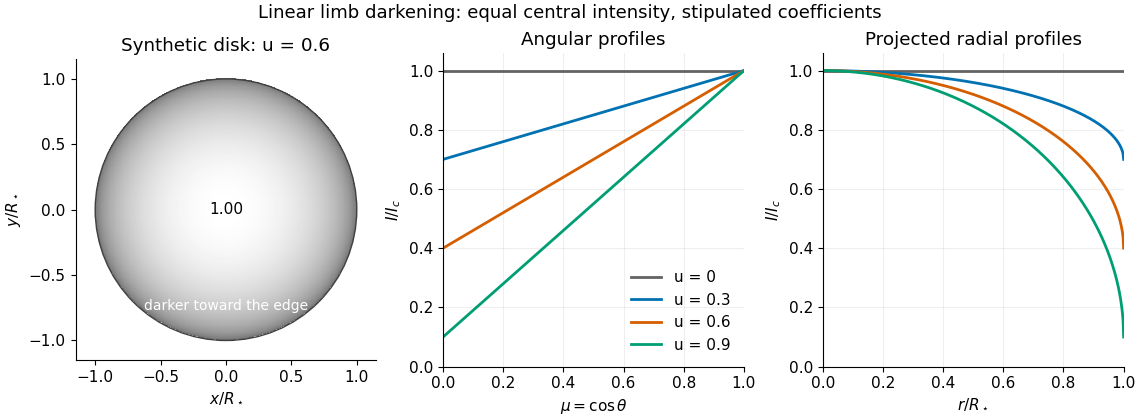
Synthetic stellar disk and angular and radial limb darkening profiles
. The disk uses the stipulated linear limb-darkening law with . The profiles compare four stipulated limb-darkening coefficients at equal central specific intensity. Shading represents relative brightness, without prescribing a wavelength or copying a solar measurement. Details.
The parameter in the linear limb-darkening law specifies its contrast between disk centre and the limiting edge. Its interpretation requires the chosen law and interval of frequency or wavelength. A limb-darkening coefficient fitted to an exoplanet transit may trade off against the transit impact parameter and planet radius; it is not a direct measurement of one layer's temperature.
For a circular stellar disk whose specific intensity is independent of azimuth, its mean specific intensity over projected area isThe polar coordinates element is after angular integration, and . Substitution of the linear limb-darkening law givesFor a distant observer at distance receiving light normally to the detecting plane, the observed radiative flux isIt is spectral irradiance, with units when is per hertz. The local outward radiative flux per actual surface area is instead , a spectral radiant exitance. In a spherical model with the same stellar atmosphere everywhere, the luminosity is and , consistent with the inverse-square law. Compare disks at fixed or fixed total observed radiative flux explicitly: increasing lowers the total in the first comparison, while the second requires a larger .
A dark, opaque circular planet of radius blocks specific intensity over its overlap with the projected star. With and no transit dilution, the instantaneous exoplanet transit depth is exactlyWhen , the entire planetary disk is inside the stellar disk, and specific intensity varies little across that disk, small-planet transit weighting reduces toHere is the projected centre separation divided by . The numerator samples the local specific intensity; the denominator normalizes by the whole star's mean specific intensity. The small-size argument and the distinction between full overlap and ingress are explicit in the original analytic treatment. [ref]
Analytic Light Curves for Planetary Transit Searches by Kaisey Mandel and Eric Agol. §2, p. L171, geometry; §5, p. L174, small-planet approximation restricted to the interior
For a short approximately straight crossing at constant transverse velocity , write with at mid-transit, and let be the transit impact parameter. Then and . With stipulated and , a central crossing has mid-transit exoplanet transit depth approximately , whereas gives . A uniform disk would give for either fully overlapping crossing. The brighter central chord produces a deeper dip and the off-centre chord a shorter crossing at the same .
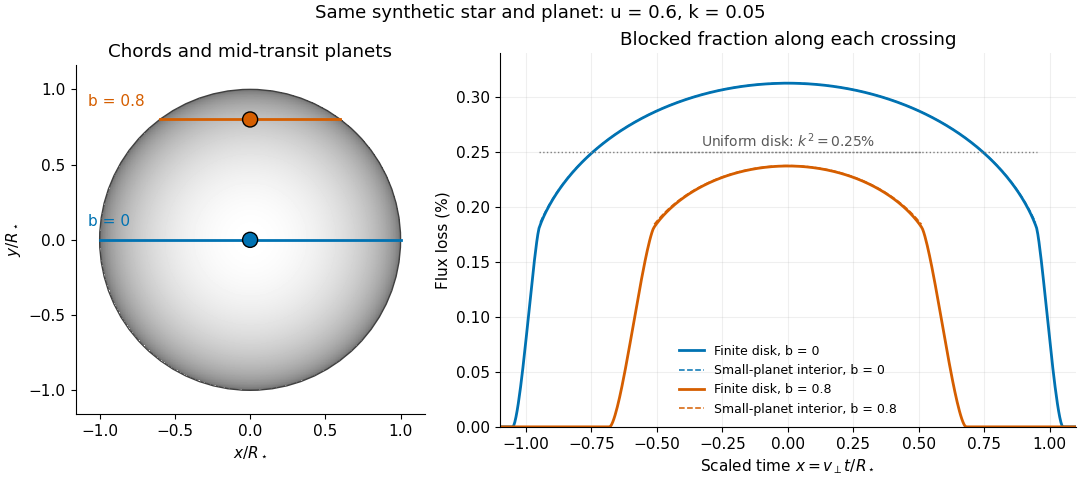
Two transit chords across the same synthetic limb-darkened disk flux distribution
. Stipulated and ; the coloured curves integrate the occulted specific intensity over the finite planetary disk, including ingress and egress. Dashed curves show small-planet transit weighting only where the whole planetary disk is inside the star. Horizontal dotted segments give the uniform-disk full-overlap depth . The chord panel shows mid-transit positions; the horizontal coordinate in the light curve is distance travelled divided by stellar radius, equivalent to scaled time at constant transverse velocity. Details.
At fixed away from the edge, a two-dimensional Taylor's theorem expansion over the symmetric planetary disk cancels the first derivatives; the first correction to the blocked radiant flux is of order if the second derivatives remain bounded. This error estimate is not uniform at the edge, where the radial derivative of the linear limb-darkening law diverges. Ingress, egress, a grazing exoplanet transit, and a crossing of a starspot require the overlap integral or a suitable more complete model. Inferring without the local-to-mean specific intensity ratio can bias the estimated planet radius.
A motivating measurement used the McMath solar optical telescope at Kitt Peak. The Sun's image drifted across a -high, -wide optical slit; a double-pass spectrograph selected wavelength intervals from wide at to at . An EMI 9750 QB photodetector or silicon photodiode supplied a digitized signal: samples were summed into 4096 positions per crossing, including dark and off-limb sky readings. [ref]
Solar limb darkening 1986–1990 (λλ303 to 1099 nm) by Heinz Neckel and Dietrich Labs. §2, p. 93, instrumental compilation: slit dimensions, double pass, detectors, sampling and drift-curve layout; p. 113, acknowledgements identifying the telescope
Controls included daily realignment of optical telescope mirrors, wavelength settings between spectral lines insensitive to the rotational Doppler shift, selection of detectors without detectable hysteresis, and measured electronic nonlinearity corrections below of maximum signal. Limb-position calibration combined centres of gravity of the edge derivative profiles with almanac semidiameters; the preliminary edge shifts were consistent with astronomical seeing of approximately arcseconds full width at half maximum. [ref]
The decreasing centre-to-limb readout gives a specific intensity profile, constraining stratification of the photosphere under a radiative transfer model. Astronomical seeing, instrumental scattering of light, and solar granulation limit this inference; brightness alone does not uniquely determine temperature versus geometric height. These observations need not follow the stipulated linear limb-darkening law.
Articles by others on the same topic
There are currently no matching articles.