At latitude , resolve the planetary angular velocity asFor velocity , the Coriolis acceleration isThe traditional approximation drops the terms involving the horizontal rotation component . The retained horizontal force is thereforeIts direct velocity-scale requirement isFor an incompressible flow, , so a sufficient condition istogether with the small aspect ratio that makes hydrostatic pressure the leading vertical momentum balance. The approximation consequently becomes delicate near the equator.
The beta plane is the local Taylor expansionwhereand is the planetary radius. It requires a local Cartesian region,and . Away from the equator, treating the variation as a perturbation of an f-plane also requires ; near the equator one instead retains the linear term as the leading Coriolis parameter.
Assume an inviscid homogeneous ocean, no horizontal pressure gradient, and no wind stress. Horizontal uniformity then removes advective acceleration, and the parcel equations on a beta plane arewith and .
Since , integration from the stated initial data givesThis is conservation of the parcel's zonal canonical momentum: its zonal speed records the meridionally accumulated Coriolis acceleration. Multiplying the two momentum equations by and and adding givesThus kinetic energy and speed are constant:Eliminating gives the required ordinary differential equation
For , the equator is at . ThereThe parcel must encounter a meridional turning point before reaching the equator if it is to remain strictly in the Northern Hemisphere. The energy relation therefore requiresor . Equality is the limiting trajectory that reaches the equator with zero meridional speed.
IntroduceBecause the speed is , writeThe momentum equations giveUse an asymptotic expansionThe zeroth-order inertial oscillation isAt first order,and integration with the initial conditions givesThereforeThe periodic terms describe a slightly distorted clockwise circle. The secular term in is a westward drift with velocityThis beta drift of an inertial oscillation occurs because the Coriolis parameter, and hence the turning rate, is larger on the poleward half of the orbit than on its equatorward half. A trajectory sketch therefore consists of clockwise loops whose centers move steadily westward; the parcel starts at the westernmost point of its first loop and initially travels northward.
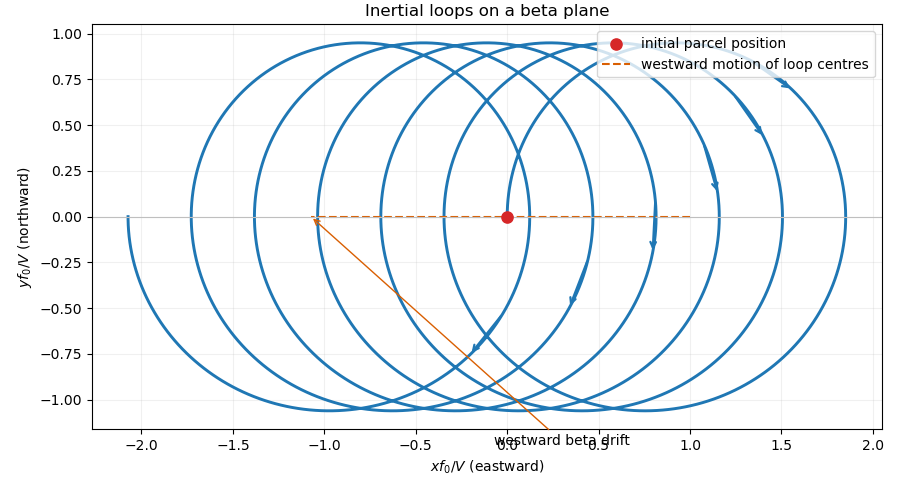
Westward beta drift of inertial loops
. The first-order beta-plane trajectory forms slightly distorted clockwise loops. Their centers follow the dashed westward path because the Coriolis turning rate is stronger on the poleward side. Details.
Assume a steady, small-Rossby number surface boundary layer, neglect horizontal viscosity and nonlinear acceleration, take the pressure gradient to be independent of depth, impose no normal flow at the surface, and let the viscous stress vanish at . Subtract the depth-independent geostrophic balance from horizontal momentum. For the ageostrophic velocity,Integrating from to and usinggives the Ekman transport
Depth-integrated mass conservation, with , givesHence the vertical velocity entering the ocean interior is the Ekman pumping velocityFor constant this reduces to
Let be the constant interior depth. Assume a homogeneous hydrostatic interior with depth-independent horizontal velocity, negligible friction, steady small-Rossby number flow, and no normal flow through the flat bottom. The vertical velocity varies from to , so incompressible flow givesThe leading horizontal momentum balance is geostrophic balance:Taking its vertical curl on a beta plane givesCombining the last two equations yields Sverdrup balanceThe zonal velocity is then fixed, up to its value on one side boundary, byEquivalently, substituting part a gives the depth-integrated formA lateral boundary condition, normally supplied by matching to a boundary current, determines the remaining zonally uniform part of .
Put and let be the depth-independent interior velocity. The kinematic boundary conditions on the sloping upper and lower surfaces areIntegrating mass conservation through the layer givesThe inviscid vertical-vorticity equation isConsequently the shallow-water potential vorticityobeys the forced evolution equationPositive upward Ekman pumping removes layer thickness and raises the potential vorticity of the remaining column.
For a steady small-Rossby number flow, , soEquivalently,The same result follows from the integrated vortex-stretching balance
When with ,If the upper pumping is absent or weak and the upper surface is locally level, the impermeable-bottom condition is . The stipulated then gives , and in the Northern HemisphereThe steady interior flow is therefore directed northeastward, along contours of in the unforced limit. As a parcel moves eastward into deeper water, its vortex column stretches; a poleward displacement increases and preserves potential vorticity. Nonzero Ekman pumping drives motion across the contours. This is topographic potential-vorticity steering and the associated topographic Sverdrup balance.
For an inviscid Boussinesq approximation fluid in a nonrotating frame, write buoyancy as and kinematic pressure as . The governing equations areThey require density variations to be small compared with a constant reference density, while retaining those variations in buoyancy; the flow scale must be small compared with the background density scale height. Ideal flow additionally neglects viscosity and scalar diffusion.
Linearize aboutwhere is the buoyancy frequency, and defineFor two-dimensional disturbances, the linear equations areThe condition expresses stable density stratification.
Differentiate horizontal momentum with respect to and vertical momentum with respect to . When the two equations are subtracted, the terms proportional to vanish by incompressible flow. The pressure derivatives also cancel, leaving
Differentiate this equation with respect to . Since continuity givesone obtainsApply and use the buoyancy equation . Multiplication by then gives
For the normal modethe linear material derivative becomesSubstitution into the equation from part b and division by gives the Taylor–Goldstein equationwhereand the Scorer parameter is
For a ridge-fixed disturbance, . If the Scorer parameter varies on a height scale much longer than the vertical wavelength, the local WKB approximation giveswhere . The disturbance is vertically oscillatory there and can carry wave activity upward. Where , is imaginary and the solution is vertically evanescent.
A rigid ridge supplies the lower boundary condition and an upper radiation or decay condition selects the physical solution. If decreases through , the crossing is a turning level: the wave is reflected or decays above it and is trapped beneath it. Increasing normally reduces , while decreasing reduces it directly; subject to the curvature term , either change therefore promotes vertical trapping of an atmospheric gravity wave.
Multiplyby and integrate from the rigid bottom to an upper endpoint at which . The bottom term also vanishes because . Integration by parts givesTherefore the horizontal wavenumber has the Rayleigh quotientFor a trapped wave the upper endpoint may be taken to infinity because the eigenfunction decays.
LetBecause the Rayleigh quotient is stationary with respect to first-order changes of its eigenfunction, only the explicit dependence of on contributes when the quotient is differentiated. ThuswhereIt follows thatSince , the horizontal group velocity is
For a stationary ridge wave, . Assume , so downstream is the positive direction. The stated inequality isThe denominator in the group-velocity formula is then positive, andThe atmospheric internal gravity waves generated by the ridge consequently carry their wave packet downstream.
Begin with the Boussinesq approximation primitive equations on a beta plane, decompose every field into a zonal mean and a disturbance, and average over longitude. The zonal momentum equation then contains the divergence of the eddy momentum flux , while the mean density equation contains the divergence of the eddy density flux . At small Rossby number, use geostrophic balance, hydrostatic pressure, thermal-wind balance, and the leading eddy equations to combine those fluxes.
Defineand introduce the residual mean circulationThe added eddy-induced velocity is nondivergent, soIt absorbs the eddy density-flux divergence into advection by the transformed circulation, giving
The mean zonal momentum equation becomeswhere the zonally averaged Eliassen–Palm flux in the meridional-vertical plane isThus the transformed Eulerian mean gathers the wave forcing into one flux divergence and makes density evolve under one residual circulation.
Define the residual-circulation stream function byThis satisfies residual mass conservation identically. LetThe momentum equation is
Differentiate geostrophic balance vertically and hydrostatic pressure meridionally to obtain thermal-wind balanceAfter a time derivative, the transformed density equation givesOn the other hand, the derivative of momentum givesEliminating yields the Eliassen equation for residual circulation
Put . For the specified quasi-geostrophic streamfunction, the complex amplitudes of the disturbance fields areThe product of these two amplitudes is purely imaginary after one is conjugated, so its zonal mean vanishes:Consequently
Geostrophic balance and hydrostatic pressure giveThereforeSince , the vertical Eliassen–Palm flux isThus it has the stated formwith
Letwhere is the Heaviside step function. Thenso the Eliassen equation for residual circulation isTake no normal residual flow at and , decay as , and choose the streamfunction constant on the connected rigid boundary to be zero. Thus
The required Fourier series in sine modes isDefineFor each mode, the vertical equation isThe Dirac delta function requiresThe solution satisfying the boundary conditions is thereforewhere
The momentum equation givesThe jump of supplies an equal positive delta function in , so the singular terms cancel. The regular acceleration iswhereFinally, the transformed density equation givesThese exponentially decaying modes are the balanced mean response to wave-activity deposition at .
Define the Eulerian-mean streamfunction byWiththe transformation in part a givesHence, up to an irrelevant additive constant,For the step-profile flux,
The residual streamfunction vanishes on the rigid boundaries, decays away from the absorption level, and has opposite-signed values immediately below and above . Its vertical derivative gives a zonal acceleration concentrated around and largest near the channel center. Its meridional derivative gives a dipolar density tendency: changes sign across the channel center and reverses vertical structure across the absorption level.
The eddy term in has a compensating downward jump at , so the Eulerian-mean streamfunction is continuous even though jumps in the idealized step limit. Below the critical layer, the Eulerian view contains a broad circulation associated with the eddy density flux; the transformed view subtracts that reversible eddy-induced motion and isolates the residual circulation forced where the waves dissipate.
In the Eulerian density budget, vertical advection by and the divergence of can be individually large and largely cancel. The transformed Eulerian mean combines them into advection by , making the irreversible mean response to wave-activity deposition much clearer.
Let the wave-forcing layer have vertical scale and meridional scale . In the Eliassen equation for residual circulation, the two restoring terms scale asTheir ratio is controlled by
In the shallow-forcing limit , the vertical derivative term dominates:After one vertical integration,The Coriolis force on the residual mean circulation therefore balances most of the wave forcing, andis small at leading order. The response is primarily an overturning circulation with an associated density tendency.
Articles by others on the same topic
There are currently no matching articles.