Put . The spring exerts the force by Hooke's law, while Coulomb's law gives the attractive force . Newton's second law therefore gives the equation of motionFor , the derivative is . Thus increases up to and decreases thereafter. Also at both ends of the positive half-axis. Its unique maximum isThere are therefore two equilibrium points precisely whenWriting them , the linearization has exponentially growing solutions at and oscillatory solutions at . Equivalently, the potential energy has a strict local maximum at and a strict local minimum at . Hence the smaller equilibrium point is an unstable equilibrium; the larger is a stable equilibrium, with no damping to make it attracting.
At equality there is one degenerate equilibrium point ; it is unstable, since a displacement to its left gives a leftward force. For there are no equilibrium points.
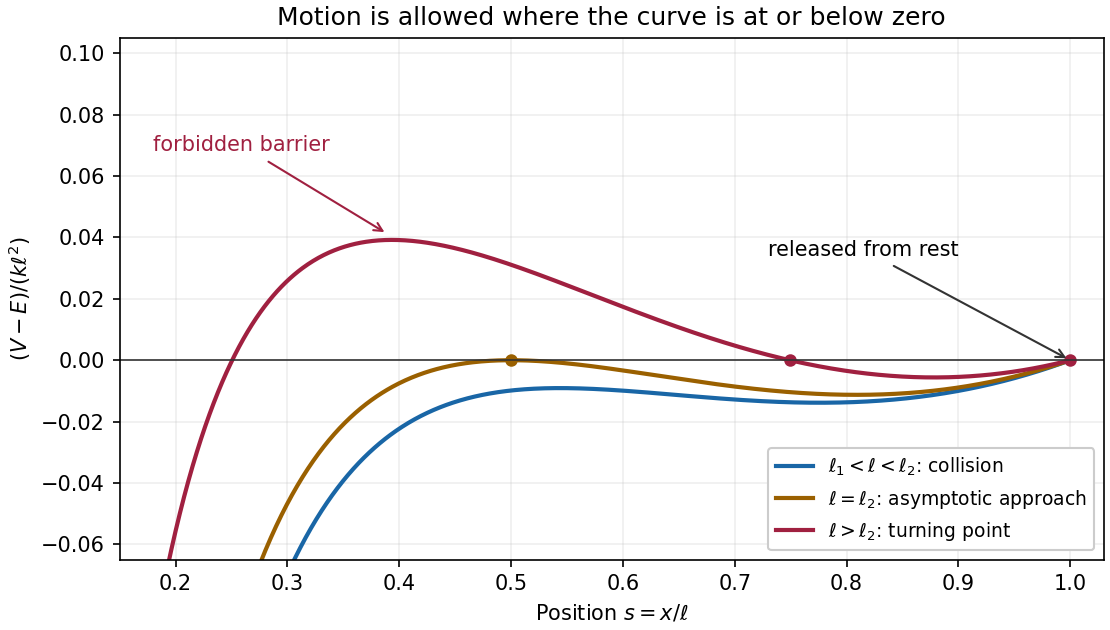
Multiply the equation of motion by and integrate. The conserved mechanical energy isThe initial conditions , give , soInitially , so the particle starts moving towards the origin. For , factor its kinetic energy asThe quadratic function has maximum at . Consequently kinetic energy is strictly positive throughout exactly when . Thus the collision threshold isFor there is no intervening turning point, and the particle collides with the fixed particle. The collision takes finite time: near zero, , so the remaining time is bounded by a constant times .
For , the first turning point encountered isThe particle oscillates periodically between and , around the larger stable equilibrium, without collision. The zeros of at the two endpoints of this allowed region are simple, so travel to each turning point takes finite time. At the boundary , is a double zero of and an unstable equilibrium; the inward trajectory approaches it only as .

Articles by others on the same topic
There are currently no matching articles.