For vectors , the scalar product, cross product and scalar triple product are respectivelyExpanding the dot product givesInterchanging and changes the sign of their cross product, so its dot product with is also zero. Thus the cross product is orthogonal to both vectors, including when it is the zero vector.
The displayed scalar triple product is a determinant. A square matrix has nonzero determinant exactly when its rows are linearly independent. Hence
Subtracting the first row from the other two in the determinant givesThis vanishes exactly when the two displacements and are linearly dependent. If , that means for some real number . Thus all three points lie on the lineConversely, putting three points on any one line makes their displacements linearly dependent, so the determinant vanishes.
The equivalence remains true without distinctness. If exactly two points coincide, the two distinct locations determine a line containing all three, and two rows of the original determinant coincide. If all three points coincide, any line through that point works and the determinant is again zero. Existence persists, although uniqueness of the line can fail.
The value is twice the signed area of the triangle traversed in that order; it is positive for counterclockwise orientation. Choose points on the parabolaFor , subtracting the first row in the determinant and factoring givesEach of the three factors is positive, proving the required property for every integer .
For a fixed point not on a fixed line , the ellipse with focus of a conic , directrix of a conic and eccentricity is the locus of points satisfyingSet and . One matched focus of a conic and directrix of a conic pair isIndeed the squared distance condition isExpanding and cancelling the terms linear in giveswhich is exactly . Both sides of the unsquared distance condition are nonnegative, so squaring introduces no extra points. Reflecting across the -axis gives the other matched pair: and , with the same eccentricity.
Use the point and the orthonormal basis of directions in the cutting planeBoth vectors are orthogonal to the normal vector , so every point of the plane has unique coordinatesSubstituting into the cone equation givesConsequently the intersection has equationBecause these are orthonormal coordinates, their lengths are the actual lengths in the plane. Thus this is an ellipse with semi-major axis and semi-minor axis , not merely a projected ellipse. By a, its eccentricity is
The ellipsoid is the level set . Its gradient is , which never vanishes on the ellipsoid. Half this gradient gives the outward normal vectorThis normal vector remains valid at , where the given parametrization is singular.
The partial derivatives of the parametrization areTheir cross product isTaking its euclidean norm gives the surface area elementThe two poles and duplicated seam have zero surface area, so integrating over the stated parameter domain counts the surface area once. With the change of variables and the supplied definite integral,Here because .
Using the normal vector from i, the normal line isFor , the - and -coordinates vanish together exactly when . At that point, the -coordinate isThusAt or , both the position vector and normal vector lie along the -axis, so is the whole -axis in either case.
The required lines are the -axis and every line through the origin in the plane . Explicitly,The -axis meets the ellipsoid at its two poles and is a normal line at each. A line of the second kind meets it at the antipodal points , whose normal vectors are parallel to that line.
To prove completeness, suppose a common normal line passes through distinct points and . If either is a pole, b forces the line to be the -axis. Otherwise b says that the line meets the -axis at and at . A line other than the -axis has at most one such intersection, so .
The points consequently have equal -coordinates. Since they are distinct, their joining line has zero -component in its direction. Its normal vector at therefore has . Hence lie in , and the normal line there passes through the origin. This gives exactly the listed family.
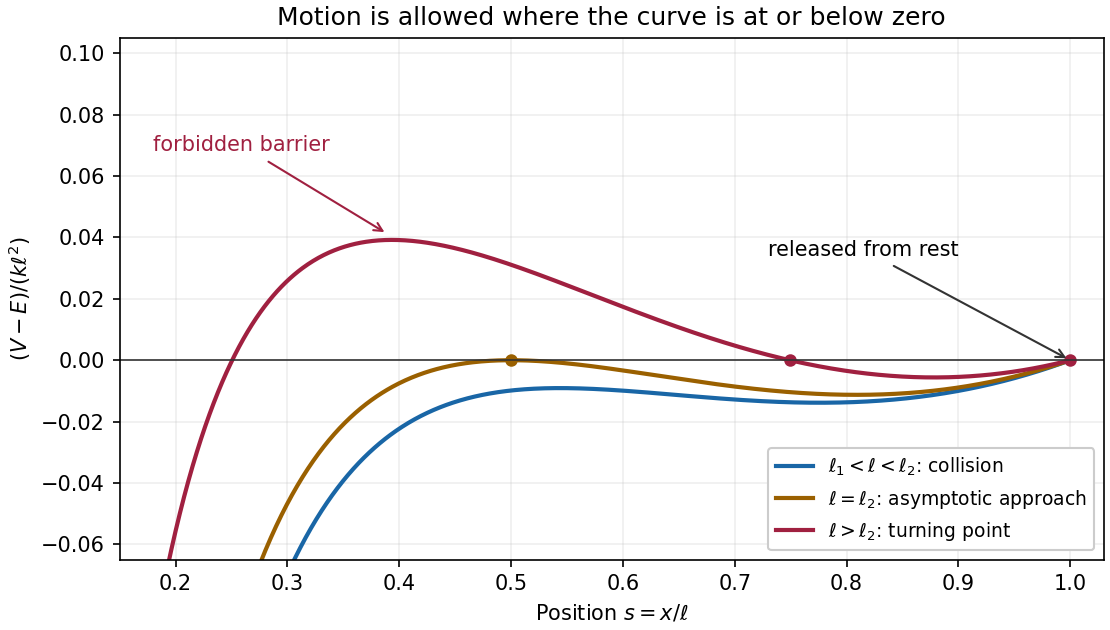
Put . The spring exerts the force by Hooke's law, while Coulomb's law gives the attractive force . Newton's second law therefore gives the equation of motionFor , the derivative is . Thus increases up to and decreases thereafter. Also at both ends of the positive half-axis. Its unique maximum isThere are therefore two equilibrium points precisely whenWriting them , the linearization has exponentially growing solutions at and oscillatory solutions at . Equivalently, the potential energy has a strict local maximum at and a strict local minimum at . Hence the smaller equilibrium point is an unstable equilibrium; the larger is a stable equilibrium, with no damping to make it attracting.
At equality there is one degenerate equilibrium point ; it is unstable, since a displacement to its left gives a leftward force. For there are no equilibrium points.
Multiply the equation of motion by and integrate. The conserved mechanical energy isThe initial conditions , give , soInitially , so the particle starts moving towards the origin. For , factor its kinetic energy asThe quadratic function has maximum at . Consequently kinetic energy is strictly positive throughout exactly when . Thus the collision threshold isFor there is no intervening turning point, and the particle collides with the fixed particle. The collision takes finite time: near zero, , so the remaining time is bounded by a constant times .
For , the first turning point encountered isThe particle oscillates periodically between and , around the larger stable equilibrium, without collision. The zeros of at the two endpoints of this allowed region are simple, so travel to each turning point takes finite time. At the boundary , is a double zero of and an unstable equilibrium; the inward trajectory approaches it only as .

Write . In polar coordinates, Newton's second law per unit mass gives the radial and transverse equations of motionThe transverse equation impliesThis is conservation of angular momentum per unit mass. For the nonradial trajectory in the next part, choose orientation so . With and primes denoting derivatives with respect to , the chain rule givesSubstituting into the radial equation yields , henceThe change of independent variable requires ; a purely radial trajectory instead has constant .
Far from the planet, the magnitude of angular momentum per unit mass is the magnitude of the cross product of position vector and velocity. The perpendicular distance from the incoming asymptote is the impact parameter , soChoose at closest approach. The general solution of the differential equation in a, with , isThe specific orbital energy isAt infinity , giving . Thus the hyperbolic orbit hasA different zero of polar angle simply replaces by .
The incoming and outgoing asymptotes have radial directions and , where and . The incoming velocity points opposite its radial direction, so the deflection angle between incoming and outgoing velocities is . HencePutting gives
In cylindrical coordinates, and . ThusThe acceleration isA tangent vector along the wire is . Because the wire is smooth, its constraint force is orthogonal to . Taking the dot product of Newton's second law with eliminates that force; gravitational weight contributes . HenceMultiplying by gives
The linearization at rest at isFor , small disturbances oscillate. To verify nonlinear stability, multiply the full equation of motion by and integrate to obtain the first integralFor , is positive away from the equilibrium point in a sufficiently small neighborhood of ; its small level sets confine the motion. ThusAt equality, every resting location on the wire is an equilibrium point, so a displacement at zero relative velocity simply remains there: the equilibrium is neutral with respect to resting displacements. It is unstable with respect to general perturbations in phase space, however. An arbitrarily small outward initial velocity gives from the first integral, eventually taking the bead outside any prescribed small neighborhood. Thus strict phase space stability holds only for .
Put . The zero value of the first integral in b givesAt the endpoint , this gives . The absolute speed includes radial, azimuthal and vertical components. Since there,Hence the limiting exit speed isThere is a small initial condition qualification in the wording. The exact initial conditions give the stationary solution forever, by Picard-Lindelöf theorem. The displayed zero-first integral moving branch instead approaches that unstable equilibrium as .
For a precise small disturbance, release the bead with zero relative velocity at . Its first integral is , givingThe bead initially accelerates outward and reaches the end. Letting recovers exactly the stated exit speed. The conserved is a Jacobi integral associated with the imposed rotation; ordinary mechanical energy need not be conserved because the apparatus driving the wire can do work.
The euclidean algorithm computes the greatest common divisor of two integers by repeated division with remainder. Start with , , interchanging them if necessary, and repeatedly writeuntil a zero remainder occurs. The positive remainders strictly decrease, so the process terminates. At each step the common divisors of are exactly the common divisors of , because . HenceIf one input is zero, the answer is the absolute value of the other; the usual convention sets . Back-substitution also expresses the greatest common divisor as an integer linear combination of the inputs, as in Bézout's identity.
Let and . Applying polynomial long division gives the euclidean algorithmThus their polynomial greatest common divisor is , up to a nonzero constant factor. Their unique common root of a polynomial is therefore
The polynomial factors as , so is a multiple root of multiplicity two. The Newton root-finding iteration isFor , cancelling a factor givesThis expression extends continuously to . Let . On this closed interval,Thus is increasing, andBy the mean value theorem, for all . The contraction mapping theorem states that a contraction mapping from a nonempty complete metric space into itself has a unique fixed point, and every fixed-point iteration converges to it. The closed interval with ordinary Euclidean distance is complete, and , soIn fact . The Newton iteration at a multiple root here has linear convergence, since . Thus the convergence assertion is true for the simplified fixed-point iteration, and for the usual Newton root-finding iteration that stops upon reaching an exact root of a polynomial. If one insists on applying the unsimplified quotient at every step, it is undefined for the allowed starting value , since both and vanish there; that literal version of an infinite sequence requires the stated stopping convention or continuous extension.
Articles by others on the same topic
There are currently no matching articles.