Let be the continuous triangular bumpand set . At every term is zero, and each fixed eventually lies outside the support, so pointwise. The triangle has base and height , henceThis concentrating triangular bump shows that pointwise convergence does not preserve integrals, even for continuous functions on a compact interval.
Take on . Each function is continuous, and the pointwise limit is for , while . NeverthelessThe limiting function is Riemann integrable, since changing a value at one point does not change its Riemann integral. There is no uniform convergence: for every , , with the supremum approached as from below. Equivalently, the uniform limit theorem would require the limit to be continuous.
No: the unbounded length of the domain matters. Let and define on . These are continuous functions with compact support, and , so the sequence has uniform convergence to zero. However, the change of variables givesThe integral of the limit is zero. The supports widen as the heights decrease; a uniform bound on the heights gives no bound on the total area over an infinite interval.
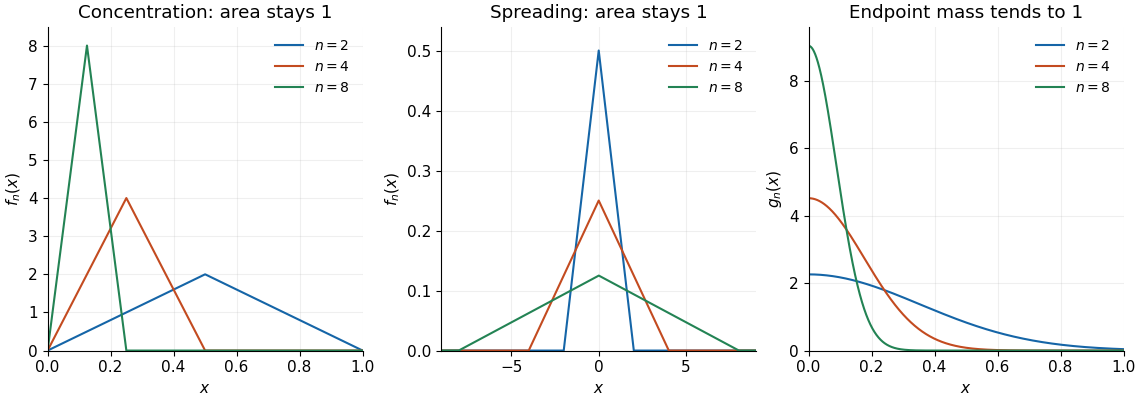
Concentrating bumps, spreading bumps, and a one-sided approximate identity
. Left: the examples in part (b)(i) converge pointwise to zero while their integrals remain one. Middle: the examples in part (b)(iii) have uniform convergence to zero but retain integral one by spreading across the real line. Right: the nonnegative functions in part (c) concentrate their mass at zero and recover the endpoint value of a continuous function. Details.
Articles by others on the same topic
There are currently no matching articles.