Solutions to all seven questions, including every optional question, of the examination sat on 20 June 2023.
For a nonempty set , a supremum is a real number such that for every , and every upper bound of satisfies . Equivalently, is an upper bound and, for every , some satisfies . By completeness of the real numbers, it exists whenever is nonempty and bounded above.
An increasing monotone sequence satisfies for every ; a bounded sequence satisfies for some finite and every . Put . Given , the defining property of the supremum supplies with . For every , monotonicity givesThis is exactly the definition of convergent sequence, so the bounded monotone sequence theorem gives .
Choose with . Every tail of a sequence is nonempty and bounded, so its supremum exists and lies in . Removing one term cannot increase a supremum, hence . The bounded monotone sequence theorem, applied to , provesThus is the limit superior of .
For , eventually , and then . Only finitely many indices can satisfy . If only finitely many satisfied , some entire tail of a sequence would have . Its supremum would also be at most , contradicting .
Inductively choose so late that and . There are infinitely many choices for the latter inequality, so both requirements can be met. Then , proving . This constructs a subsequence attaining the limit superior.
At even integers , the terms are . At odd integers they are . The largest eventual values therefore come from the subsequence at even integers, andExplicitly, every sufficiently late term is below , while infinitely many even integers give terms greater than .
The sine has values on the four residue classes of modulo four. For , the exponential function gives ; the other residue classes tend to . All terms satisfy , and the first class approaches . Hence
The comparison test says that if eventually and converges, then converges. Indeed, the partial sums of the nonnegative terms are increasing, and are bounded above by a fixed initial contribution plus the sum of the comparison series. The bounded monotone sequence theorem proves their convergence. Finite initial terms do not affect convergence. Applying this result to also proves absolute convergence whenever eventually with .
The implication is true, with absolute convergence. Since , there is such that for . The p-series converges because its exponent exceeds one. The comparison test proves , and absolute convergence implies convergence of .
The implication is false. SetThen . For , , so . The integral test givesThus the comparison test shows that diverges.
The binomial theorem gives . ThereforeThe geometric series with ratio converges. By the comparison test, the given series is absolutely convergent.
For , , soThe integral test applies to the decreasing positive comparison function, andThe comparison test proves that the series converges; since all terms are nonnegative, this is also absolute convergence.
Let . Its derivative iswhich is negative for . Also , since a positive power eventually dominates the natural logarithm. Thus the alternating series test proves convergence of .
For , , whose p-series diverges. The comparison test therefore rules out absolute convergence. The answer is conditional convergence.
For a power series , its radius of convergence separates absolute convergence for from divergence for . One may define , allowing .
To justify convergence inside the radius, choose with . In particular for some , soThe comparison test with a geometric series proves absolute convergence. Conversely, convergence at a point of modulus makes bounded there and gives absolute convergence at all smaller moduli by the same estimate. Consequently a convergent point of modulus greater than would contradict the definition of .
For , the real domain of convergence is one of , , , or . At these are realized respectively byThe endpoint assertions follow from the harmonic series, alternating series test, and p-series. Replacing by realizes every finite positive radius. The degenerate domain occurs for , while the entire real line occurs for . Their radii are zero and infinity by the ratio test.
The Cauchy-Hadamard theorem states . At the prime numbers , this root equals . There are infinitely many prime numbers, so these indices form an unbounded subsequence. For every other positive index the root is zero. The limit superior is therefore one, and .
By Stirling's approximation,Here and , as is seen by taking the natural logarithm. The Cauchy-Hadamard theorem gives .
At the nonzero indices with ,since . At all other sufficiently large indices the coefficient is zero. The initial coefficients do not affect the limit superior, which equals one. The Cauchy-Hadamard theorem therefore gives .
A limit point of is a point such that, for every , the punctured neighbourhood meets . A closed set contains all of its limit points.
Every nonempty open interval contains a rational number; applying this to shows that every is a limit point of . Thus the limit points of form , and is not closed.
If , radius excludes all other integers. If , its distances to the two neighbouring integers have a positive minimum, and a smaller radius excludes every integer. Thus has no limit points in and is closed.
Suppose is a closed set and . Then is not a limit point of , so some punctured neighbourhood of misses . As , the entire neighbourhood misses . Thus is an open set.
Conversely, suppose every point has a neighbourhood disjoint from . No such point can be a limit point of , so every limit point lies in . This proves the equivalence between containing all limit points and having an complement that is an open set.
A point is in the closure exactly when every neighbourhood meets . This is equivalent to belonging to or being a limit point of .
If , choose with . Every with has a smaller neighbourhood contained in this interval and disjoint from . Thus misses , and the complement of is open. Hence is closed.
Every closed set containing contains all limit points of : a limit point outside would have a neighbourhood missing , and hence missing . Therefore . Since is itself one of these closed sets,
The limit of a function at a limit point of is whenThe function converges as if such a finite exists. The puncture excludes any value assigned at .
For , continuity at meansWhen is also a limit point, this says that the limit of a function is . At an isolated point of , every function is continuous relative to , even though the punctured limit does not have a unique forced value.
Take with . Given , continuity gives such that implies . Since , choose with . Thus every neighbourhood of meets , provingEquality need not hold. Let and . The exponential function is continuous, butThe additional point zero comes from arguments escaping to , not from a finite point of .
The sequence of functions converges uniformly to on ifThe same must work for every . Equivalently, the supremum norm of tends to zero. This is stronger than pointwise convergence, where may depend on .
The Uniform Cauchy criterion says that converges uniformly on if and only ifFor necessity, use the triangle inequality through the uniform limit. For sufficiency, the condition makes a Cauchy sequence for each , so completeness of the real numbers defines a pointwise limit . Apply the condition with and let to obtain uniformly in .
Use uniform convergence to choose with for all and ; this follows, for example, from the Uniform Cauchy criterion. Since each is a bounded function, put for . Thenfor every and . Thus is a uniformly bounded family of functions. The finite initial segment is essential: uniform convergence directly controls only a tail of a sequence.
If every is a bounded function, part iii gives constants bounding the two families. Their pointwise limits satisfy and . ConsequentlyThus both sums and products have uniform convergence under the stated hypotheses. The product estimate is the uniform convergence product rule for bounded functions.
On , take and . Then with uniform convergence, because there is no error, and with uniform convergence, with error . Their products converge pointwise to zero, but for every the choice gives . Thus the products do not converge uniformly. Here the first family consists of unbounded functions, exactly the missing hypothesis in the preceding estimate.
The mean value theorem states that if is continuous on and differentiable on , where , there is such thatNo continuity assumption on the derivative is needed.
The constancy theorem states that a differentiable function on an interval whose derivative vanishes everywhere is constant. At any included endpoints, continuity there is understood.
Indeed, take arbitrary in the interval. The mean value theorem applies on and gives . Every pair of values is equal, proving the assertion. The interval hypothesis ensures that the whole segment lies in the domain.
The derivative of vanishes. By the constancy theorem on the interval ,This need not hold on a disconnected domain. On , define for and for . The function is differentiable throughout with , but no single works on both components.
Suppose distinct fixed points existed. Then satisfies . Rolle's theorem supplies with , hence , contrary to the hypothesis. Thus there is at most one fixed point. The argument does not require to be continuous.
For every real , , so there is no fixed point. Direct differentiation givesWriting , the inequality showsIn particular , but as . There is no common contraction constant smaller than one. Strict pointwise bounds on the derivative therefore do not suffice for the contraction mapping theorem.
By the mean value theorem, for all real . Thus is a contraction mapping on the complete metric space . Starting from arbitrary , define . Induction gives . For , the triangle inequality and a geometric series yieldHence is a Cauchy sequence and completeness of the real numbers supplies a limit . The Lipschitz continuity of implies . Thus the limit is a fixed point, independently of the initial value. If were another, would force . This proves the contraction mapping theorem in this setting, with error estimate
Assume, as required for the displayed integrals, that the are Riemann integrable on . Their uniform limit is also Riemann integrable: if , the upper and lower Darboux sums for a partition of an interval differ for by at most the corresponding difference for plus . Choosing and then a sufficiently fine partition of an interval proves the Riemann integrability criterion for .
The integral estimate then givesThis proves that uniform convergence preserves integrals on a compact interval. Some integrability hypothesis is necessary: uniform convergence alone cannot make the integral of an arbitrary starting function exist.
Let be the continuous triangular bumpand set . At every term is zero, and each fixed eventually lies outside the support, so pointwise. The triangle has base and height , henceThis concentrating triangular bump shows that pointwise convergence does not preserve integrals, even for continuous functions on a compact interval.
Take on . Each function is continuous, and the pointwise limit is for , while . NeverthelessThe limiting function is Riemann integrable, since changing a value at one point does not change its Riemann integral. There is no uniform convergence: for every , , with the supremum approached as from below. Equivalently, the uniform limit theorem would require the limit to be continuous.
No: the unbounded length of the domain matters. Let and define on . These are continuous functions with compact support, and , so the sequence has uniform convergence to zero. However, the change of variables givesThe integral of the limit is zero. The supports widen as the heights decrease; a uniform bound on the heights gives no bound on the total area over an infinite interval.
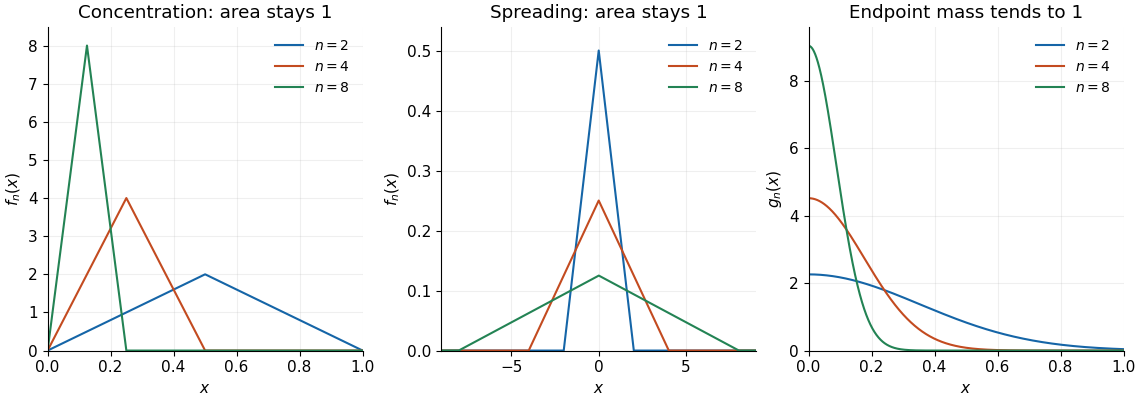
Concentrating bumps, spreading bumps, and a one-sided approximate identity
. Left: the examples in part (b)(i) converge pointwise to zero while their integrals remain one. Middle: the examples in part (b)(iii) have uniform convergence to zero but retain integral one by spreading across the real line. Right: the nonnegative functions in part (c) concentrate their mass at zero and recover the endpoint value of a continuous function. Details.
The functions are nonnegative. The change of variables and the given Gaussian integral implyFor every fixed ,Thus the mass concentrates at the endpoint zero. This is a one-sided approximate identity.
Because is continuous on the compact interval , it is a bounded function; put . Given , choose with for . Splitting the integral near and away from zero yieldsTaking the limit superior gives a bound of , and was arbitrary. ConsequentlyOnly continuity at zero and boundedness on were needed for this final estimate; the assumed continuity everywhere also guarantees the ordinary integrals exist.
Articles by others on the same topic
There are currently no matching articles.