Use the ideal transverse-motion model of the question: constant tension, small slopes, no bending stiffness, and no transverse body-force term. On a short segment away from , the vertical components of the endpoint tensions are, to first order in , and . Its mass is , since is linear mass density. Newton's second law givesDividing by and taking its limit proves the wave equation on a string on each side of the mass:The string on the right pulls the point mass with vertical component , while the string on the left contributes . HenceThe fixed supports and attachment impose the boundary conditionsTogether with the mass equation, these are the endpoint and matching conditions. The slope can jump at : the jump supplies the mass's vertical acceleration. Requiring the slope to be continuous would incorrectly remove its dynamics.
Use separation of variables to seek a normal mode , with angular frequency and wavenumber . The endpoint boundary conditions are built intoLet and denote the mass's displacement amplitude by . Continuity and the mass equation becomeThe two possibilities must be separated before dividing by .
Antisymmetric modes. If , then , , and . The force equation gives , since . Thus and the mass stays at rest. These allowed angular frequencies satisfyThe restoring forces on the mass cancel even though the string vibrates.
Symmetric modes. If , continuity forces . Cancelling the nonzero amplitude in the mass equation and using givesThese modes have and move the mass. In dimensionless form their equation is , where . This is the spectral splitting for a string with a central point mass.
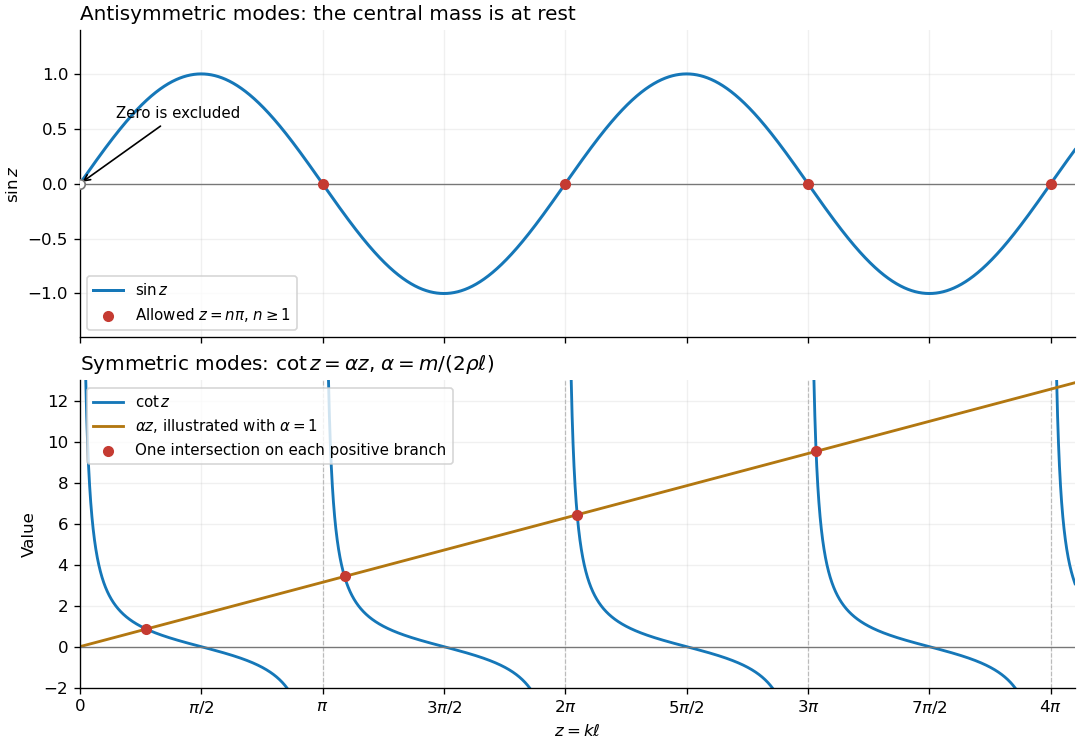

For the antisymmetric family, the graph of crosses zero at every positive multiple of . For the symmetric family, on each interval , , the graph of decreases continuously from to zero while increases. By the intermediate value theorem and strict monotonicity, there is exactly one intersection in each interval. On the remaining half-intervals , so there are no further positive roots. This proves graphically and analytically that both families contain infinitely many normal modes. The figure uses for illustration.
The algebraic case is not a mode: a zero-frequency profile would be linear on each half, continuous and zero at the endpoints; the zero-acceleration mass equation also makes its slopes agree, forcing the entire profile to be zero. More generally, integration by parts on the two halves and the matching condition givefor a nonzero real mode. Thus no nonzero static or exponentially growing mode has been omitted.
The lowest positive root belongs to the symmetric family and lies in ; all antisymmetric roots are at least . Let . The equation forces its first root to tend to zero: for any fixed , the right side eventually exceeds at , so the decreasing-minus-increasing difference has its zero below .
The Taylor series then givesSince and , the lowest angular frequency isPhysically, at such a low frequency each half-string is nearly straight. If the mass moves up by , the two slopes are approximately and , so the restoring force is . The resulting harmonic oscillator equation, , has exactly the leading angular frequency above. The next correction from the same expansion is .
Articles by others on the same topic
There are currently no matching articles.