The full cumulative distribution function isThus the function graph is horizontal at zero for , rises continuously from to , and is horizontal at one for . Its derivative is positive on and zero at both endpoints. The second derivative changes sign at , giving an inflection point there.
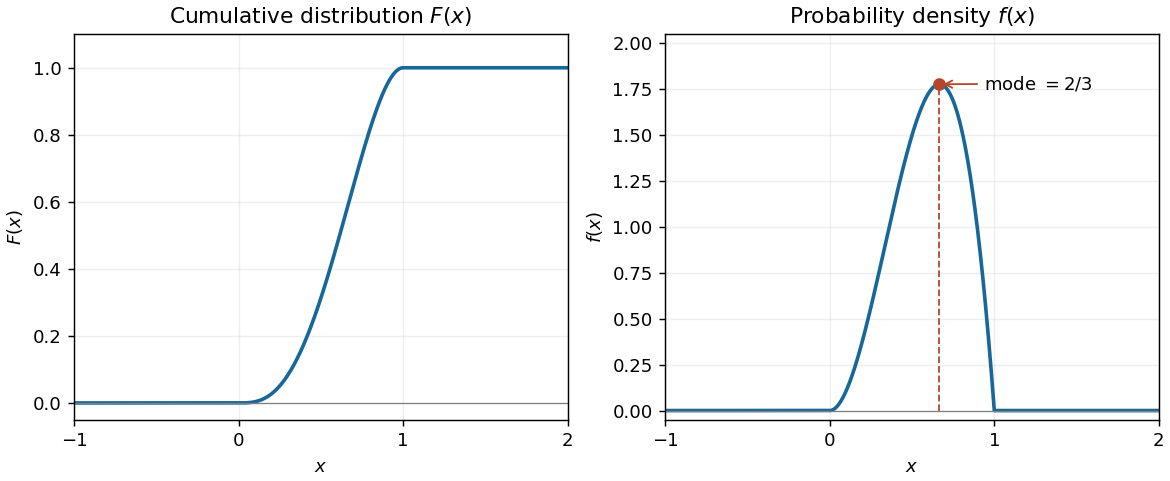

The probability density function is the derivative of the cumulative distribution function:It is nonnegative and has integral . This is a beta distribution with parameters and .
The probability density function is zero outside . Inside that interval, it rises from , reaches its only interior maximum at , and falls to . The derivative ispositive for and negative for . Its maximum height is . The second panel of the figure in part (b) shows the function graph on the requested full range, with this mode marked.
The interior stationary point of the probability density function solves with , giving . The sign change of established in part (d), together with zero endpoint values, makes this the global maximum. Thus
At the mode, the cumulative distribution function has valueSince is strictly increasing on , its unique crossing of occurs earlier. Therefore the median is less than the mode.
The requested bounds are and , both within the support. Since the probability distribution is continuous, endpoints have zero probability, and subtraction of the cumulative distribution function givesThis leaves the answer in rational fractions as requested.
Articles by others on the same topic
There are currently no matching articles.