General definitions. The Euler-Lagrange equation gives . Write and . A normal mode has fixed displacement pattern and common time factor, ; its normal frequency satisfiesHere is angular frequency. A normal coordinate is the coefficient of one pattern in a complete modal expansion, so these coordinates decouple the equations. Since is positive definite, the change turns the mode equation into the ordinary symmetric eigenvalue problem for .
Three-mass equations. Let be horizontal displacements from the unstretched equilibrium, ordered left to right. The kinetic energy and potential energy areDifferentiating the potential energy givesThus and
Frequencies and patterns. Put . Expansion of the generalized eigenvalue problem for small oscillations givesSolving at each root givesThe zero normal mode is uniform translation. In the lower nonzero mode, the central mass stays fixed, the two end masses move oppositely, and their unequal displacements balance both the end-mass momenta and the forces on the central mass. In the upper mode the end masses move together and the centre oppositely. Both vibrating modes leave the centre of mass fixed.
Orthogonality. Because is symmetric, two mode equations implyDistinct eigenvalues therefore give the mass-matrix orthogonality of normal modes:The Euclidean dot product need not vanish for unequal masses; for example , while . The modal squared norms are .
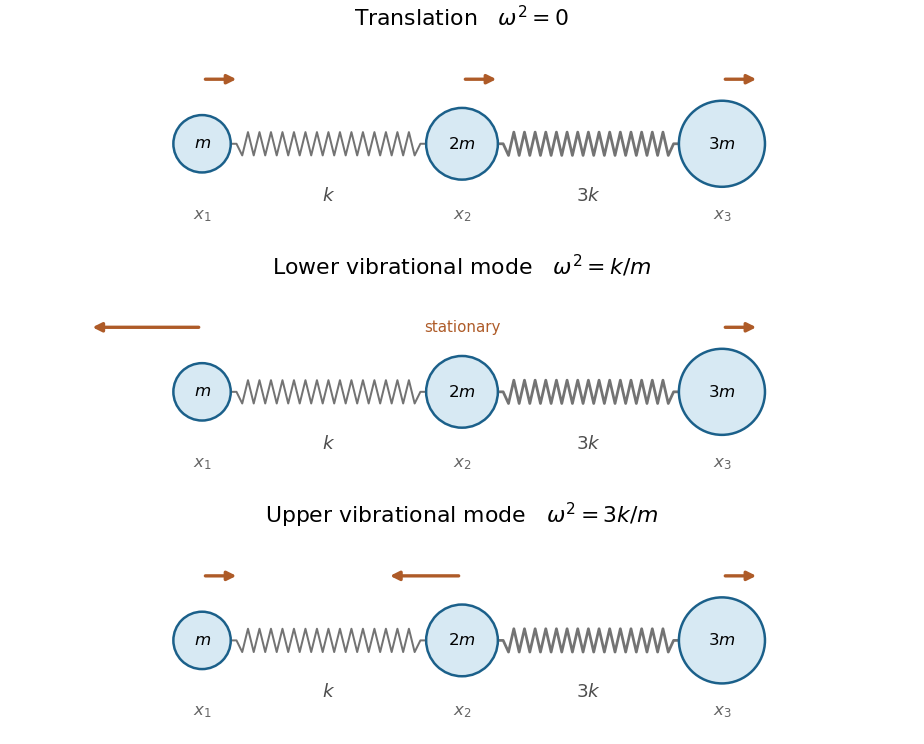

Normal coordinates. Expand . Project using the mass-weighted inner product and divide by each modal norm to obtainFor example, the inverse equations are , , . They reduce the energies toand henceThe first coordinate is the centre of mass and has free linear motion. Multiplying by respectively gives mass-normalized normal coordinates if desired.
Articles by others on the same topic
There are currently no matching articles.