For a bounded region with piecewise smooth boundary and a continuously differentiable vector field, the divergence theorem gives , with outward unit normal . Apply it to . The cross terms cancel, giving the Green's second identityThe terms cancel identically. Sending proves the whole-space identity provided the boundary integral tends to zero. The boundary term at infinity in Green's second identity requires adequate derivative decay as well as field decay; mere pointwise convergence does not suffice. The screened kernels used below satisfy the required decay.
Take . Apply the identity with and , treating the source through its Dirac delta function, or excising a small source sphere and taking its radius to zero. It gives . Symmetry of the radial Green function then yields the requested representation.
For separation , the modified Helmholtz equation reduces to . Decay selects . Integrating the equation over a small sphere gives , so . ThusFor with , put . Then . When , decay removes , while removes an additional point source at the origin. HenceSince has a minus sign, the positive Yukawa kernel convolution isThe coincident-rate limit is for the convolution, and the origin limit for general rates is . Both are finite; the apparent denominators in the distinct-rate formula are removable limits.
Set in Laplace's equation. Separation gives and . Single-valued angular periodicity requires integer . For the radial factors are ; for they are . A term linear in is excluded by periodicity. Thus the harmonic Fourier expansions in planar concentric domains have the general formFor , the specified boundaries contain only a constant mode and a first cosine mode. The two-boundary annular harmonic interpolation givesAt , the cosine term vanishes and the logarithmic term is ; at , the first term vanishes and the cosine amplitude is . Each component is harmonic, and the maximum principle ensures uniqueness for these continuous Dirichlet boundary conditions.
Compute the complex derivative along real increments to get , and along imaginary increments to get . Equality gives the Cauchy-Riemann equations, .
For the specified real part, observe that . Thus the most general holomorphic function with this real part on the connected plane isThe difference of two such holomorphic functions has zero real part, so the Cauchy-Riemann equations make its imaginary part constant.
Next, . Its real and imaginary parts satisfy and . Their partial derivatives are continuous everywhere, proving that the complex hyperbolic cosine is entire.
A pole of order at has extending holomorphically to a nonzero value there. Its residue is the coefficient of in the Laurent series. The Cauchy integral theorem gives for a closed contour in a simply connected domain of holomorphicity. The residue theorem replaces zero by times the enclosed residues for a positively oriented simple contour avoiding finitely many poles.
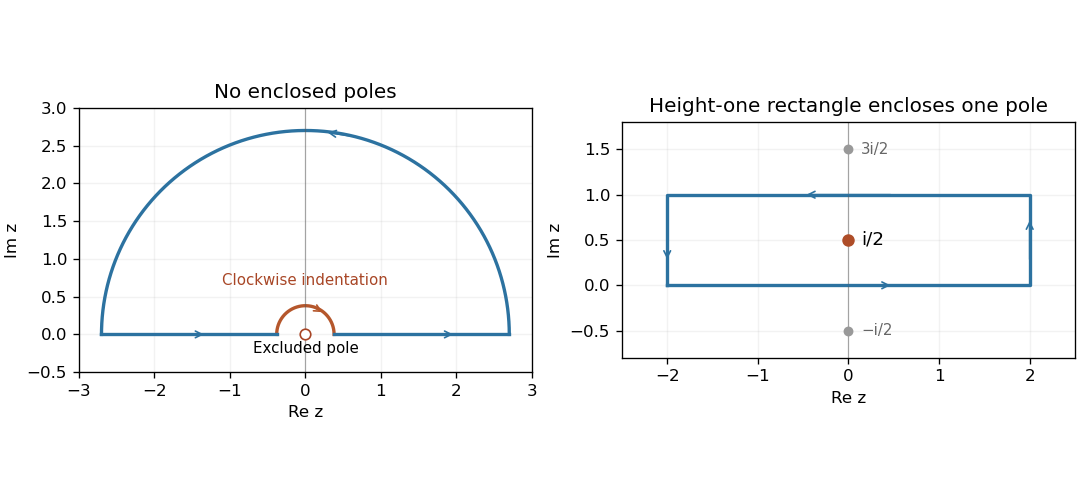
For the first integral, use the upper-half-plane semicircle, with a small clockwise upper semicircle excluding the origin. Near zero,There are no poles inside the indented contour. The large arc vanishes because and the integrand there is ; the small arc tends to . Therefore the real-axis complex principal value is . Taking real parts gives the ordinary convergent cosine-difference inverse-square integralThe real numerator cancels to second order at zero, so this final real integral itself needs no principal-value convention.
For , the simple poles are , . Differentiating the denominator givesIntegrate around the rectangle with vertices . It contains only . On the top side , and reversed traversal therefore contributes times the bottom integral. The vertical sides vanish for . The residue theorem gives , so the exponential moment of the hyperbolic secant is

The one-sided Laplace transform is for sufficiently large . Integration by parts, with the exponential suppressing the upper boundary, givesDifferentiation under the integral gives , proving . Start with and apply this rule repeatedly:With all three initial data zero, transforming the forced equation gives . Thus and the listed inverse transform givesThe cubic factor is also the resonant exponential particular solution associated with the triple characteristic root .
Under an orthogonal Cartesian change , the chain rule gives . Thus the derivative operator transforms as a rank-one Cartesian tensor. Under a general coordinate change it has the covector transformation law when applied to a scalar; derivatives of vector components then need the usual connection terms. The calculations below use Cartesian coordinates.
Use and contract the Levi-Civita symbols:This proves the convective acceleration identity, with the sign set by the displayed order .
For the curl of a cross product, the Cartesian contraction isThe product rule then givesFor the fluid equation, replace the advective term by using the preceding identity. Take its curl. Both gradient terms have zero curl, while and incompressibility gives . The vorticity equation is consequentlyThe left side is the material derivative of vorticity; the right is vortex stretching. It follows here because the given force per mass is a gradient, in addition to the flow being inviscid and incompressible.
The kinetic energy is . Differentiating the given potential and applying Newton's second law givesThese are the normal modes of a symmetric three-mass string, with mass matrix and stiffness matrix . The coordinate order here is , although the spatial order along the string is .
Reflection symmetry splits the generalized eigenvalue problem into an antisymmetric mode , , with , and symmetric modes . Writing , these obey and . Thus . The three results areThe displacement vectors are mutually orthogonal under the mass-weighted inner product , as required for these conservative normal modes.
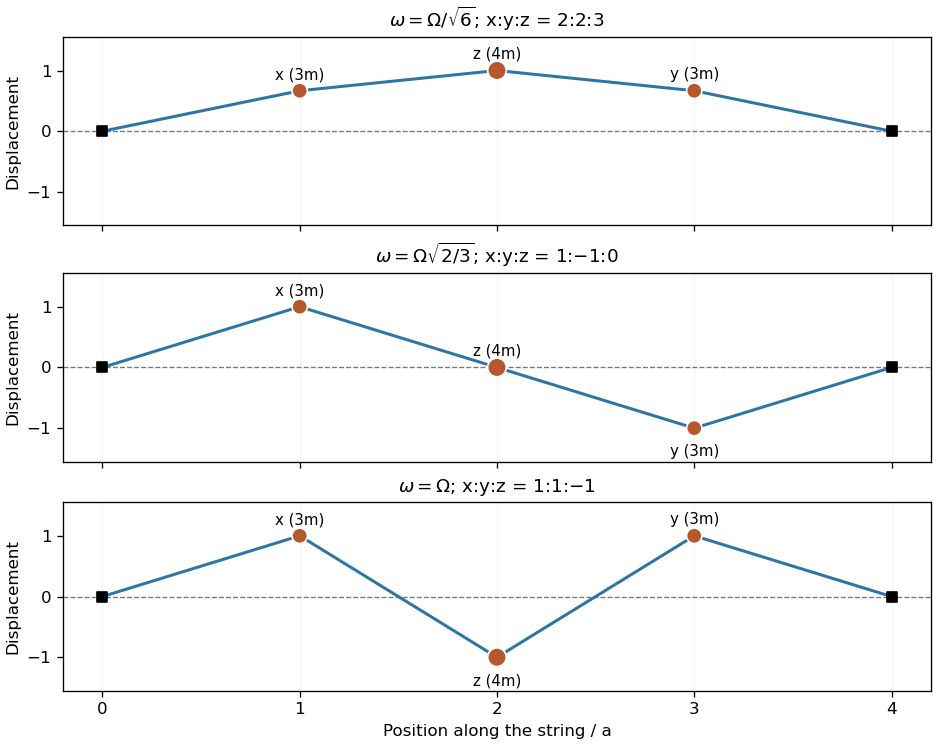
The three transverse normal modes in their physical order along the string
. Original mode shapes with segment length . The moving particles have masses from left to right and positions . Vertical displacements are normalized independently in each panel; straight string segments join the particles and fixed endpoints. Details.
A left coset is . The cosets partition a finite group into equally sized sets of elements, so Lagrange's theorem gives ; in particular subgroup order divides group order.
The table proves closure, is the identity and every element is its own inverse. Associativity is inherited from matrix multiplication, so this is the Klein four-group.
Finally, if every nonidentity element has order two, every element satisfies , including the identity. Then . Thus a group of exponent two is abelian.
A group homomorphism preserves multiplication, . A group isomorphism is a bijective homomorphism. An isomorphism from a group to itself is a group automorphism.
The automorphism group contains the identity map. Composition is associative, and if are automorphisms, ; composition is also bijective. For and , , proving the inverse bijection is a homomorphism. These facts establish all group axioms.
A finite cyclic group is with of order . The map is well defined modulo , bijective onto the roots of unity, and preserves multiplication. It identifies with the multiplicative group of th roots of unity.
For prime , Lagrange's theorem leaves only subgroup orders one and : there is no nontrivial proper subgroup. The trivial subgroup is nevertheless proper when , so that qualification is necessary in the printed claim. The characterization of groups with no proper nontrivial subgroups makes the distinction explicit.
For composite , choose a prime divisor and take , of orders and . They are distinct proper subgroups, with nontrivial. If the question intended two nontrivial proper subgroups, that demand is not always possible: a cyclic group of order has only the one of order . The subgroups and quotients of a cyclic group are controlled by its divisors. The order-one group is a separate trivial case, with no proper subgroups.
A group representation is a homomorphism . It is a reducible representation if there is a nonzero proper invariant subspace of preserved by every , and an irreducible representation otherwise. With invertible,so changing basis gives another representation. Its character of a representation is , and cyclicity of the trace gives .
A conjugacy class consists of as varies. Since , a power equals the identity exactly when does. Thus conjugation preserves element order, including infinite order.
For the square, let be rotation by and reflection in a horizontal symmetry axis. The dihedral group has the eight elementsThe conjugacy classes of a finite dihedral group specialize toThe two central rotations are singletons. Reflection conjugation reverses rotations, while conjugation by shifts a reflection exponent by two, giving the two reflection classes.
For finite groups over , character orthogonality and completeness make the irreducible characters a basis of the class functions. The latter space has one independent value per conjugacy class. Hence the square group has five inequivalent irreducible complex representations. The sum of squares of irreducible representation dimensions is eight, forcing four one-dimensional representations and one two-dimensional representation. The four scalar choices , supply the former; the ordinary action on the plane supplies the latter.
Articles by others on the same topic
There are currently no matching articles.