For the proposed trial profile, . Its weighted energy isThe squared weighted norm isBoth are finite for and , and . Therefore the Rayleigh-Ritz variational principle givesWhen a fundamental diffusion mode exists, its decay rate is the infimum and is bounded above by this expression.
The existence qualification matters for the full range of printed in the question. For , trial functions concentrated within radius have quotient proportional to , proving the loss of a spectral gap under strongly degenerate radial diffusion. The infimum is zero and is not attained, because zero energy together with forces the zero function. Thus there is no positive lowest-mode decay rate in that case. Even at , the mode equation is : its characteristic powers are , and for every nonzero solution is unbounded at the centre. Hence the asserted bounded fundamental mode cannot be assumed for all . The trial quotient remains valid, and the next part's case has the usual fundamental mode.
For constant diffusivity, the trial Rayleigh quotient simplifies toIts derivative is , so its only positive critical point is . The second derivative is ; also the quotient diverges as or . Therefore this is the global optimum within the trial family:The two requested profiles areThe initial radial graph decreases from one at the centre to zero at the rim, has horizontal tangent at the centre, and is concave downward for . The central temperature decreases exponentially from one to zero, with initial time derivative . These are trial profiles, not exact solutions of the full heat equation. Although the radial trial function is not twice differentiable at the centre, it has finite weighted energy and belongs to the variational trial class used by the Rayleigh-Ritz variational principle.
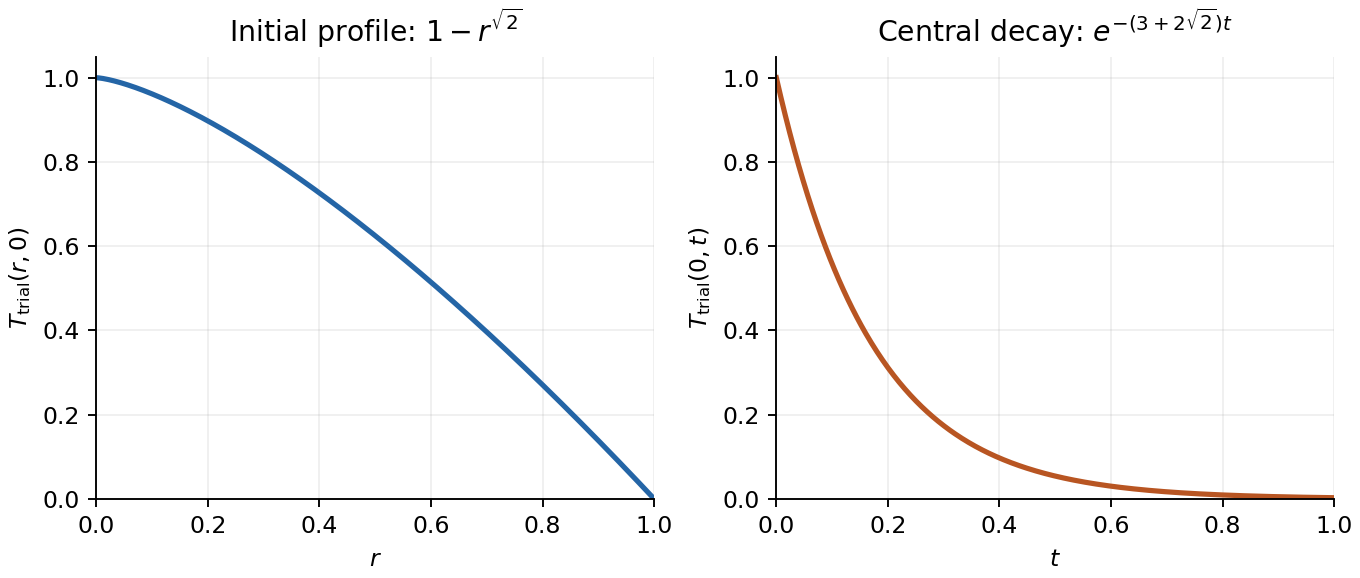
Optimal trial radial profile and its assumed exponential decay at the centre
. Details. 
Articles by others on the same topic
There are currently no matching articles.