Substitute into the axisymmetric heat equation and cancel the exponential:Thus the radial ordinary differential equation and its Sturm-Liouville form areThe weight in this Sturm-Liouville problem is therefore . The outer Dirichlet boundary condition is , and the physical solution is regular at the centre. The factor in the weighted inner product is also the radial part of the polar area element.
Multiply the separated Sturm-Liouville problem by real and apply integration by parts:The outer endpoint term vanishes because . At zero, regularity gives vanishing radial flux. This can be obtained from the equation without assuming a bounded derivative: let . Since and is bounded, has a finite limit at zero. If that limit were nonzero, positive bounded thermal diffusivity would make have fixed sign and magnitude at least a constant times sufficiently near zero, contradicting bounded . Hence , and in fact . This also forces for bounded .
The boundary terms therefore vanish, provingAs usual for diffusion, is nonnegative and positive for ; the later power-law case may vanish at the centre. The argument applies in that case as well.
For a nonzero admissible radial profile define the radial diffusion Rayleigh quotientMinimizing the numerator subject to introduces a multiplier . The Euler-Lagrange equation for isThe allowed variations vanish at , and the natural condition at the centre is zero radial flux. Thus the minimum, when attained, is the smallest decay eigenvalue . Equivalently, expansion in weighted-orthogonal eigenfunctions makes a weighted average of their decay eigenvalues. The Rayleigh-Ritz variational principle therefore givesAdmissible trial functions must obey the outer boundary condition, be nonzero and have finite weighted norm and energy; they need not solve the differential equation. If the diffusion operator has no lowest eigenfunction, the same variational argument bounds the infimum of its spectrum. Existence of a fundamental diffusion mode is an additional assumption for strongly vanishing diffusivity, not a consequence of the identity alone.
For the proposed trial profile, . Its weighted energy isThe squared weighted norm isBoth are finite for and , and . Therefore the Rayleigh-Ritz variational principle givesWhen a fundamental diffusion mode exists, its decay rate is the infimum and is bounded above by this expression.
The existence qualification matters for the full range of printed in the question. For , trial functions concentrated within radius have quotient proportional to , proving the loss of a spectral gap under strongly degenerate radial diffusion. The infimum is zero and is not attained, because zero energy together with forces the zero function. Thus there is no positive lowest-mode decay rate in that case. Even at , the mode equation is : its characteristic powers are , and for every nonzero solution is unbounded at the centre. Hence the asserted bounded fundamental mode cannot be assumed for all . The trial quotient remains valid, and the next part's case has the usual fundamental mode.
For constant diffusivity, the trial Rayleigh quotient simplifies toIts derivative is , so its only positive critical point is . The second derivative is ; also the quotient diverges as or . Therefore this is the global optimum within the trial family:The two requested profiles areThe initial radial graph decreases from one at the centre to zero at the rim, has horizontal tangent at the centre, and is concave downward for . The central temperature decreases exponentially from one to zero, with initial time derivative . These are trial profiles, not exact solutions of the full heat equation. Although the radial trial function is not twice differentiable at the centre, it has finite weighted energy and belongs to the variational trial class used by the Rayleigh-Ritz variational principle.
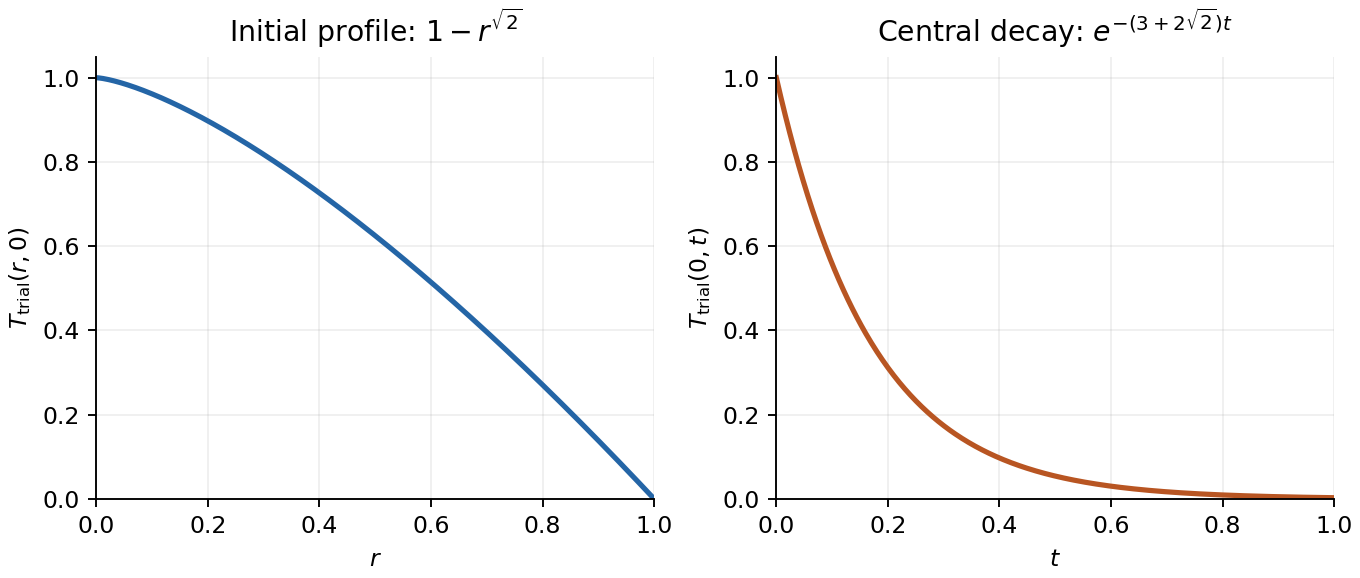
Optimal trial radial profile and its assumed exponential decay at the centre
. Details. 
Articles by others on the same topic
There are currently no matching articles.