Expanding the characteristic polynomial givesTherefore and . Both are polynomial functions of the three real coordinates, so they are continuous functions, including on the open subset of invertible matrices.
On , . Its image contains positive values, for example , and negative ones, for example . If were connected, its continuous real image would be an interval containing both signs and hence zero. That is impossible. Thus is not connected. More precisely its determinant image is : take for a positive value and for a negative one.
On , , so and therefore . Yet and . The same continuous image of a connected space argument shows that is not connected.
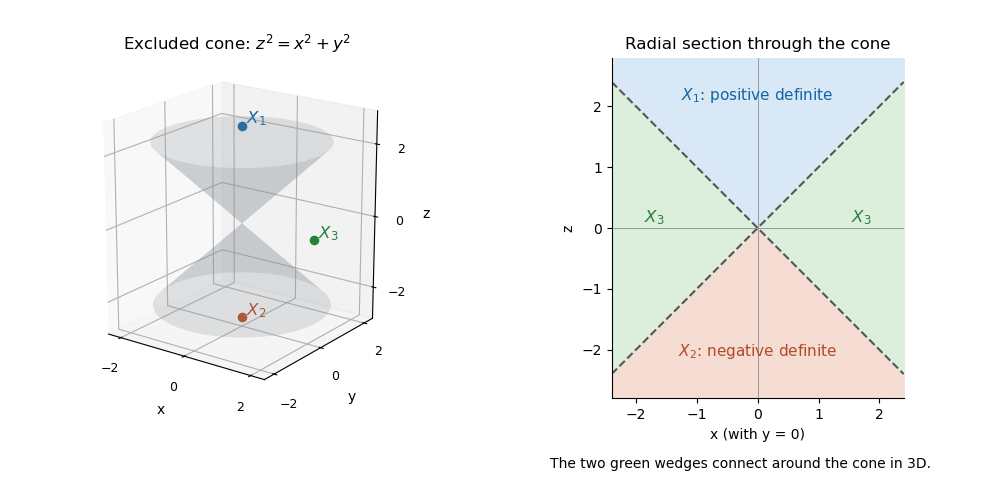
Put . The required three disjoint nonempty open sets areTheir union is precisely , the complement of the double cone . The eigenvalues are , so consists of positive-definite matrices above the upper sheet, of negative-definite matrices below the lower sheet, and of indefinite matrices outside the double cone. Examples are respectively.
The two definite cones are convex sets. The indefinite region is path-connected: shrink continuously to zero while keeping , then change the nonzero vector within the punctured plane. Thus these sets are also exactly the three connected components. This is the determinant cone for real symmetric two-by-two matrices.

Articles by others on the same topic
There are currently no matching articles.