A decahedral nanoparticle is a multiply twinned nanoparticle: five fcc-like tetrahedral domains share a common fivefold axis and meet on coherent twin planes. The angle of an ideal fcc tetrahedral wedge is , so five wedges leave about of angular deficit. Elastic distortion and defects accommodate closure. The external shape can be a pentagonal bipyramid or a truncated variant; it is not one unstrained, periodically repeated fcc crystal.
An icosahedral nanoparticle comprises twenty tetrahedral domains arranged around a common centre, with twenty approximately triangular outer facets, twelve vertices and thirty edges. Five domains meet around each radial fivefold direction. Coherent twinning exposes many low-energy close-packed facets, but fivefold symmetry cannot tile ordinary three-dimensional space periodically without strain. The competition between favourable surface/twin energies and volume-dependent elastic strain explains why such morphologies are especially plausible for small particles.
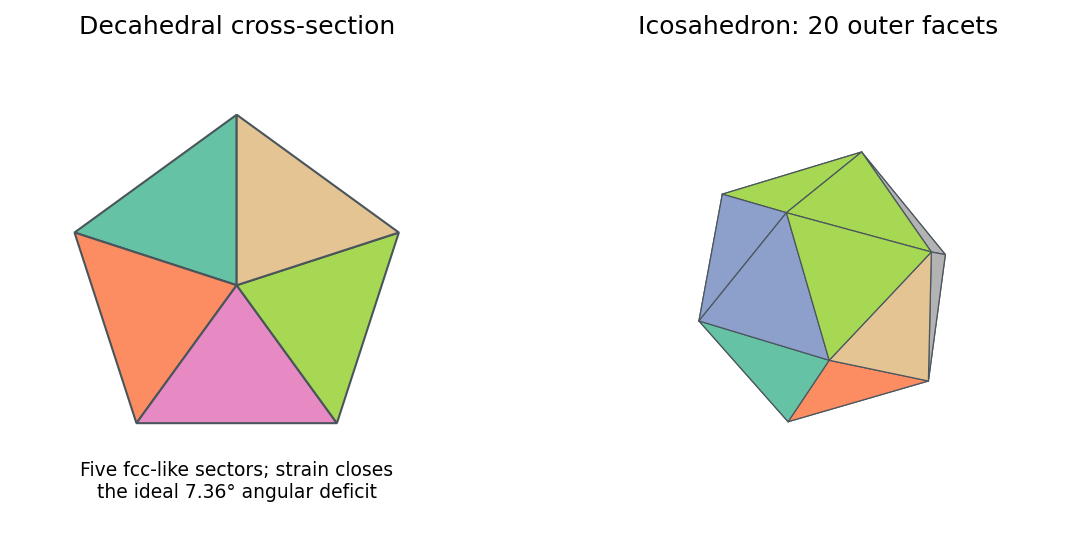
Five tetrahedral sectors in a decahedral cross-section and the twenty outer facets of an icosahedron
. Source. Details. 
These labels describe the observed domain geometry; cobalt can adopt different crystal phases, so identifying fcc-like twinning also requires diffraction rather than assuming every cobalt particle is bulk fcc.
The Winterbottom construction extends the Wulff construction to a crystal supported on a substrate. It includes the particle-substrate interfacial energy and the substrate surface energy displaced by contact, so the equilibrium Wulff body is truncated by the support plane. The relevant contact contribution is ; it determines wetting and contact geometry. The basic unsupported construction accounts only for orientation-dependent free surface energies.[ref]
Equilibrium shape of a small particle in contact with a foreign substrate by W. L. Winterbottom. Supported-particle equilibrium construction
In cluster-beam deposition, evaporated or sputtered cobalt atoms cool in an aggregation gas, nucleate clusters and are carried to a substrate. Source temperature, gas pressure, aggregation length and residence time tune the mean size and distribution. A mass selector can narrow the delivered size range, at the cost of transmitted flux; an unfiltered beam does not automatically produce monodisperse particles.
Shape control is less direct. Growth kinetics and cluster temperature can favour particular structures, while multiple morphologies can coexist at one size. Landing energy, substrate interactions and post-deposition annealing can change the delivered shape or cause coalescence. Soft landing helps preserve gas-phase clusters. In solution, ligands, selective facet binding, seed-mediated growth and precursor feeding can give stronger chemical control over shape and size, but introduce ligand/solvent residues and require purification. Neither method guarantees a unique shape merely by selecting particle size.
A bulk fcc atom has twelve nearest neighbours, whereas surface atoms are undercoordinated: ideal (111) terrace atoms have nine and (100) terrace atoms eight. Steps, kinks, edges and corners can have still lower coordination and different bond-angle environments. These sites change electronic structure, adsorption energies and activation barriers, making geometrically different sites catalytically inequivalent.
In a Pt-Pd particle, a site's neighbours may be Pt, Pd or a mixture; surface segregation means surface composition need not equal overall composition. Alloying also changes strain and electronic interactions. Surface relaxation, reconstruction, adsorbed ligands, oxide or contamination can further alter accessibility and chemical state. A high nominal Pt fraction therefore does not establish either accessible Pt sites or a particular catalytic activity.
Use complementary composition, spatial and population measurements:
- Insufficient Pt: digest representative aliquots and measure calibrated ICP-OES or ICP-MS to obtain bulk Pt/Pd ratio and trace Fe. Blanks, recovery checks and standards control contamination and matrix effects. This is sensitive and quantitative but destructive and supplies no particle-by-particle spatial information.
- Poor Pt-Pd mixing: use STEM-EDS maps or line profiles of many individual particles. Characteristic X-ray energies identify the elements; background subtraction and calibrated sensitivity factors permit local composition estimates. HAADF-STEM supplies complementary atomic-number-sensitive contrast, with Pt generally brighter than Pd for comparable thickness. Core-shell segregation or distinct domains can then be tested. Projected overlap can imitate mixing, and low counts, thickness and beam damage limit nanoscale quantification; tomography or multiple views can resolve important ambiguities.
- Fe impurities: EDS/EELS can locate Fe-rich inclusions or surface-associated material, while the bulk digest establishes whether a trace signal is representative. Failure to detect Fe in a few TEM fields does not rule out dilute contamination below local detection limits. XPS can additionally assess near-surface composition and oxidation state, but is not a bulk assay.
- Size uniformity: obtain calibrated TEM images from randomly chosen independent fields, segment individual particles and report a number-weighted size histogram with sample count and shape descriptors. Avoid overlap and selection of only well-dispersed or attractive particles. A projected diameter is not a complete three-dimensional volume; scattering methods can corroborate ensemble size but weight particles differently.
Articles by others on the same topic
There are currently no matching articles.