In floating-catalyst CNT growth, a controlled sulfur additive acts as a growth promoter for the catalyst, commonly iron. Sulfur modifies catalyst surface composition, carbon uptake and the strength of the catalyst-carbon interaction; it can facilitate cap formation/lift-off and sustained tube growth instead of complete catalyst encapsulation. It also changes catalyst-particle evolution and hence tube yield, diameter and wall-count distributions.
There is an optimum range: excessive sulfur can occupy active sites or form an insufficiently active sulfide-rich catalyst and reduce growth. The additive is not simply a constituent that must be incorporated into every carbon wall. Its detailed action depends on catalyst, carbon source and process conditions; a single universal melting-point explanation is insufficient.[ref]
The promoter role of sulfur in carbon nanotube growth by Balázs Orbán and Tibor Höltzl. First-principles evidence for sulfur weakening iron-carbon binding; later mechanistic support, not an official answer
The circumference is the length of the graphene wrapping vector:For ,Approximating the closest wall-to-wall separation by the graphite interlayer spacing gives the nearest-neighbour axis separation in a triangularly packed bundle:This assumes undeformed circular tubes with a graphitic contact gap. Faceting, flattening, adsorbates or pressure can alter a real bundle's spacing.
Each concentric shell has a different circumference, so it generally needs a different integer wrapping vector . Different vector lengths do not force different chiral angles, but exact atomic registry between all curved shells is geometrically restrictive. The shells can nucleate with different wrapping orientations, and strong covalent bonding within each shell dominates the weaker intershell interaction.
Consequently, it is usually unnecessary to strain every shell into a common orientation and registry; many multiwall tubes have incommensurate shells with different chiral angles. Identical chiral angles are possible, for example among suitable members of one armchair family, and should not be ruled out purely because the radii differ. Atomic indices, chiral angle and interwall commensurability are distinct descriptions.
The real-space carbon honeycomb has two atoms in a primitive cell of its triangular Bravais lattice. The reciprocal lattice is also triangular, and its Wigner-Seitz cell is a hexagonal first Brillouin zone. With a consistent orientation convention, the reciprocal-zone hexagon is rotated by relative to a real-space carbon-ring hexagon; reciprocal lengths scale inversely with the direct lattice spacing.
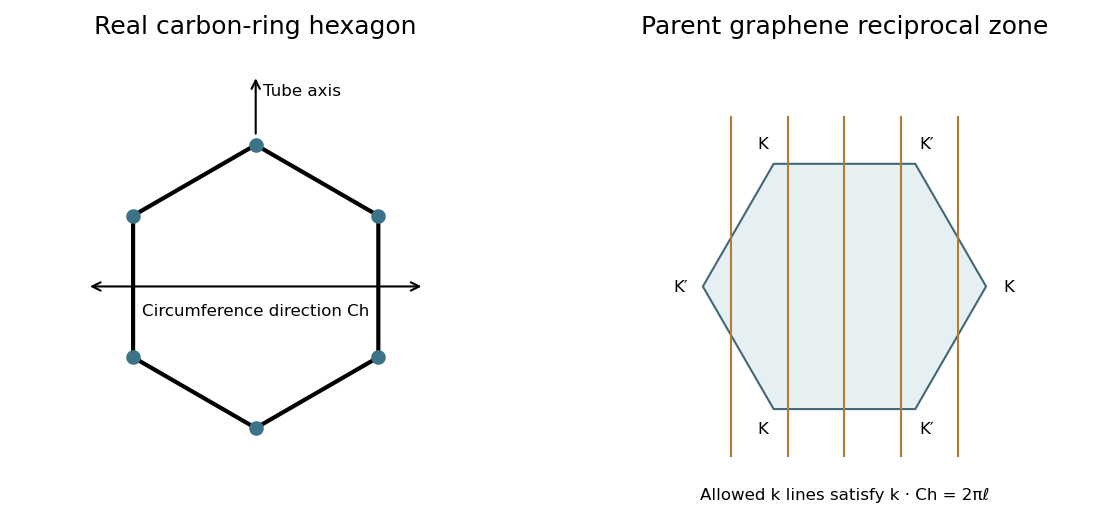

Rolling into a tube imposes , leaving parallel allowed lines in graphene's two-dimensional reciprocal space. They run along the tube-axis direction, perpendicular to the circumferential wrapping vector. The nanotube's actual one-dimensional Brillouin zone is an interval of axial wave vectors with period , where is its axial translation. The parent hexagon is therefore a zone-folding construction, not a literal two-dimensional Brillouin zone for the finished one-dimensional tube.
For a tube, . A cut normal to its axis crosses ten axial load-bearing C-C bonds in the ideal unstrained honeycomb geometry. Assuming equal load sharing and simultaneous failure at per bond,The graphene areal mass is , giving linear mass densitysince the tex unit has . Thus the ideal carbon nanotube tenacity isThis neglects vacancies, curvature-induced changes in bond strength, thermal activation, imperfect load sharing and structural relaxation at failure. An aligned macroscopic fibre is a network of finite tubes or bundles: sliding, weak intertube shear transfer, imperfect alignment, defects and unequal load participation limit its strength. The nominal fibre diameter alone does not turn it into one defect-free covalent cylinder, explaining why a value near can be much lower than this ideal single-tube estimate.
Articles by others on the same topic
There are currently no matching articles.