The important change is preorganization of the chloride-binding amide groups. In the hydroxylated host, intramolecular hydrogen bonds from the phenolic OH groups to the amide carbonyl oxygens restrict rotation and favor a geometry in which the amide NH donors converge on the anion-binding cavity. chloride can therefore accept two favorable hydrogen bonds with a smaller conformational penalty than in the unsubstituted host. The hydroxyl groups need not be counted as two additional freely available chloride donors: their role includes organizing the existing donors.
The association constant increases by . At , the corresponding difference in standard Gibbs free energy isThis is a modest molecular free-energy advantage amplified into a substantial change in the equilibrium constant. solvent competition and changes in solvation also contribute to measured binding; the structures chiefly suggest the preorganization explanation.
The molecule combines three chemically different binding regions.
- sodium: the oxygen-rich calixarene/polyether region, including the ether oxygens and suitably oriented ester carbonyl oxygens. sodium is a hard Lewis acid and favors multidentate coordination by hard oxygen donors. The scaffold holds several donors near one another and can reduce the conformational cost of binding.
- nitrate: the two urea groups. Their NH groups donate hydrogen bonds to nitrate oxygens. Several NH donors can cooperate around an anion; the carbonyl oxygen of a urea is an acceptor and is not the proposed nitrate-binding donor.
- silver: the terminal bipyridyl nitrogen donors. The pyridine lone pairs coordinate the softer silver ion. The actual coordination may involve donor sites on more than one arm or more than one receptor, depending on geometry and concentration.
These assignments identify the preferred local sites, rather than guaranteeing three independent binding constants: occupancy can alter conformation, electrostatics and the affinity of neighboring sites.
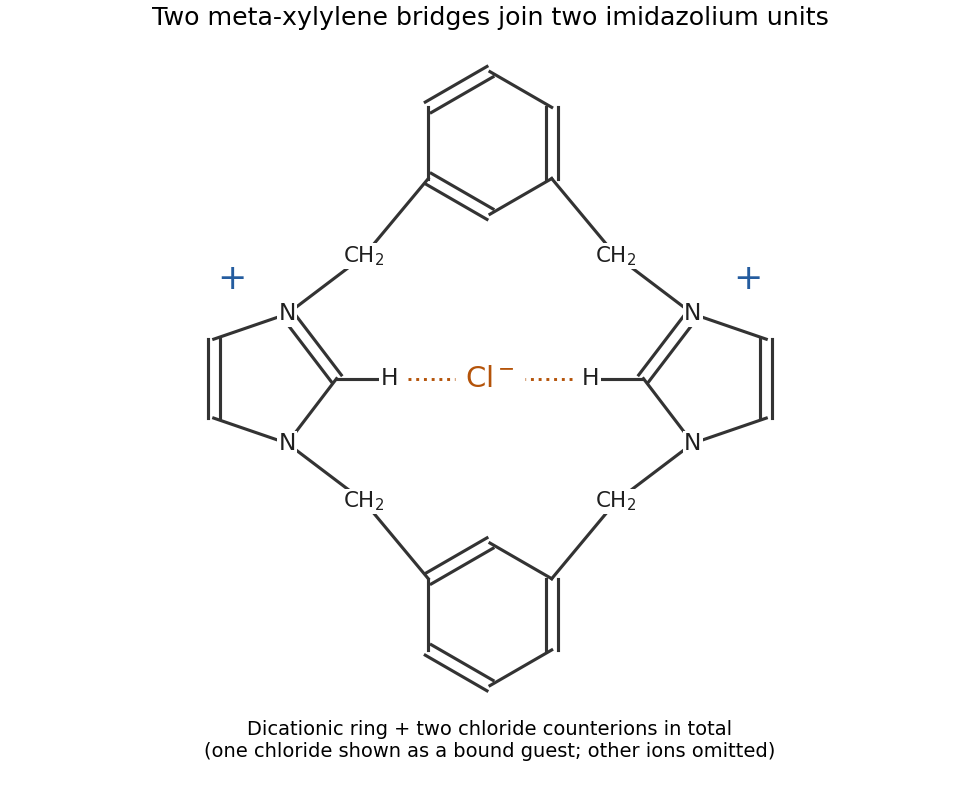
Each imidazole already has one nitrogen substituted. Its remaining pyridine-like nitrogen attacks a benzylic carbon bearing chlorine in an reaction, expelling chloride and producing an imidazolium center. Repetition at the other end closes the ring. The expected product is therefore a dicationic bis-imidazolium macrocycle, in which two meta-xylylene bridges connect the two imidazolium rings. Both nitrogens of each imidazolium are alkylated; the aryl rings remain intact.
A compact way to specify its connectivity is to traverse the ring:Here each indicated imidazolium connects its two substituents through its two different ring nitrogen atoms, rather than through a single nitrogen.
chloride acts as an anion template: association with the positively charged intermediates and the inward-facing imidazolium CH donors brings the reacting ends together, favoring cyclization over intermolecular oligomerization. Tetrabutylammonium is a spectator counterion, not a covalent part of the product. The two substitutions produce two chloride counterions for the dication; template chloride can also occupy the cavity, with the remaining ions in solution. The schematic below specifies connectivity and charge without reproducing the source drawing.

One design is an anthracene–methylene–aza-15-crown-5 sensor, with the tertiary amine of the aza-crown linked through to anthracene. The crown supplies the sodium-binding oxygen/nitrogen cavity, the amine supplies an electron donor and anthracene supplies the fluorophore. A sufficiently rigid sodium-sized cryptand could improve discrimination further.
Without a bound cation, photoinduced electron transfer from the amine can quench excited anthracene. sodium coordination lowers the electron-donating ability of that lone pair, suppressing this quenching route and increasing fluorescence. The methylene spacer allows electronic communication by electron transfer while limiting direct conjugation between the binding site and fluorophore.
A cavity appropriate to sodium is preferable to an 18-crown-6-like potassium-sized cavity. Selectivity must be tested, not inferred perfectly from cavity size. Potassium binding, including possible sandwich complexes of flexible crowns, can still compete. At the intended concentrations the design should satisfy and should give a fluorescence change on sodium binding. Rigidity, cavity size and suppression of competing stoichiometries are useful design controls. fluorescence calibration in the actual potassium-containing solvent establishes the usable detection range.
Articles by others on the same topic
There are currently no matching articles.