Brownian motion is the irregular thermal displacement produced by fluctuating molecular forces from the surrounding liquid. In the overdamped regime its long-time displacement is diffusive, with mean squared displacement proportional to time. It brings nanoscale building blocks into contact and lets them sample orientations and escape weak incorrect contacts. Interparticle forces bias this exploration toward lower-free-energy structures; thermal motion alone does not select a particular crystal. Strong irreversible attraction, high viscosity or glassy arrest can stop the defect correction needed for successful self-assembly.
For a no-slip spherical particle in a Newtonian fluid at low Reynolds number, Stokes law gives . The fluctuation-dissipation theorem then gives the Stokes–Einstein relation . Using the conventional radial Brownian displacement in three dimensions,Here is the Boltzmann constant, absolute temperature, dynamic viscosity, particle radius and elapsed time. Larger thermal forcing raises diffusion; larger viscous drag reduces it. The formula requires times long relative to momentum relaxation and neglects walls, interactions and external drift.
The word “average” needs a statistic: the vector mean is zero, while the mean radial displacement for Gaussian three-dimensional diffusion is , not . Both scale as . Neither is the total length of a microscopic random path.
In the imposed free-draining polymer friction model, the drag coefficients of the monomers add, giving and . Taking the same three-dimensional centre-of-mass RMS convention as part (ii),The polymer is a one-dimensional connected contour, but that alone does not restrict its centre of mass to one spatial axis. If the intended coordinate is instead literal one-dimensional curvilinear motion along an entanglement tube, its RMS contour displacement is . That is a different coordinate and should not be compared with a three-dimensional displacement without stating the conversion/model.
Additive local drag is the free-draining Rouse model approximation. It neglects long-range solvent-mediated hydrodynamic interactions and is not a complete theory of an entangled chain. In a tube/reptation description, curvilinear diffusion can scale as while long-time spatial centre-of-mass diffusion scales as after the chain renews its tube. Conversely a dilute unentangled coil can exhibit Zimm model hydrodynamic coupling. Monomer motion, centre-of-mass motion and contour sliding therefore cannot all be identified with the same displacement law.
At the theta condition, effective excluded volume approximately cancel and a freely jointed ideal chain has . With the stipulated segment length ,In a good solvent repulsive excluded volume swells the coil, giving with in three dimensions, or the Flory approximation . In a poor solvent effective segment attraction favours a compact globule, whose linear size scales as at roughly fixed internal density. The latter are scaling laws with model-dependent prefactors. A real chemical monomer need not be a statistical Kuhn length; using as the independent segment length is part of this question's idealized model.
For the stipulated effective-sphere polymer drag, the radius is the end-to-end RMS distance, , rather than the single-monomer radius. Its Stokes law and translational diffusion coefficient areUnder the same three-dimensional RMS convention as used above,Thus for sufficiently long chains (), this model gives a larger displacement than independent monomer drag: solvent motion couples the parts of a coil, reducing its effective friction relative to isolated moving beads. The theta-solvent scaling is consistent with the dilute-coil hydrodynamic scaling underlying the Zimm model, but treating a permeable fluctuating coil as a solid sphere with radius exactly gives only an order-one hydrodynamic approximation. The hydrodynamic radius and end-to-end radius are not generally equal. Neither model by itself restores the long-time constraints of a truly entangled solution.
If the one-dimensional contour statistic in part (iii) is used literally, the comparison of this three-dimensional with that contour RMS is ; it compares different coordinates. Using mean radial displacements in both three-dimensional models instead changes both prefactors equally and leaves their ratio unchanged.
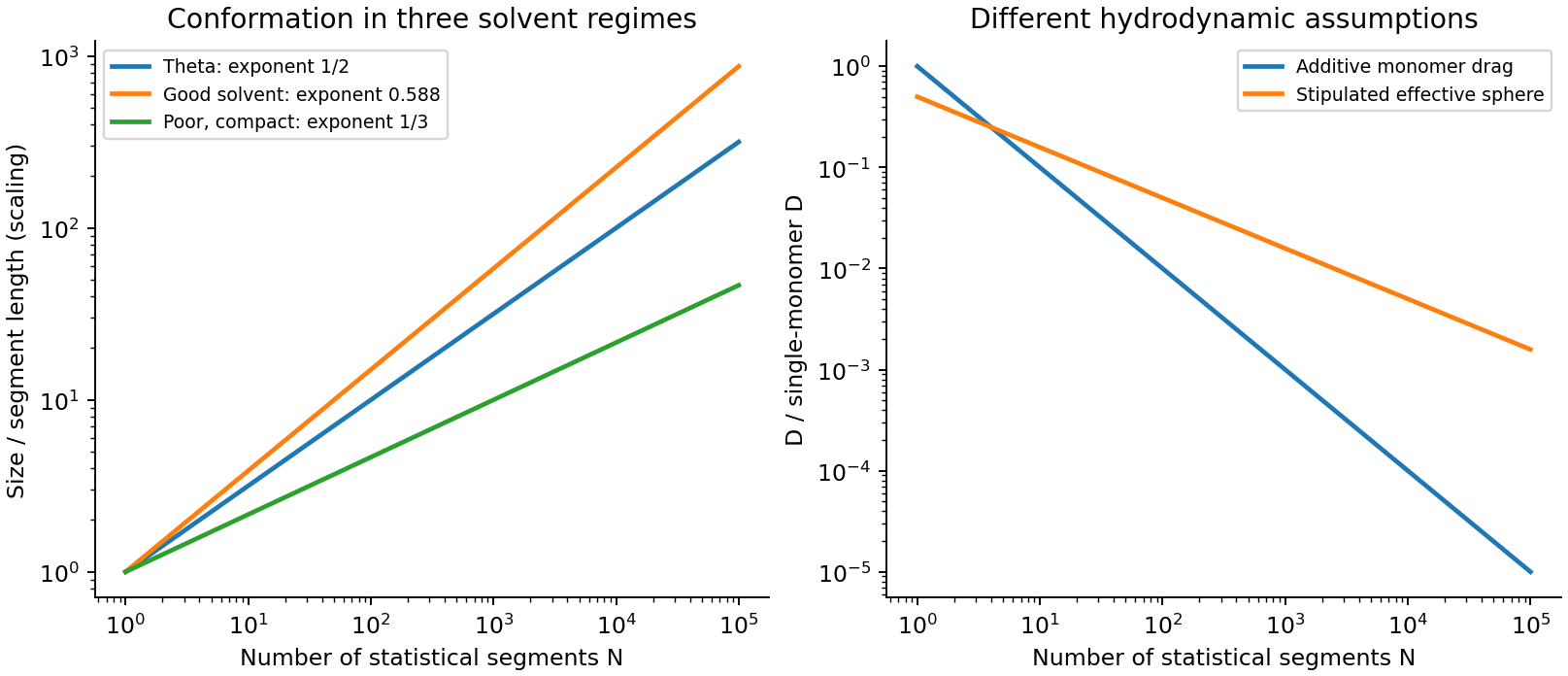
Original idealized polymer size and translational-diffusion scalings under explicitly different drag models
. Details. 
The Flory interaction parameter measures the effective free energy penalty for unlike A–B contacts relative to like contacts, and is the total number of statistical segments per chain. Their product is the segregation strength: contact-energy preference competes with the conformational entropy cost of separating covalently joined blocks. does not grow during solvent evaporation. For an approximately nonselective solvent, increasing polymer concentration instead increases the effective importance of A–B contacts, so a roughly fixed-composition path moves from weak toward stronger effective segregation.
The diagram's labels are DIS: disordered; S: block-copolymer sphere phase; H: hexagonal cylinder block-copolymer phase; G: double gyroid; L: lamellar microphase. At , A is the minority component and B forms the continuous matrix. Reading the supplied diagram vertically at this composition gives disorder initially, a sphere region when segregation first becomes sufficient, and a cylinder region if sufficiently strong segregation is reached within the displayed range. The thin gyroid and central lamellar regions are not the thermodynamic equilibrium path at this composition. The dry endpoint cannot be fixed numerically without the final value. The cited theoretical calculation determines thermodynamic equilibrium phase stability, not a universal evaporation trajectory.[ref]
Stability of the Gyroid Phase in Diblock Copolymers at Strong Segregation by Eric W. Cochran and others. Macromolecules 39 (2006), pp. 2449–2451, equilibrium diblock phase stability
Crucially, at least one block is glassy at room temperature. Solvent can initially plasticize it, but solvent loss can raise its effective glass-transition temperature above the processing temperature. Chain relaxation then becomes too slow to equilibrate. Even slow evaporation can therefore freeze disorder, spheres, cylinders or another transient morphology before the thermodynamic equilibrium dry state is reached. Solvent concentration, annealing time and segmental mobility must be followed alongside the phase diagram.
One explanation is block-copolymer kinetic trapping. A solvent-swollen transient sheet structure can be immobilized when a block vitrifies during drying; accurately measured block fractions do not guarantee thermodynamic equilibrium. Thermal annealing above the relevant glass transition, or a controlled nonselective solvent-vapour anneal followed by structural characterization, can test whether the sheets relax toward the bulk composition-appropriate morphology.
A second is surface or confinement selection of lamellar microphase. The diagram describes a bulk reference model. A thin film, preferential wetting at the substrate/free surface or a commensurate confining thickness adds interfacial and geometrical free energy terms that can favour layered arrangements even at an asymmetric global fraction. Unequal layer thicknesses can accommodate ; equal block fractions are not required for every layered metastable or confined structure. Varying film thickness and surface chemistry, and comparing bulk-like and confined samples after adequate annealing, distinguishes this explanation from kinetic arrest. Strong conformational asymmetry is another possible departure from the reference model, but an incorrect measured composition need not be invoked.
Articles by others on the same topic
There are currently no matching articles.