Three suitable examples are cubes bounded mainly by facets, octahedra bounded by facets, and truncated octahedra bounded by both and facets. These are crystallographically distinct shapes rather than three arbitrary rounded particle outlines.
At fixed volume the thermodynamic equilibrium shape minimizes , with an edge/corner correction when particles are very small. In the Wulff construction, facet support-plane distances scale as their interfacial free energies. Silver's clean low-index energies, selective adsorption of ligands or ions, solvent chemical potential and possible support contact alter those energies. Crystal twinning and elastic strain can add further costs or stabilize multiply twinned forms. A face with slow attachment kinetics can also survive during growth even when that morphology is not the thermodynamic equilibrium Wulff shape. Homogeneous nucleation describes where nuclei form; it does not guarantee an thermodynamic equilibrium final shape.
In a polyol process, a hot polyol such as ethylene glycol acts as solvent and reductant for a silver precursor. Nucleation creates seeds; controlled reduction supplies atoms for their subsequent growth, while polyvinylpyrrolidone adsorption and seed crystal twinning favour anisotropic growth. For the common silver nanowire route, a fivefold-twinned seed can develop into a pentagonal wire with predominantly side faces and growth at less-passivated ends. Cross-sectional microscopy and diffraction of microtomed wires provide evidence for that twinned structure rather than an inference from a long outline alone.[ref]
Polyol Synthesis of Uniform Silver Nanowires: A Plausible Growth Mechanism and the Supporting Evidence by Yugang Sun and others. Nano Letters 3 (2003), pp. 955–960, pentagonal cross sections and fivefold twinning
The aspect ratio depends on seed population and twin survival, relative end/side growth rates, precursor feed and reduction rate, PVP coverage, temperature, trace halides, dissolved oxygen and growth time. High aspect ratio requires a suitable population of twinned seeds, suppression of competing particle nucleation and continued atom supply while sidewall thickening is restrained. These variables must be controlled together; adding more capping polymer alone is not a universal recipe. Advantages are solution processing, substantial yield and tunable dimensions without an etched hard template. Disadvantages include sensitive batch reproducibility, particle by-products, residual insulating ligand, purification, oxidation/tarnish and nanowire junction resistance in later films. Compare seed/capping/halide controls using microscopy and size distributions, not only solution colour.
A transparent metallic network must span the patterned electrode with many redundant current paths while obscuring little area. For random rods, number density times squared wire length is a useful percolation measure; greater aspect ratio generally reaches a connected network at lower coverage. Conductivity also depends on intrinsic metal resistivity, wire cross section, orientation, length distribution, wire–wire contact resistance and the number of junctions along each spanning path. Insulating capping layers can make nanowire junction resistance dominate even when the individual wires are excellent conductors.
Near the connectivity threshold, small density changes or wire breaks produce large resistance changes. For a narrow stripe, finite-size effects and orientation matter: a macroscopic sheet-average percolation result does not ensure a reliable 100 µm-wide path. Optical performance depends on coverage, metal extinction, wire diameter, aggregation, optical haze, substrate transmission and any binder. Increasing wire density lowers resistance but usually lowers transmission. Welding, pressing or suitable embedding can improve contacts with less additional optical coverage than simply adding metal.[ref]
Self-limited plasmonic welding of silver nanowire junctions by Erik C. Garnett and others. Nature Materials 11 (2012), pp. 241–249, junction-localized welding mechanism
The stripe has squares, so its end-to-end resistance is ; the stated sheet-resistance limit requires a stripe resistance below 5 kΩ, not 20 Ω. The sketch below separates sparse connectivity, redundant paths and junction quality.
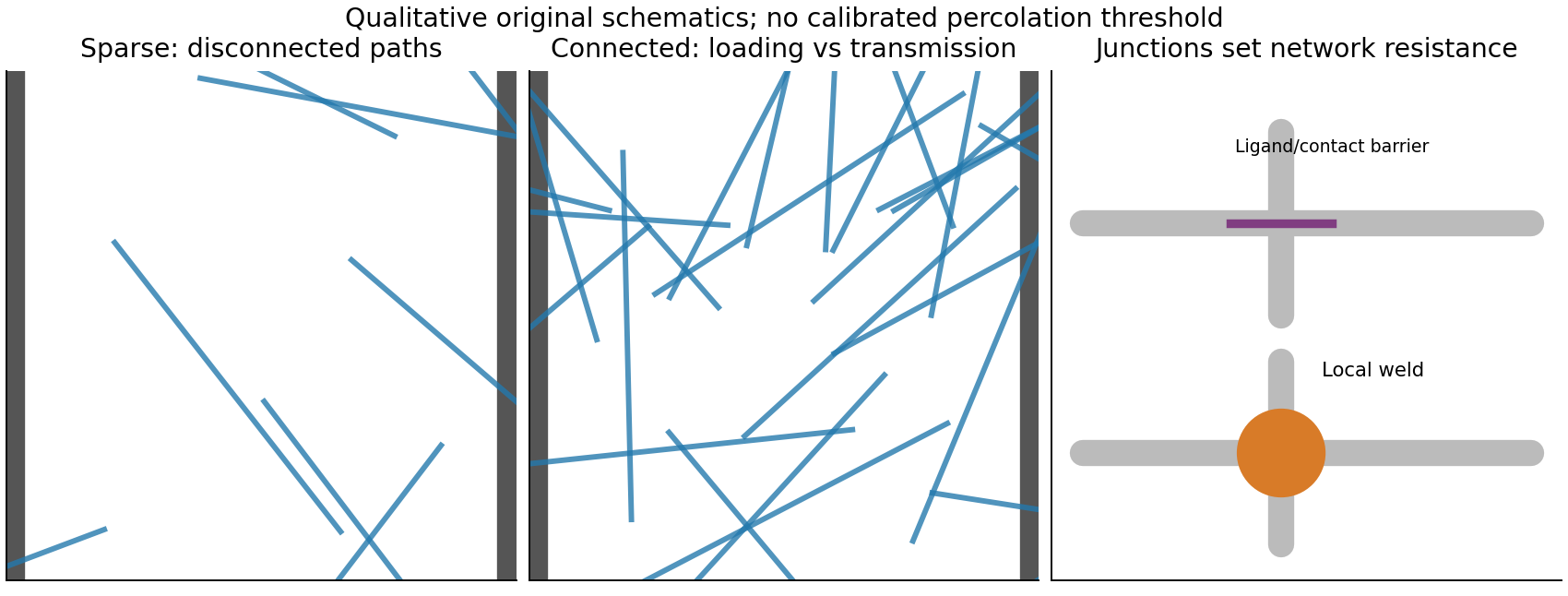
Original network schematics distinguishing connectivity, optical coverage and wire-junction resistance
. Details. 
Three credible architectures are a welded silver nanowire network; a thin silver nanowire network with a conducting polymer overcoat; and a nanocrystalline silver grid formed from nanoparticle ink. Silver provides low intrinsic resistivity. A sparse long-wire network can be both flexible and highly transmitting if its junctions are well connected. A thin, optically weak conducting polymer overcoat can bridge junctions and smooth the surface, provided its added absorption and moisture sensitivity are controlled. A fine grid offers a more directly designed optical/electrical trade-off and does not rely on operating near random percolation.
For a quantitative grid feasibility screen, take pitch , line width and metal thickness . An opaque-line square-grid estimate gives . With a transmitting polymer substrate of 0.95, the combined estimate is 0.912. The sheet resistance is approximately . Even an effective silver resistivity four times gives , with a coating thinner than 400 nm. There are about 20 mesh periods across the stripe, making the finite-width design more credible than a pitch comparable with its whole width.
These are feasible material/process choices, not guaranteed specifications for every film carrying those names. For the two nanowire architectures, choose wire dimensions, loading and junction treatment to pass the same finished-stripe measurements; the hybrid's optical budget must include its overcoat. Measure transmission at 550 nm with its reference stated, sheet resistance, profile thickness, bend-cycle stability and pattern continuity. Bare nanotube or graphene networks should not be assumed to meet this demanding resistance–transmission combination without additional metallic conduction or other demonstrated improvement.
For the silver nanowire network, synthesize or source long, narrow wires, remove excess ligand without causing aggregation, formulate a stable coating ink and coat the flexible web by a scalable method such as slot-die coating or gravure printing. Dry below the substrate's damage temperature, then press or locally weld junctions and embed or cap the network if required. Define 100 µm stripes by masked coating, a printing-compatible patterned wetting layer, or post-coating laser ablation; provide robust end contacts and remove stray bridges between adjacent stripes. Roll processing offers throughput, but coffee-ring effect, wire alignment, random weak links and ablation damage require inline optical/electrical inspection. Verify that the local junction treatment improves resistance without simply darkening the whole film.
For the silver nanoparticle-derived grid, use a repeatable nanoimprint lithography to form a fine mesh inside the outer 25 mm by 100 µm stripe pattern. Fill the channels with a silver nanoparticle ink, remove excess from the transparent openings, and consolidate the metal by substrate-compatible chemical, photonic or low-temperature thermal sintering. Transfer or embed the grid into the polymer surface and add electrical pads. The quantitative design in part (b) sets target pitch, line width and thickness; the large-scale process must maintain those dimensions and a continuous metal cross section. A master enables repeated replication and deterministic open area, but tooling cost, incomplete filling, residual metal in windows, shrinkage cracks, imperfect sintering and adhesion are important limitations. Test the finished patterned stripes, rather than relying on a large unpatterned test coupon alone.
A two-dimensional electron gas is confined into discrete subbands perpendicular to an interface while retaining nearly free motion in its plane. It is not a literal zero-thickness electron sheet. In a GaAs/AlGaAs semiconductor heterostructure, the band offset and self-consistent band bending confine electrons on the GaAs side. Donors in AlGaAs can supply electrons while an undoped spacer separates them from the ionized dopants, reducing impurity scattering. This modulation-doping arrangement yields a high-mobility channel, with the lowest confinement subband occupied when the confinement spacing exceeds the Fermi and thermal scales. Gates tune the density or locally deplete the channel into constrictions. Low-temperature Hall and longitudinal measurements test the resulting sheet density and transport quality.
Use the magnitudes of the single-electron-band Drude Hall relation and longitudinal sheet resistivity:The given values are two-dimensional resistivities, so no sample thickness is inserted. ThusThe carrier sign follows from a specified Hall-voltage orientation; these calculations use positive magnitudes. A parallel conducting layer, several occupied subbands or a quantized Hall plateau would require a different interpretation of a single-field measurement.
For a parabolic two-dimensional electron gas with one valley and two spin states, the density of states per area is . Integrating from the subband edge to the zero-temperature Fermi energy gives , henceHere , and the energy is measured from the occupied subband bottom. Equivalently . ThereforeThe spin factor is already included in ; counting it again would halve the energy incorrectly.
This is transverse magnetic focusing. The depleted gates form reflecting boundaries and two constrictions. A narrow quantum point contact collimates carriers into cyclotron trajectories with cyclotron radius . When an integer number of semicircular skipping arcs links the two openings, the collector couples particularly strongly to the injector population. A floating voltage contact then changes its electrochemical potential to satisfy zero net current, producing a peak in the measured nonlocal voltage. Sweeping the field changes the arc diameter, moving the focused population into or away from the collector.
The connection condition is for integer , with the higher orders requiring specular reflections. The effect needs ballistic electron transport, sufficiently narrow openings and a smooth boundary. Electron phase coherence can add interference structure, but the basic geometrical focusing condition is semiclassical.[ref]
Coherent electron focusing with quantum point contacts in a two-dimensional electron gas by H. van Houten and others. Physical Review B 39 (1989), pp. 8556–8575, focusing geometry and peak structure
There is a polarity qualification in the printed geometry. The electron charge is negative: for a field out of the page, an electron launched upward through the left opening bends left, not toward the right opening. A direct left-opening-to-right-opening focusing path in the upper region therefore requires the field into the page; the printed outward field supports the reverse connection. Reversing conventional current reverses the occupation perturbation and voltage sign, but does not reverse the curvature of an individual electron. Thus the standard injector-to-collector explanation describes the focusing mechanism, while the asserted signed voltage increase requires a consistent field/lead convention. The calculated results below are peak-field magnitudes; taking outward field positive gives negative fields for direct left-to-right electron injection.
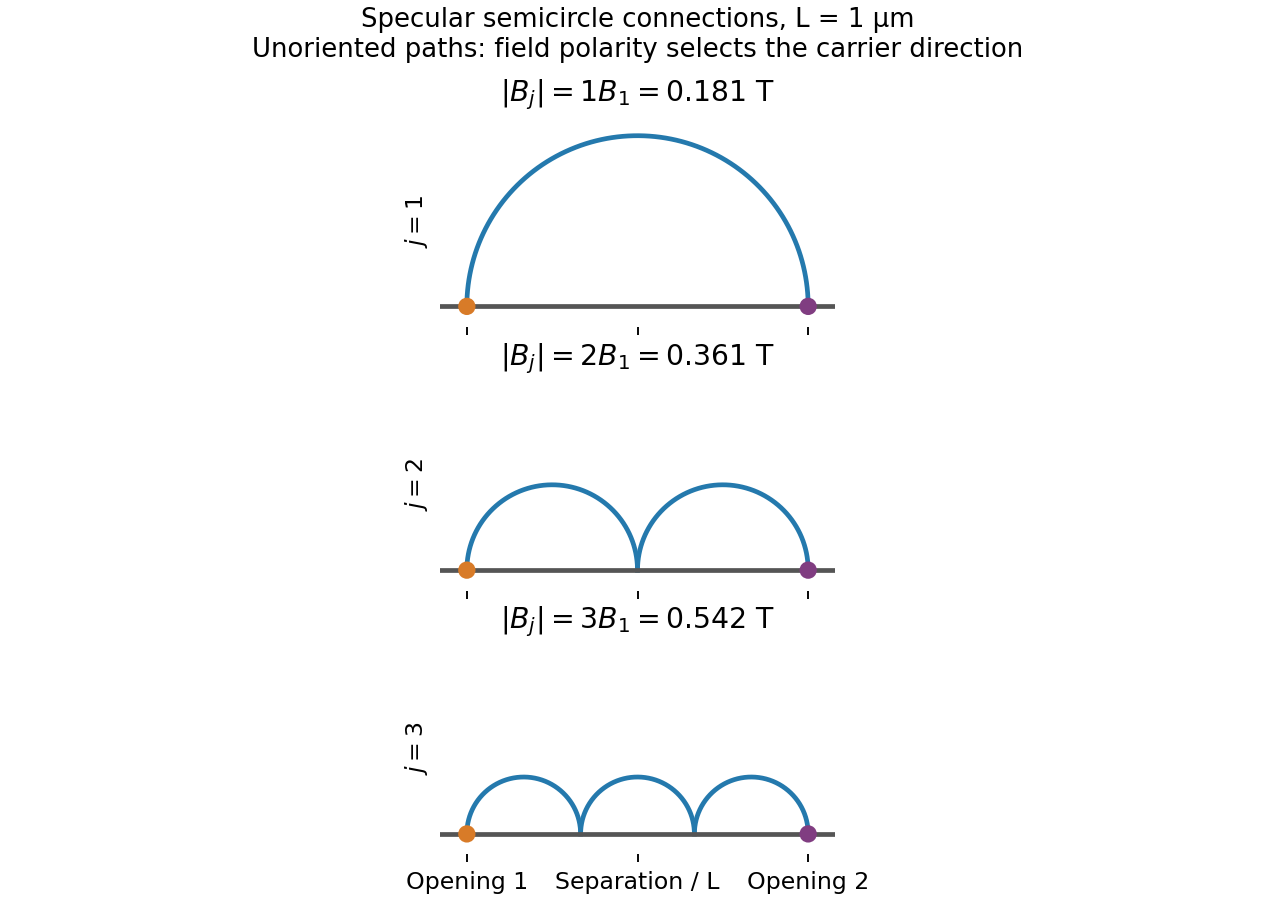
Original semicircular connections for three focusing orders; trajectories are shown without carrier-direction arrows
. Details. 
Substituting into givesUsing the density-derived Fermi wave vector gives the first three peak magnitudesThe equally spaced sequence follows from the number of reflected half-orbits, not from successive quantum Hall fillings. The field polarity selecting a given injector–collector orientation follows from the Lorentz force direction.
The transport mean free path is , while . Eliminating the scattering time gives . The usual ballistic focusing mobility criterion therefore givesA more geometrically faithful first-peak survival criterion uses the semicircular path length , giving . There is no sharp universal visibility threshold: clearly resolved peaks favour , small aperture broadening and specular reflection. The mobility inferred in part (ii) corresponds to , comfortably above both estimates. Higher-order peaks can still be reduced by boundary roughness even when bulk mobility is high.
Treat the top gate as a parallel-plate capacitor, neglecting fringing and assuming its voltage change couples to the 2DEG without a dominant trap or series-capacitance correction. Its capacitance per area and induced electron density areIn this top-gate density tuning, a positive gate change increases the electron density in this model, giving . Since ,The fields rise by a factor , not by the density ratio itself. Finite quantum capacitance is a small correction here: the one-subband value is much larger than the stated geometric capacitance per area.
The highest-field plateau is labelled , so it is the plateau in the filling factor, with the longitudinal resistivity returning to approximately zero after the transition near 10 T. The odd integer indicates a resolved spin branch at these fields; assuming a permanent twofold spin degeneracy for every orbital Landau level would misidentify the plotted sequence.
For a nominal exactly filled state at a chosen field , the density target is . Combining this with the same gate capacitor model gives the required gate-voltage change relative to the original ungated-density reference:Taking as the graph's onset-scale estimate gives andRelative to the positive 0.2 V setting in part (v), this is an additional change of approximately . An absolute laboratory gate voltage cannot be obtained without its initial offset or threshold; the calculated quantities are voltage changes.
There is a graphical/model qualification: a quantum Hall plateau occupies a finite field interval, and its onset is not an exact statement that at that edge. The plot identifies from about 10 T onward but does not specify a unique plateau-centre field or the gate setting at which the trace was recorded. The boxed formula gives the result for any selected target field. For comparison, the nominal exact-filling fields are 12.39 T at the original density and 18.34 T at the unchanged positive 0.2 V density. Thus the graph must not be combined silently with the latter density as if its onset uniquely fixed the same gate bias.
Brownian motion is the irregular thermal displacement produced by fluctuating molecular forces from the surrounding liquid. In the overdamped regime its long-time displacement is diffusive, with mean squared displacement proportional to time. It brings nanoscale building blocks into contact and lets them sample orientations and escape weak incorrect contacts. Interparticle forces bias this exploration toward lower-free-energy structures; thermal motion alone does not select a particular crystal. Strong irreversible attraction, high viscosity or glassy arrest can stop the defect correction needed for successful self-assembly.
For a no-slip spherical particle in a Newtonian fluid at low Reynolds number, Stokes law gives . The fluctuation-dissipation theorem then gives the Stokes–Einstein relation . Using the conventional radial Brownian displacement in three dimensions,Here is the Boltzmann constant, absolute temperature, dynamic viscosity, particle radius and elapsed time. Larger thermal forcing raises diffusion; larger viscous drag reduces it. The formula requires times long relative to momentum relaxation and neglects walls, interactions and external drift.
The word “average” needs a statistic: the vector mean is zero, while the mean radial displacement for Gaussian three-dimensional diffusion is , not . Both scale as . Neither is the total length of a microscopic random path.
In the imposed free-draining polymer friction model, the drag coefficients of the monomers add, giving and . Taking the same three-dimensional centre-of-mass RMS convention as part (ii),The polymer is a one-dimensional connected contour, but that alone does not restrict its centre of mass to one spatial axis. If the intended coordinate is instead literal one-dimensional curvilinear motion along an entanglement tube, its RMS contour displacement is . That is a different coordinate and should not be compared with a three-dimensional displacement without stating the conversion/model.
Additive local drag is the free-draining Rouse model approximation. It neglects long-range solvent-mediated hydrodynamic interactions and is not a complete theory of an entangled chain. In a tube/reptation description, curvilinear diffusion can scale as while long-time spatial centre-of-mass diffusion scales as after the chain renews its tube. Conversely a dilute unentangled coil can exhibit Zimm model hydrodynamic coupling. Monomer motion, centre-of-mass motion and contour sliding therefore cannot all be identified with the same displacement law.
At the theta condition, effective excluded volume approximately cancel and a freely jointed ideal chain has . With the stipulated segment length ,In a good solvent repulsive excluded volume swells the coil, giving with in three dimensions, or the Flory approximation . In a poor solvent effective segment attraction favours a compact globule, whose linear size scales as at roughly fixed internal density. The latter are scaling laws with model-dependent prefactors. A real chemical monomer need not be a statistical Kuhn length; using as the independent segment length is part of this question's idealized model.
For the stipulated effective-sphere polymer drag, the radius is the end-to-end RMS distance, , rather than the single-monomer radius. Its Stokes law and translational diffusion coefficient areUnder the same three-dimensional RMS convention as used above,Thus for sufficiently long chains (), this model gives a larger displacement than independent monomer drag: solvent motion couples the parts of a coil, reducing its effective friction relative to isolated moving beads. The theta-solvent scaling is consistent with the dilute-coil hydrodynamic scaling underlying the Zimm model, but treating a permeable fluctuating coil as a solid sphere with radius exactly gives only an order-one hydrodynamic approximation. The hydrodynamic radius and end-to-end radius are not generally equal. Neither model by itself restores the long-time constraints of a truly entangled solution.
If the one-dimensional contour statistic in part (iii) is used literally, the comparison of this three-dimensional with that contour RMS is ; it compares different coordinates. Using mean radial displacements in both three-dimensional models instead changes both prefactors equally and leaves their ratio unchanged.
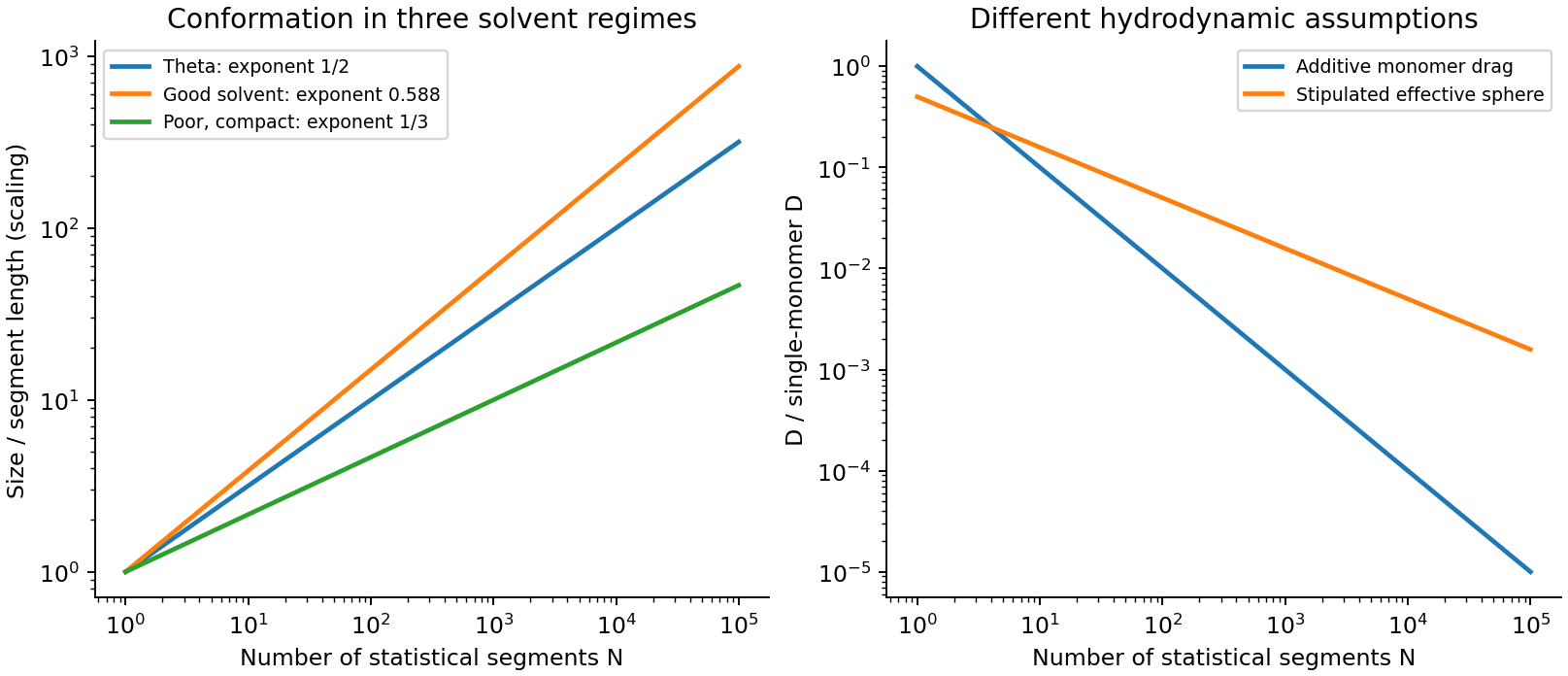
Original idealized polymer size and translational-diffusion scalings under explicitly different drag models
. Details. 
The Flory interaction parameter measures the effective free energy penalty for unlike A–B contacts relative to like contacts, and is the total number of statistical segments per chain. Their product is the segregation strength: contact-energy preference competes with the conformational entropy cost of separating covalently joined blocks. does not grow during solvent evaporation. For an approximately nonselective solvent, increasing polymer concentration instead increases the effective importance of A–B contacts, so a roughly fixed-composition path moves from weak toward stronger effective segregation.
The diagram's labels are DIS: disordered; S: block-copolymer sphere phase; H: hexagonal cylinder block-copolymer phase; G: double gyroid; L: lamellar microphase. At , A is the minority component and B forms the continuous matrix. Reading the supplied diagram vertically at this composition gives disorder initially, a sphere region when segregation first becomes sufficient, and a cylinder region if sufficiently strong segregation is reached within the displayed range. The thin gyroid and central lamellar regions are not the thermodynamic equilibrium path at this composition. The dry endpoint cannot be fixed numerically without the final value. The cited theoretical calculation determines thermodynamic equilibrium phase stability, not a universal evaporation trajectory.[ref]
Stability of the Gyroid Phase in Diblock Copolymers at Strong Segregation by Eric W. Cochran and others. Macromolecules 39 (2006), pp. 2449–2451, equilibrium diblock phase stability
Crucially, at least one block is glassy at room temperature. Solvent can initially plasticize it, but solvent loss can raise its effective glass-transition temperature above the processing temperature. Chain relaxation then becomes too slow to equilibrate. Even slow evaporation can therefore freeze disorder, spheres, cylinders or another transient morphology before the thermodynamic equilibrium dry state is reached. Solvent concentration, annealing time and segmental mobility must be followed alongside the phase diagram.
One explanation is block-copolymer kinetic trapping. A solvent-swollen transient sheet structure can be immobilized when a block vitrifies during drying; accurately measured block fractions do not guarantee thermodynamic equilibrium. Thermal annealing above the relevant glass transition, or a controlled nonselective solvent-vapour anneal followed by structural characterization, can test whether the sheets relax toward the bulk composition-appropriate morphology.
A second is surface or confinement selection of lamellar microphase. The diagram describes a bulk reference model. A thin film, preferential wetting at the substrate/free surface or a commensurate confining thickness adds interfacial and geometrical free energy terms that can favour layered arrangements even at an asymmetric global fraction. Unequal layer thicknesses can accommodate ; equal block fractions are not required for every layered metastable or confined structure. Varying film thickness and surface chemistry, and comparing bulk-like and confined samples after adequate annealing, distinguishes this explanation from kinetic arrest. Strong conformational asymmetry is another possible departure from the reference model, but an incorrect measured composition need not be invoked.
Articles by others on the same topic
There are currently no matching articles.