A parent initially at rest emits an alpha particle and a recoiling heavy daughter. momentum conservation gives equal and opposite momenta, so their nonrelativistic kinetic energies satisfyHere is the kinetic energy available to this branch; excitation of the daughter reduces it and may be followed by photon emission. For an illustrative MeV, and , the energies are MeV in the alpha particle and keV in the daughter. The heavy daughter receives much less energy, but that does not imply much less atomic damage.
The fast alpha particle loses most of its energy through electronic stopping: ionization and electronic excitation along a relatively long path. It also undergoes nuclear collisions, particularly towards the end of its range, and can produce displacement damage. The slower, heavy, highly charged recoil couples strongly to surrounding nuclei and generates a compact displacement cascade. Successive knock-on atoms create vacancies, interstitial defects and clusters. Some Frenkel pairs recombine as the cascade relaxes; the initial collision count is therefore not the number of defects that remain.
A quantitative illustration comes from brannerite rather than an assumed universal ceramic. Simulations in the primary natural-mineral study used a MeV alpha particle and an keV daughter recoil. The corresponding ranges were about micrometres and nanometres. At the study's assumed eV threshold displacement energy, its tabulated results give roughly – recoil atomic displacements and – alpha particle atomic displacements per radioactive decay. The numbers depend strongly on the displacement threshold and material, but the shorter recoil path contains the dominant and much denser ballistic radiation damage.[ref]
Chemistry, microstructure, and alpha decay damage of natural brannerite by G. R. Lumpkin and others. Chemical Geology 291, section 2.3 and Table 5; simulated ranges and threshold-dependent displacement counts
In a susceptible ceramic, cascade cores can accumulate into an amorphous fraction; defects and associated relaxation can also change volume, thermal conductivity and mechanical response. molecular dynamics simulations of zirconolite found a strongly disordered core surrounded by more isolated point defects, supporting this distinction between local cascade damage and an entirely transformed specimen.[ref]
Molecular dynamics simulation of the α-recoil nucleus displacement cascade in zirconolite by L. Veiller and others. Journal of Nuclear Materials 306, 61–72, abstract and cascade-core/point-defect results
The alpha particle eventually becomes a helium atom after slowing and charge exchange. helium accumulation can have later microstructural effects distinct from the initial knock-on cascade. Material-dependent recombination and annealing limit surviving disorder; a change in diffraction or radiation-induced swelling is not automatically radiation-induced amorphization, and radiation-induced amorphization is not automatically dissolution or release of the contained radionuclide.
Consider a representative bulk volume and let be its amorphous fraction. With alpha-decay event rate density , during the expected number of independent alpha decay events is . Each produces effective amorphization volume per decay , but only the fraction of a randomly placed damage region was previously crystalline. The expected new amorphous volume is thereforeDividing by givesSeparate variables and integrate:Hence, with cumulative alpha-decay event density ,The product is dimensionless: events per cubic metre accumulated over time multiply cubic metres damaged per event. Here “dose” is an event density, not an absorbed energy per kilogram.
An independent probability interpretation reaches the same result. A particular point is covered by a number of random damage events with a Poisson distribution of mean . Its probability of remaining crystalline is the zero-hit probability ; the complementary fraction has been hit at least once. Overlapping events do not create a second copy of already amorphous material.
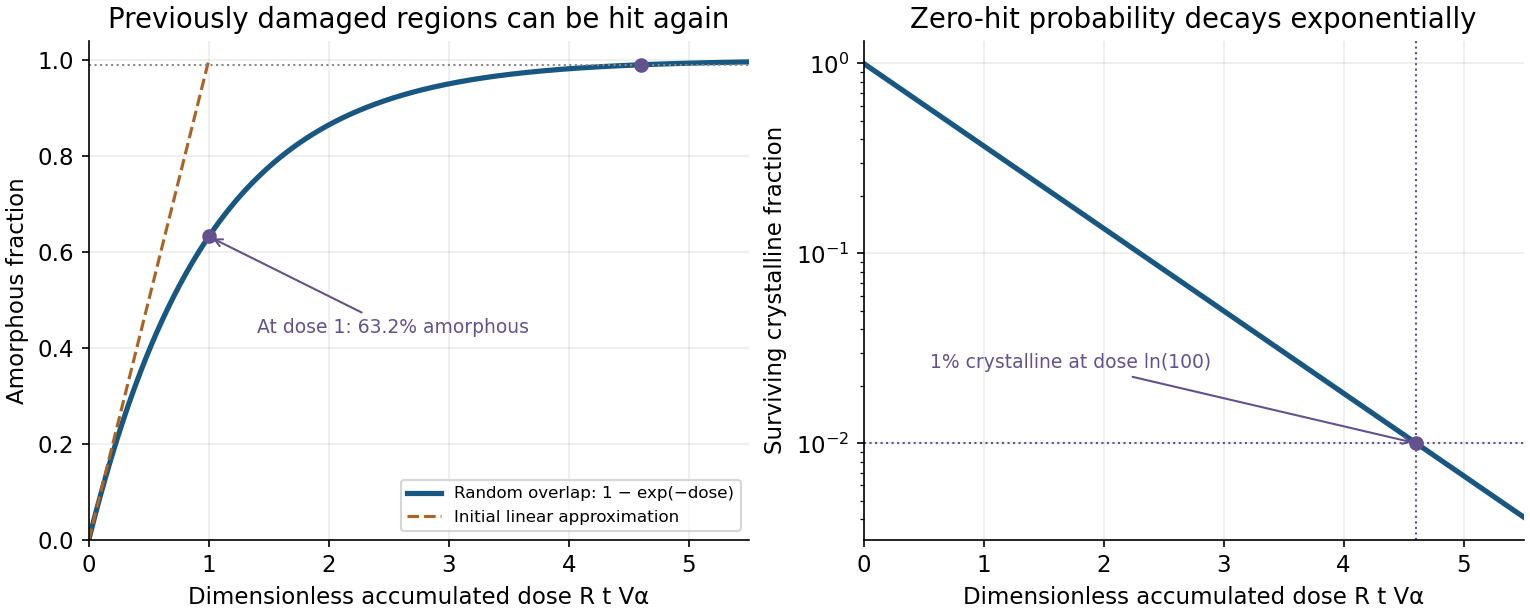

At small dose, ; at larger dose, overlap bends the curve towards one. For example, gives , not full radiation-induced amorphization, and requires .
The derivation assumes a homogeneous, initially crystalline material; independent random event locations; one-event radiation-induced amorphization of a fixed effective volume; and no recovery of that volume. It is the direct-impact model, not a model requiring several prior hits to cross a damage threshold. If varies while stays fixed, replace by . If annealing, material evolution or spatially correlated actinide distributions matter, this simple law need not hold. The subscript on indexes an alpha decay event: it does not require the emitted alpha particle itself to produce the damaged volume.
The assumption is a leading approximation for concentrated ballistic radiation damage, not an exact statement that the alpha particle displaces no atoms. The daughter has only about times the alpha particle's kinetic energy, but it is much slower and loses a much larger fraction of that energy in collisions with target nuclei. Those collisions initiate closely packed recoil cascades. The alpha particle deposits most of its much larger energy into the electronic system over a path hundreds of times longer, with a less concentrated displacement contribution.
Thus the dense region susceptible to one-event loss of crystalline order can reasonably be associated chiefly with the daughter recoil. This explains why the effective damaged volume in the direct-impact amorphization model can be estimated or fitted from recoil-dominated cascades. It is the spatial density and stopping channel of the damage, not simply which particle carries more energy, that matters.
The approximation has a measurable limit. Turcotte's comparison of actinide-dioxide self-damage and external alpha irradiation found a nonzero alpha contribution, reporting about of total damage in the studied case. Comparison of diffraction-derived lattice changes with internal-reference measurements helps separate real radiation-induced swelling from instrument shifts, while the distinction between self-decay and external-alpha irradiation probes the omitted recoil channel.[ref]
Alpha radiation damage in the actinide dioxides by R. P. Turcotte. BNWL-SA-5333, summary and experimental/results discussion; nonzero alpha damage and diffraction measurements
Consequently “all ballistic radiation damage” is useful as the stated model assumption but should not be promoted to an exact material-independent law. electronic excitation can also couple to structural change, and recovery alters what survives. The derivation in part (b) remains valid for an effective one-event volume fitted consistently to the relevant regime; it does not establish that all ceramics or spent fuels share the same or the same eventual amorphous fraction.
Articles by others on the same topic
There are currently no matching articles.