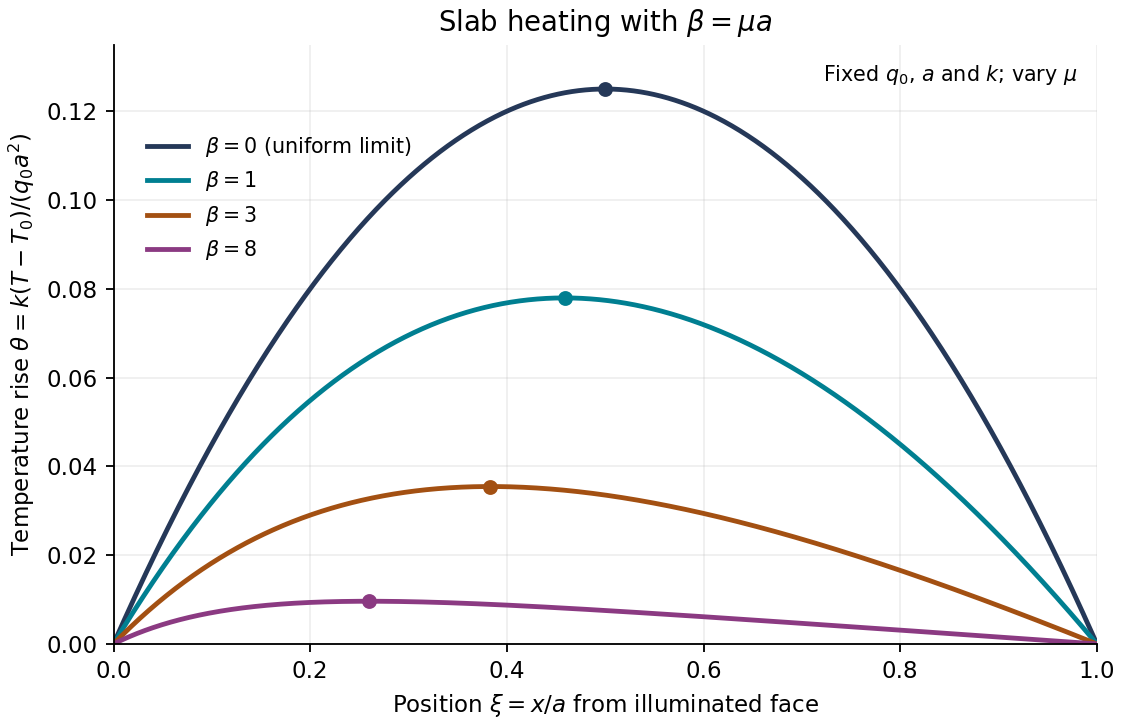
The graph holds the normalization q0a2/k fixed. Its decreasing peaks with increasing β reflect a decreasing source away from the illuminated face under that comparison; they do not assert the same trend at fixed total absorbed power.
The illuminated face removes more heat because heating is concentrated nearer it. Equivalently, weighting each source slice by the fraction of its heat conducted to either equal-temperature boundary gives
A decreasing source weights the left face more strongly. In the uniform-heating limit, each face removes q0a/2. If aheat removal rate rather than aflux is wanted, multiply the relevant expression by the face area.
Reduce incident photon intensity, intercept part of the beam in a separately cooled upstream shield, or distribute the deposited power over a larger cooled region. These reduce the relevant volumetric heat generation rate or local heat load. Intermittent exposure can reduce average heating, but the peak then requires a transient heat equationcalculation; a smaller average alone does not establish a safe pulse maximum.
Increase the effective thermal conductivity, for example through a suitable material or a well-bonded conductive path to aheat sink. Reduce contact thermal resistance in any added path. Material substitution must also satisfy shielding, mechanical and environmental constraints.
Shorten the maximum conduction distance by introducing cooled internal surfaces or dividing the shield into thinner, separately cooled layers. Reducing the thickness of a single slab lowers its temperature rise at fixed q0 and μ, but also reduces attenuation; it is not automatically an acceptable shield modification. A layered arrangement can preserve the required total shielding while changing the thermal boundary-value problem.
Do not change the attenuation coefficient independently of the heat-source normalization without explaining the comparison. At fixed incident photon energyflux, the entrance deposition q0 generally changes with absorption properties. A larger μ with artificially fixed q0 is a different experiment. Similarly, increasing total slab heat capacity delays heating but does not lower the steady state maximum for an unchanged source and unchanged thermal boundary conditions.
Use a common comparison for all of question2: retain the same number and height of fuel rods and approximately the same normalized rod-powershape; reduce fuel lattice pitch by making the active core cross-section smaller. Compare otherwise similar operating states of an initially under-moderated reactor, typical of a pressurized water reactor. Rod number, core height, reflector and control settings are not all fixed explicitly by the question, so these are stated assumptions. Keeping the external core envelope fixed while inserting more rods would be a different comparison.
Neutron leakage would usually tend to increase. The smaller transverse core extent increases the geometric tendency to leak, and reduced moderation generally increases the slowing-down distance. There are competing changes in fuel absorption, transport lengths and reflection. Thus a definite leakage fraction needs the actual core and reflectorarrangement; the usual increase is a qualitative tendency, not a geometric theorem for every redesign.
Continue the same-rod-number and same-height comparison from part(a), and assume unchanged pumpspeed, similar inlet conditions and single-phase forced flow for the normal-operation hydraulic argument.
The core pressure drop normally increases for the usual pumpcurve. Its resistance at any given flow is higher. At the new, smaller flow, unchanged external piping and component losses are smaller, whereas a conventional falling pump head-versus-flowcurve gives greater available head. The core takes the difference. This conclusionuses the stated pump-curve assumptions; holding flow fixed or holding pump head fixed would be different models. The exact new flow and pressure drop need both system and pump characteristics.
Fuel temperature would normally tend to rise, especially downstream, if the loss of flow increases coolant heating without a compensating improvement in filmheat transfer. At fixed inlet state,
A tighter core is likely to have a more demanding cooling response, but the specification does not determine a unique peak cladding temperature or reflood time in a loss-of-coolant accident. Several effects compete.
At the same pre-accident power and comparable irradiationhistory, the total decay heat source remains of broadly comparable scale; increasing core power density does not multiply the total decay power by the inverse change in core volume. The core nevertheless has less water within its tighter rod lattice. Its local thermal buffer is smaller, and the same heat must be removed through narrower passages. If the normal-operation fuel temperature is higher, more stored fuel thermal energy must also be removed after shutdown.
Reduced passage size and increased hydraulic resistance can impede emergency-coolant penetration and steam discharge during reflood. Local two-phase flow, entrainment and boilingheat transfer can change, so single-phase pump-curve reasoning is insufficient during blowdown and reflood. Less local water can favor earlier uncovering, but blowdown flow and the much larger inventory elsewhere in the unchanged primary circuit also matter. It would be unjustified to infer a proportionate reduction in the entire primary-circuit inventory.
A quantitative comparison needs break characteristics, initial states, emergency injection performance, bypass paths and a transient two-phase calculation. The defensible conclusion is potentially reduced thermal margin and more difficult reflood, requiring reassessment of the emergency core cooling system, rather than an unconditional prediction that every large-break transient becomes worse in every metric.
Higher conversion can support greater discharge burnup and a longer nuclear fuel cycle length, but neither follows automatically. The improvement tends to slow the loss of useful fissile inventory during irradiation. The same change of lattice, however, lowers beginning-of-cycle reactor reactivity under the usual under-moderated assumptions. With enrichment unchanged, the available initial reactivity margin may become inadequate before any later benefit from improved conversion can be realized.
For a constant-powerirradiation interval t, B=Pt/MHM. A longer achievable interval would consequently increase the burnup accumulated in that interval. This relation alone says nothing about whether that interval remains possible.
If sufficient initial reactor reactivity, shutdown capability and thermal margins are retained, slower depletion can allow increased discharge burnup and a longer cycle. If initial reactivity is too low, or the reduced boiling margin or fuel limits become controlling, either can instead decrease. Discharge burnup also depends on batch residence and refuelling strategy, so it is not generally identical to burnup accumulated in one operating cycle.
The appropriate qualitative answer is therefore conversion tends upward; achievable discharge burnup and cycle length are conditional on the full reactivity history and operating limits. An increased conversion ratio by itself does not determine a longer cycle.
The mechanical-test temperature also matters. Material irradiated cold can become embrittled during subsequent hot testing or service when trapped gas and defects become mobile. Distinguish gasproduction during irradiation from the later conditions under which its mechanical consequences are expressed.
Irradiation softening occurs when irradiation removes pre-existing strengthening obstacles faster than it creates new ones. It is particularly plausible in an initially hardened alloy, rather than an initially soft annealed reference.
where μ is the shear modulus, b the magnitude of the Burgers vector, ρd the dislocation density, and the last two terms represent precipitate and irradiation-obstacle strengthening. It is an illustrative decomposition, not an exact additive law for every alloy. A sufficiently large decrease in the pre-existing contributions can exceed the increase in Δσirr.
In a material strengthened by precipitation hardening, ballistic mixing can dissolve or disorder the original obstacles. Radiation-enhanced diffusion can change their composition or accelerate coarsening; increasing obstacle spacing can reduce strength. In an ordered alloy, irradiation-induced loss of order can also remove a strengthening contribution. None of these outcomes is inevitable: irradiation can instead create new strengthening precipitates.
At sufficiently high temperature, thermal material creep can dominate. Changes in microstructure caused by irradiation hardening, softening, bubbles and cavities can either alter the creep rate or shorten rupture life. Thus enhanced defect-driven creep is the central effect, while the net rate and lifetime remain material- and history-dependent.
Assume a homogeneous Fe–Cr–Ni alloy, normal incidence, independent scatteringevents and the stated effective scattering cross-sections. Neglect absorption, other constituents and changes in neutronenergy within the thin sheet. The atomic fractions are not supplied; take xFe=0.70, xCr=0.20, xNi=0.10as an explicit representative assumption, not a composition measured or specified in the paper.
Thus Σs=27.751m−1. For thickness t=10−3m, the unscattered fraction U satisfies dU/dz=−ΣsU with U(0)=1. The fraction undergoing at least one neutron scatteringevent is
The thin-sheet approximation gives Ps≃Σst=2.78%, consistent to the accuracy of the assumed composition. A simple iron-dominated estimate σˉs≃3.2barns gives essentially the same about 3% scatteredconclusion.
For any other assumed composition, use the displayed weighted formula; mass fractions must first be converted to atomic fractions. Since the supplied elemental cross-sections span 2.8–4.1barns, any mixture of these three elements at the stated number density gives approximately 2.39–3.48%. This is a bound within the idealized mixture model, not a claim that every such composition is stable austenite.
There is also acounting convention in “other atoms”: 430 counts secondary displacements, while including the displaced primary knock-on atom itself gives ν=431. The corresponding first-collision result is 54.58 rather than 54.45 dpa, an increase of only 0.23%. Both conventions round to about 55 dpa. The numerical estimate is explicitly conditional on assigning the stated displacement yield to each scatteringevent.
Original solutions to both printed questions. The University of Cambridge release occupies physical PDF pages 37–40, with the question body on pages 38–39. [ref]
The fuel-cycle account uses the stated assays and explicitly identifies the assumed full-poweryear. The chemical-separation answer has a visible conceptual scope limitation.
Conceptual scope: the safe account below describes the functions of spent nuclear fuelmanagement and the chemical basis of partitioning. It does not supply an ordered fissile-separation flowsheet, reagents, process conditions or purification instructions. In particular, the requested operational eight-step separation scheme is outside this answer's scope.
The remaining natural feed is 313.36245tUyr−1, a 9.885% resource saving relative to the full-power once-through requirement. This credits one uranium recycle only; it adds no second-pass recycling or plutonium credit.
Asa whole-cycle check, the fresh route requires 215668.0851 kg-SWU per year, while the mixed fresh-plus-recycled supply requires 214075.3261 kg-SWU. The net saving is only 0.7385% of the original work. The recovered stream has a higher uranium-235 assay than natural feed, but the higher required product assay uses most of the work credit. These equations are resource accounting and do not specify an uranium enrichmentplant or its operation.
Resource savings do not by themselves establish a financial saving. The one-recycle case avoids purchasing 34374.04 kg U in natural feed and 1592.76 kg-SWU per year. Those are the benefits to compare with the incremental costs, not the whole value of the recovered uranium or the gross avoided fresh-product separative work.
Let pU be the concentrate price per kilogram of uranium, pS the price per kg-SWU, and Cadd the annual net extra cost of recovery, recycle-specific conversion and fabrication, wastemanagement and financing, relative to the once-through alternative. Recycling is cheaper under this simplified boundary only if
An avoided spent-fuel-disposal charge belongs asa credit in Cadd; a new radioactive waste conditioning or disposal liability belongs asa cost. They must not both be assigned the same sign simply because each concerns waste.
The natural-uranium saving is appreciable, but the fractional separative-work saving is small. Recovery losses and the uranium-236 compensation limit the value of recycling. Additional radiological handling, separate fabrication campaigns, secondary waste streams, capital tied up during storage and recovery, and uncertain future disposal costs can matter. Conversely, a higher natural-uranium price, a lower incremental recovery cost or an independently justified disposal credit can favour reuse. The calculation gives a conditional comparison, not a uniquely determined economic verdict or market-price threshold, because no costs are supplied. plutonium utilisation is a different option and has not been silently credited to this uranium-only recycle.
Here Q is the kinetic energy available to this branch; excitation of the daughter reduces it and may be followed by photon emission. For an illustrative Q=5 MeV, mα=4u and Md=236u, the energies are 4.917 MeV in the alpha particle and 83.3 keV in the daughter. The heavy daughter receives much less energy, but that does not imply much less atomic damage.
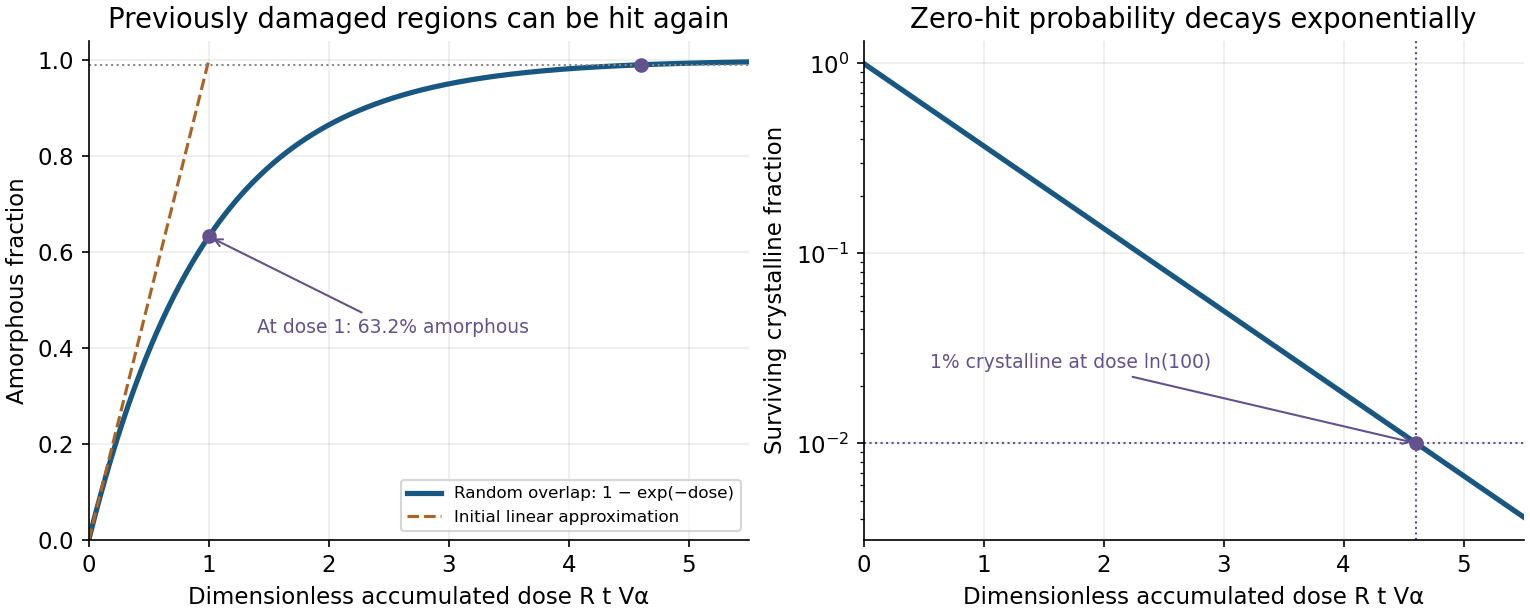
An independent probability interpretation reaches the same result. A particular point is covered by anumber of random damage events with a Poisson distribution of mean DVα. Its probability of remaining crystalline is the zero-hit probabilitye−DVα; the complementary fraction has been hit at least once. Overlapping events do not create asecond copy of already amorphous material.
At small dose, fa≃DVα; at larger dose, overlap bends the curve towards one. For example, DVα=1 gives fa=0.6321, not full radiation-induced amorphization, and fa=0.99 requires DVα=ln100=4.6052.
The derivation assumes a homogeneous, initially crystalline material; independent random eventlocations; one-event radiation-induced amorphization of a fixed effective volume; and no recovery of that volume. It is the direct-impact model, not amodel requiring several prior hits to cross a damage threshold. If R varies while Vα stays fixed, replace Rt by ∫0tR(s)ds. If annealing, material evolution or spatially correlated actinide distributions matter, this simple law need not hold. The subscript on Vα indexes an alpha decayevent: it does not require the emitted alpha particle itself to produce the damaged volume.
Thus the dense region susceptible to one-event loss of crystalline order can reasonably be associated chiefly with the daughter recoil. This explains why the effective damaged volume in the direct-impact amorphization model can be estimated or fitted from recoil-dominated cascades. It is the spatial density and stopping channel of the damage, not simply which particle carries more energy, that matters.
The approximationhas a measurable limit. Turcotte's comparison of actinide-dioxide self-damage and external alpha irradiation found a nonzero alpha contribution, reporting about 19% of total damage in the studied case. Comparison of diffraction-derived lattice changes with internal-reference measurements helps separate real radiation-induced swelling from instrument shifts, while the distinction between self-decay and external-alpha irradiation probes the omitted recoil channel.[ref]
Consequently “all ballistic radiation damage” is usefulas the stated model assumption but should not be promoted to an exact material-independent law. electronic excitation can also couple to structural change, and recovery alters what survives. The derivation in part (b) remains valid for an effective one-eventvolume fitted consistently to the relevant regime; it does not establish that all ceramics or spent fuels share the same Vα or the same eventual amorphous fraction.