Use the standard repeated game convention that the first round's joint action is observed before round two. The following original game tree represents simultaneous moves by making row move first in each round while hiding that current move from column. Terminal labels are total payoffs over both rounds, ordered row then column.
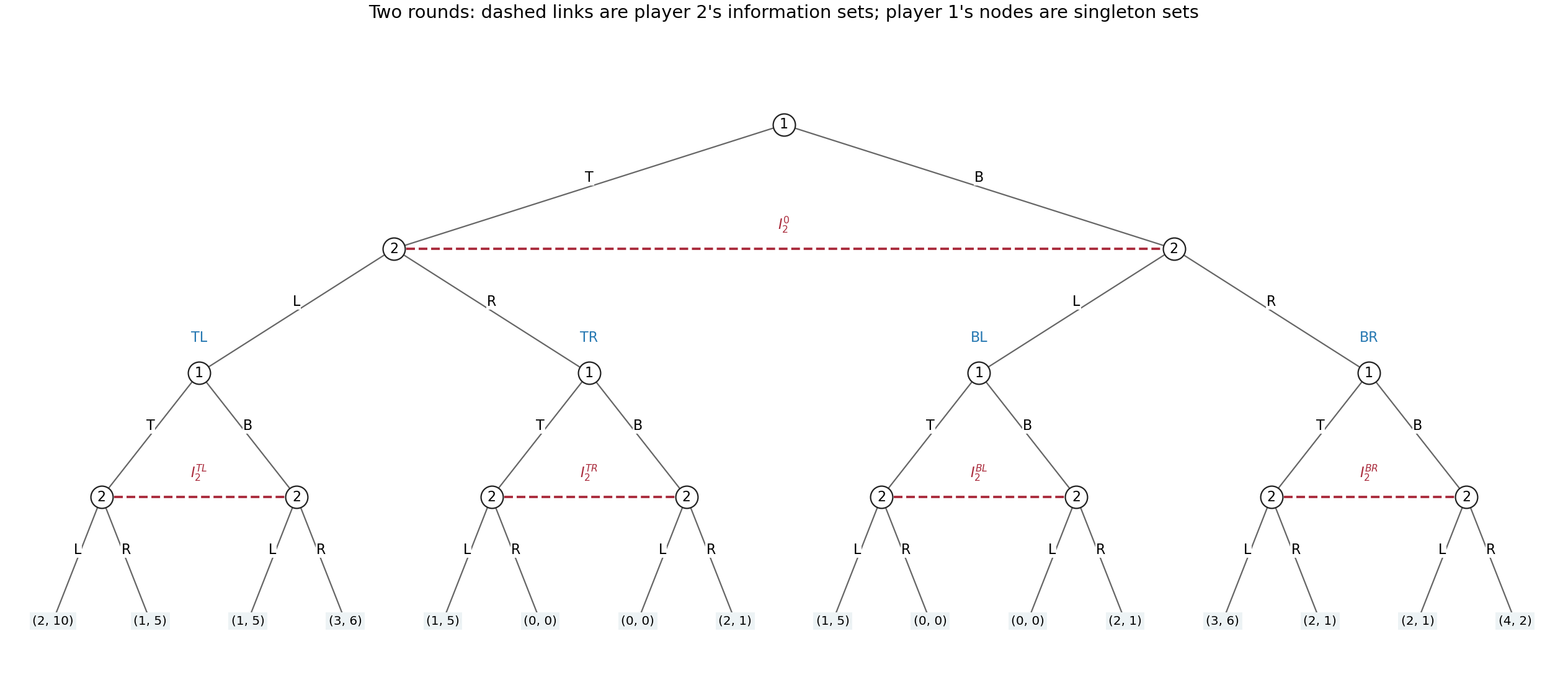
The full two-round extensive-form game, with all sixteen terminal payoff pairs and five column information sets
. Details. 
Formally, round one starts at a row decision with actions . The two ensuing column nodes form one information set , with available actions ; column cannot tell which current row action occurred. The four completed first-round histories are . At each , round two begins at a separate row node. Its two successors, after row's current or , form a column information set . Distinct have distinct information sets: both players know the whole first-round outcome. There are sixteen terminal histories , whose total payoff is , as displayed in the tree.
The row player's five information sets are the initial singleton and the four singleton round-two nodes, one per . The column player's five information sets are and the four two-node sets . Thus each player must specify one binary choice at each of five information sets, including histories that its own first choice might prevent:Counting only the four possible two-round action sequences would miss the distinct contingent responses to the opponent's first action.
For a concrete pair of complete pure strategies, order the second-round histories as and useThe first entry is the initial action, and the four remaining entries prescribe the action after each first-round history. This induces the unique path in round one followed by in round two. Hence the total payoff isThe off-path entries are part of each pure strategy, even though this pair does not reach them.
For randomization, a mixed strategy is a probability distribution over the complete plans, with free probabilities in a general distribution. A behavioural strategy instead gives one binary-action probability at each of five information sets, requiring five parameters. This game has perfect recall: a player never forgets a previous own action or a first-round observation, and the only concealed action is the opponent's current simultaneous choice. Consequently neither kind of randomization has a greater attainable-payoff advantage: Kuhn's theorem gives realization-equivalent strategies against every fixed opposing strategy.[ref]
Extensive games and the problem of information by Harold W. Kuhn. original article, pp. 193–216, equivalence under perfect recall
The equivalence can be verified directly here. Given a behavioural strategy, sample all five contingent actions independently before play; the resulting product probability distribution over complete plans is an equivalent mixed strategy. Conversely, let be a mixed strategy for player . Use its marginal probability for the initial action. At history containing own first action , choose second action with conditional probabilitywhenever the denominator is positive; if it is zero, choose arbitrarily at that unreachable history. The opponent's first-round action is simultaneous and cannot depend on the sampled hidden plan beyond the chosen first action. Thus conditioning on preserves exactly these conditional probabilities of actions, and multiplying the first- and second-round factors reproduces each terminal probability. Correlations between prescriptions at mutually exclusive second-round histories have no further observable effect. Behavioural strategies offer the more compact representation, while mixed strategies describe a single random choice of a full plan. Imperfect information here does not mean imperfect recall.
Articles by others on the same topic
There are currently no matching articles.