Birefringence is polarization-dependent propagation in an optically anisotropic medium. Its permittivity tensor relates to . In a lossless uniaxial dielectric, take the optic axis along and the principal relative permittivities as . For a wave vector making angle with that axis, the ordinary mode has index , while the extraordinary phase-index angular dependence isThe ordinary electric field is perpendicular to the plane containing the wave vector and optic axis. The extraordinary electric displacement field lies in that plane and is perpendicular to the wave vector, but its electric field need not be. Its energy-flow direction can therefore differ from the wave-normal direction: birefringent walk-off. Along the optic axis the two indices coincide. Refraction generally splits an incident beam into two differently polarized rays, producing double images, as in calcite.
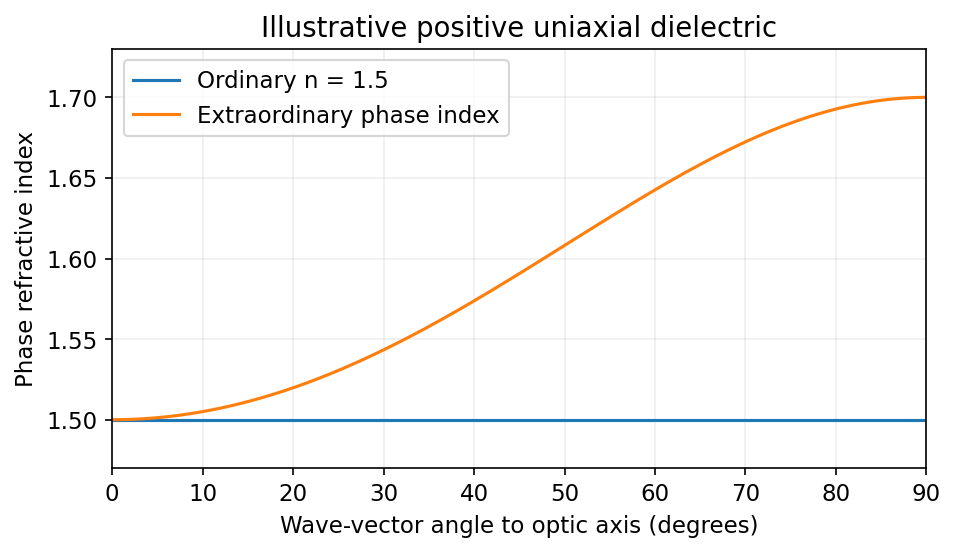
Illustrative positive-uniaxial ordinary and extraordinary phase indices coincide along the optic axis
. Source. Details. A waveplate instead uses the relative phase of two eigenpolarizations. With the axes chosen for the propagation direction, the retardance is . A quarter-wave plate gives modulo and converts equal-amplitude orthogonal components between linear and circular polarization. A half-wave plate gives and rotates a linear polarization. This is a phase effect; unequal absorption is a separate property.[ref]
Polarisation by Sander Konijnenberg, Aurèle J.L. Adam and H. Paul Urbach. Creating Different Polarisation States; wave plates and relative phase
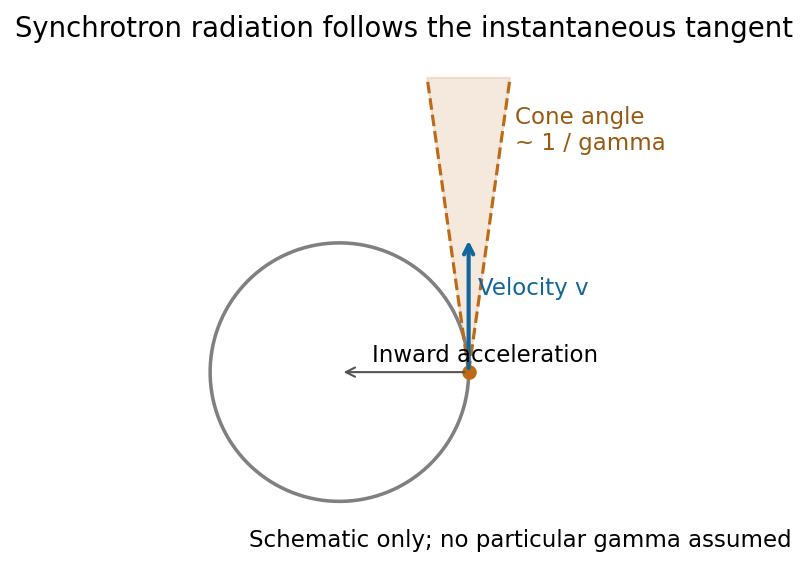
Synchrotron radiation is radiation from relativistic charges undergoing transverse acceleration, for example electrons bent by a magnetic field. Relativistic aberration concentrates the radiation within an angle of order about the instantaneous velocity. An observer sees short pulses as this cone sweeps past; synchrotron pulse compression produces a broad spectrum extending far above the orbital frequency.
For an ultrarelativistic circular trajectory of curvature radius , the characteristic scales are[ref]
Synchrotron Radiation in the Geant4 Physics Reference Manual by Geant4 Collaboration. Critical energy and critical mode number
The synchrotron critical frequency sets the spectral turnover; it is not a sharp upper cutoff. The transverse-acceleration Lienard formula givesThe strong energy dependence is a major loss mechanism in electron storage rings. Radiation observed in the orbital plane is linearly polarized in that plane; away from it the two components generally produce elliptical polarization, with opposite handedness on opposite sides. Accelerator light sources exploit its brightness, broad tunable spectrum and pulsed timing. At low speeds the relativistic beaming and high-frequency extension disappear, approaching ordinary cyclotron radiation.[ref]Synchrotron Radiation by Richard Fitzpatrick. Relativistic radiation cone, pulse compression and synchrotron spectrum
A photonic crystal has a spatially periodic dielectric response on the scale of the optical wavelength. For a nonmagnetic, lossless, nondispersive dielectric, the source-free Maxwell equations can be written as the eigenproblemThe Bloch theorem gives with periodic . The allowed frequencies form photonic band structures. Coupling of counterpropagating waves near a Brillouin zone boundary opens a stop band. A one-dimensional dielectric multilayer is a simple example; two-dimensional hole arrays and three-dimensional dielectric networks allow more extensive control.
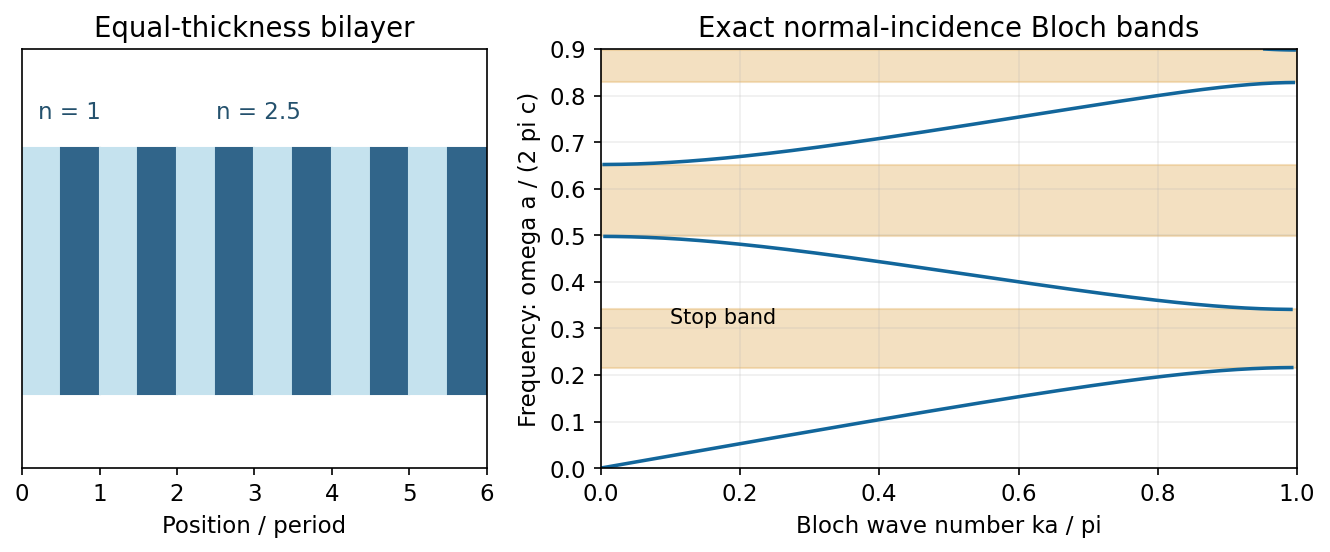


A complete photonic band gap excludes bulk propagating modes for every direction and polarization in a frequency interval. Periodicity alone does not guarantee such a gap: dimensionality, symmetry and refractive-index contrast matter. A missing or altered element can support a localized defect state in the gap, making a cavity; a line defect can guide light. Finite crystals have leakage and wavelength-dependent transmission rather than an infinitely sharp exclusion. Applications include selective mirrors, optical filters, small resonators and integrated waveguides.[ref]
Mathematical Methods in Nanophotonics, MIT 18.369, Spring 2016 by Steven G. Johnson. Lecture 2: Maxwell eigenproblem; lectures 9–14: Bloch states, one-dimensional gaps and defect localization
Articles by others on the same topic
There are currently no matching articles.