Interpreting the cone as Cherenkov radiation, its angle gives the speed, not directly the mass:Combining this with the relativistic kinetic energy gives the Cherenkov mass inferenceThe material must be transparent at the observed frequency, is its phase refractive index there, and . For this requires for a massive particle above threshold. Radiation of an unspecified other origin would not determine the mass from these data alone.
The transverse spatial coherence width is much larger than the longitudinal coherence length. The longitudinal scale is controlled by spectral bandwidth:For broad, unfiltered visible sunlight it is of order a wavelength to a few wavelengths, roughly . This is an order-of-magnitude scale, not a uniquely defined solar constant; the precise value depends on spectral response and the coherence-width convention.
The Sun subtends angular diameter at one astronomical unit.[ref]
Sun Fact Sheet by National Aeronautics and Space Administration. Sun Observational Parameters: apparent diameter at 1 A.U.
Consequently the sunlight coherence comparison gives a transverse scaleusing only as an illustrative visible wavelength. The uniform-disk spatial coherence model has first coherence zero at , about at that wavelength. The small angular size permits coherence across tens of micrometres, while the broad spectrum destroys coherence over much shorter path differences. Spectral filtering increases ; spatial filtering changes the transverse scale.[ref]Interference and Coherence by Sander Konijnenberg, Aurèle J.L. Adam and H. Paul Urbach. Coherence of Light Sources; More on Spatial Coherence
Write . For a slowly evolving circular Coulomb orbit, force balance and the mechanical energy giveThe supplied Larmor formula therefore yieldsSet . Since ,Thus the classical radiation collapse of a Coulomb orbit obeysThe decreasing mechanical energy means a more tightly bound orbit, not a smaller speed. The formal collapse time is . The nonrelativistic, small-loss-per-orbit approximation eventually fails; the result demonstrates the classical instability rather than describing an actual hydrogen atom.
Birefringence is polarization-dependent propagation in an optically anisotropic medium. Its permittivity tensor relates to . In a lossless uniaxial dielectric, take the optic axis along and the principal relative permittivities as . For a wave vector making angle with that axis, the ordinary mode has index , while the extraordinary phase-index angular dependence isThe ordinary electric field is perpendicular to the plane containing the wave vector and optic axis. The extraordinary electric displacement field lies in that plane and is perpendicular to the wave vector, but its electric field need not be. Its energy-flow direction can therefore differ from the wave-normal direction: birefringent walk-off. Along the optic axis the two indices coincide. Refraction generally splits an incident beam into two differently polarized rays, producing double images, as in calcite.
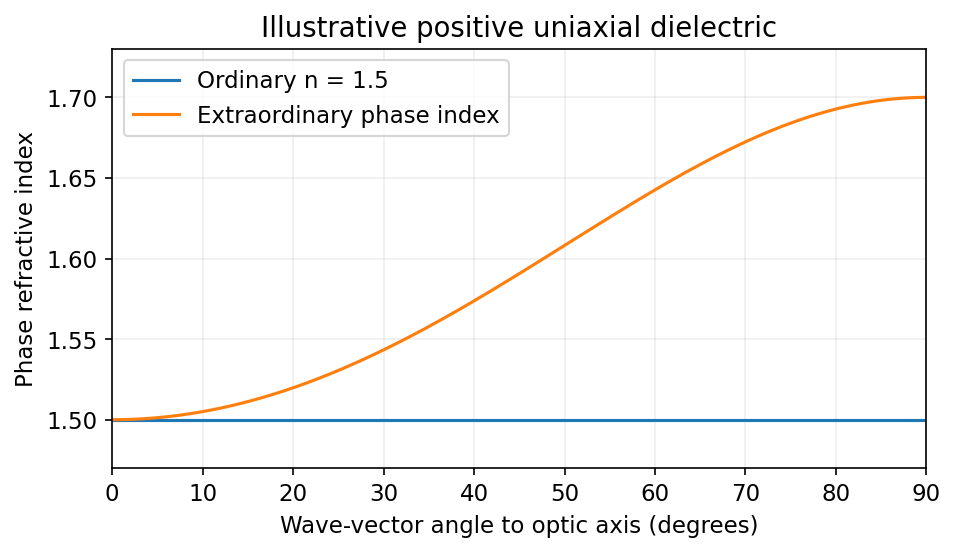
Illustrative positive-uniaxial ordinary and extraordinary phase indices coincide along the optic axis
. Source. Details. A waveplate instead uses the relative phase of two eigenpolarizations. With the axes chosen for the propagation direction, the retardance is . A quarter-wave plate gives modulo and converts equal-amplitude orthogonal components between linear and circular polarization. A half-wave plate gives and rotates a linear polarization. This is a phase effect; unequal absorption is a separate property.[ref]
Polarisation by Sander Konijnenberg, Aurèle J.L. Adam and H. Paul Urbach. Creating Different Polarisation States; wave plates and relative phase
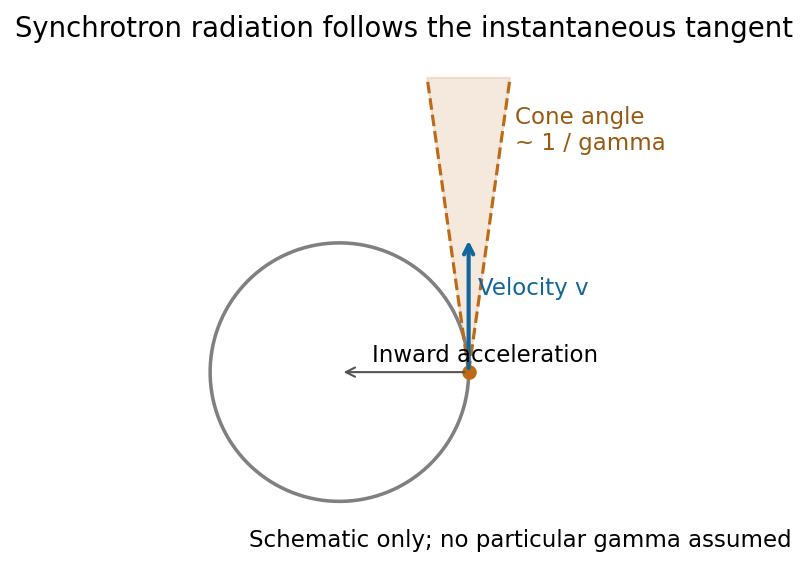
Synchrotron radiation is radiation from relativistic charges undergoing transverse acceleration, for example electrons bent by a magnetic field. Relativistic aberration concentrates the radiation within an angle of order about the instantaneous velocity. An observer sees short pulses as this cone sweeps past; synchrotron pulse compression produces a broad spectrum extending far above the orbital frequency.
For an ultrarelativistic circular trajectory of curvature radius , the characteristic scales are[ref]
Synchrotron Radiation in the Geant4 Physics Reference Manual by Geant4 Collaboration. Critical energy and critical mode number
The synchrotron critical frequency sets the spectral turnover; it is not a sharp upper cutoff. The transverse-acceleration Lienard formula givesThe strong energy dependence is a major loss mechanism in electron storage rings. Radiation observed in the orbital plane is linearly polarized in that plane; away from it the two components generally produce elliptical polarization, with opposite handedness on opposite sides. Accelerator light sources exploit its brightness, broad tunable spectrum and pulsed timing. At low speeds the relativistic beaming and high-frequency extension disappear, approaching ordinary cyclotron radiation.[ref]Synchrotron Radiation by Richard Fitzpatrick. Relativistic radiation cone, pulse compression and synchrotron spectrum
A photonic crystal has a spatially periodic dielectric response on the scale of the optical wavelength. For a nonmagnetic, lossless, nondispersive dielectric, the source-free Maxwell equations can be written as the eigenproblemThe Bloch theorem gives with periodic . The allowed frequencies form photonic band structures. Coupling of counterpropagating waves near a Brillouin zone boundary opens a stop band. A one-dimensional dielectric multilayer is a simple example; two-dimensional hole arrays and three-dimensional dielectric networks allow more extensive control.
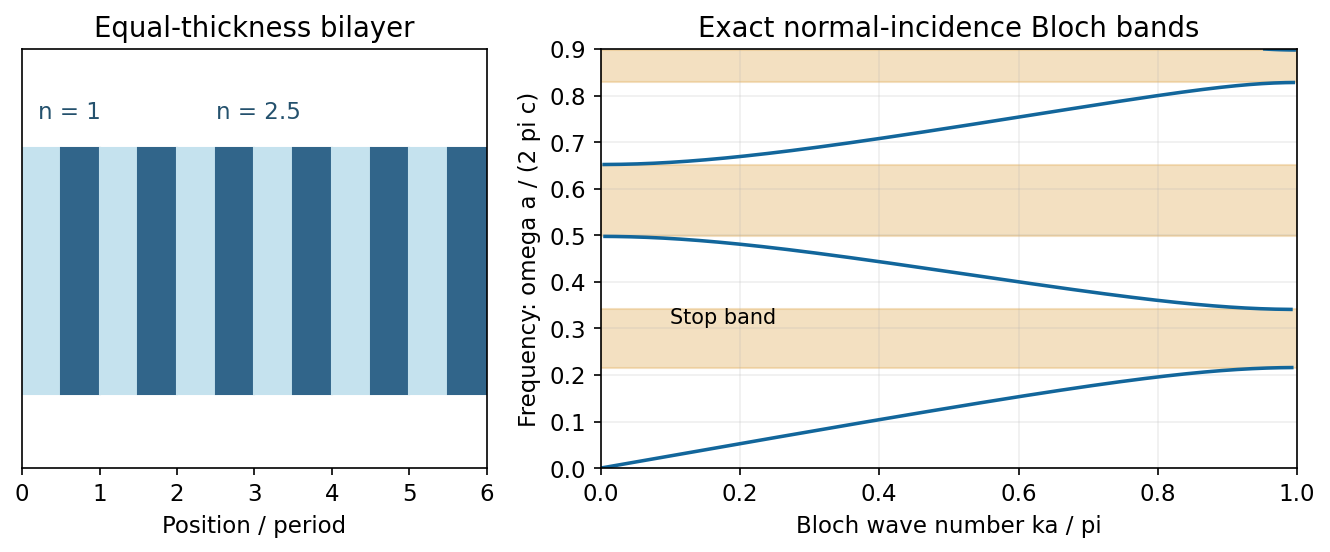
A complete photonic band gap excludes bulk propagating modes for every direction and polarization in a frequency interval. Periodicity alone does not guarantee such a gap: dimensionality, symmetry and refractive-index contrast matter. A missing or altered element can support a localized defect state in the gap, making a cavity; a line defect can guide light. Finite crystals have leakage and wavelength-dependent transmission rather than an infinitely sharp exclusion. Applications include selective mirrors, optical filters, small resonators and integrated waveguides.[ref]
Mathematical Methods in Nanophotonics, MIT 18.369, Spring 2016 by Steven G. Johnson. Lecture 2: Maxwell eigenproblem; lectures 9–14: Bloch states, one-dimensional gaps and defect localization
The magnetic vector potential is defined by . The gauge transformationleaves both and unchanged. In magnetostatics choose the Coulomb gauge . Then Ampère's law and the curl-of-curl identity giveThe free-space Green function identity therefore givesThe boundary condition selects the homogeneous solution; the usual decay condition assumes suitably localized sources. An infinitely long static wire needs a reference for its logarithmically divergent potential, although its magnetic field is finite away from the wire.
For time-dependent sources use the Lorenz gauge, , and the outgoing retarded potentialThe scalar potential has the analogous retarded charge-density integral. The two gauges should not be conflated for a general time-dependent source.[ref]
Retarded Potentials by Richard Fitzpatrick. Equations (73)–(76): Lorenz-gauge retarded scalar and vector potentials
For the prescribed uncharged wire, and is consistent. Translation invariance makes with , so this particular solution satisfies both gauge conditions. With ,It is zero for . For , set . The causal interval is , giving the switched infinite-wire retarded potentialDifferentiation gives the fields and Poynting vector, for , :Here and . All three fields vanish before arrival. For positive , opposes the imposed current and the radial energy flow after switching a line current points radially outward: .
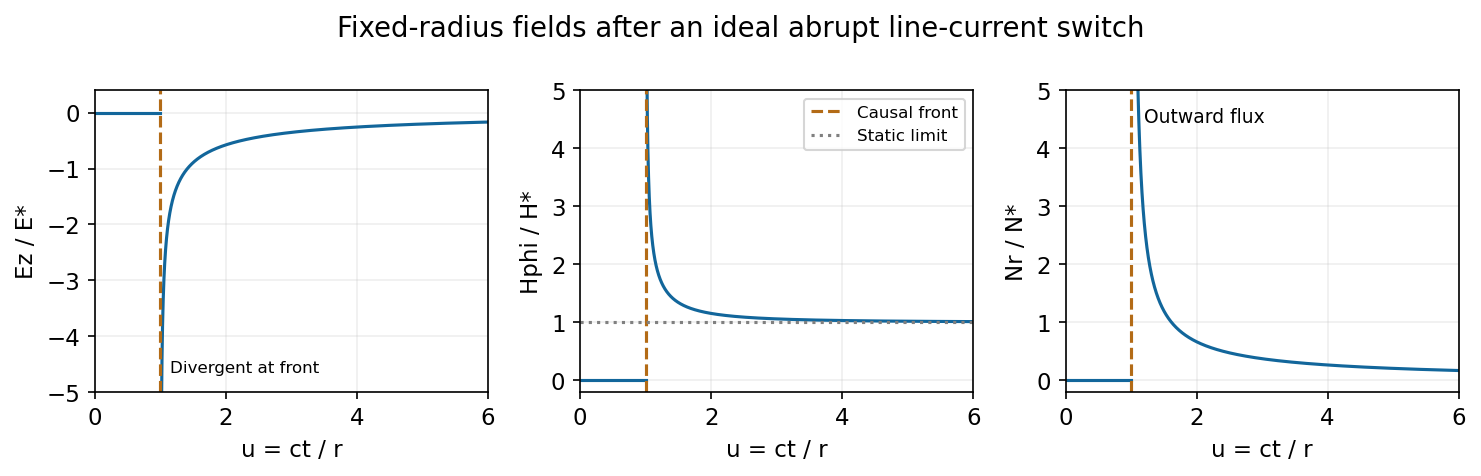
At fixed radius the causal fields start at t equals r over c and relax toward the magnetostatic limit
. Source. Details. For the graph, let . Normalized to , and , the curves areAt the wavefront, and diverge as and as . This abrupt line-current wavefront singularity reflects the ideal instantaneous turn-on of a line current; a finite rise time smooths the front. At late times,The vector potential grows logarithmically with time in this infinite-wire idealization even as the local magnetic field approaches its static limit. The divergent front should not be interpreted as a finite-energy pulse from a real instantaneous switching experiment.
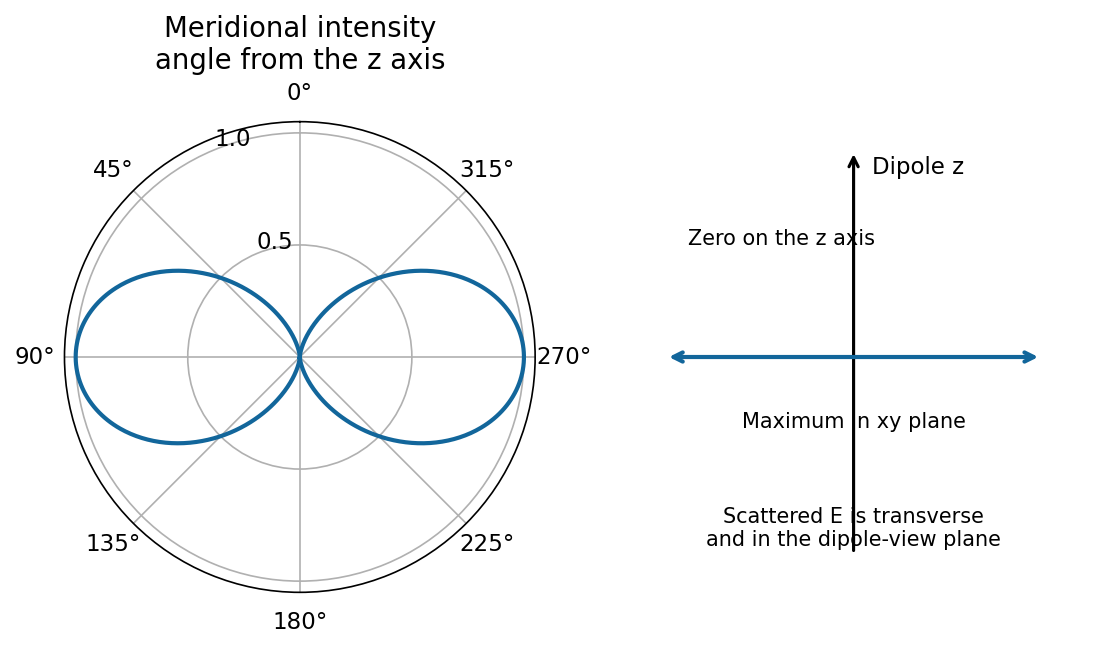
Spherical-particle frequency scaling. For a dielectric sphere of radius , the quasistatic electric polarizability isThe electric dipole radiation formula and giveThus Rayleigh scattering scales as , or , when the polarizability varies slowly with frequency. Material resonances and absorption can change this simple scaling. For the incident polarization, the dipole is along : intensity is proportional to , where is the angle from . There is no radiation on the dipole axis and a maximum in the plane. In a direction the scattered electric field is along , hence linearly polarized wherever nonzero.[ref]
Rayleigh Scattering by Richard Fitzpatrick. Small-particle dipole response and inverse-fourth-power wavelength dependence


Needle model used in parts (a)–(d). Let its axis be . A very slender, high-permittivity needle has dominant longitudinal response, so use the rank-one needle polarizability . Its transverse response is neglected at leading order. For observation along , define , andFor a unit incident Jones vector , the common far-field relation is , and . Here is irradiance at distance ; multiplying by gives power per solid angle. No absolute value of is given or needed for the requested relative intensities.
Diffuse random cloud, with the incident polarization of (a). The single-particle amplitudes through and analysers are proportional to and . The isotropic orientation fourth moment gives the needle-scattering analyzer momentsFor example, ; symmetry and give . Since the particles scatter mutually incoherently, intensities add. For illuminated particles,The cross correlation vanishes by reflection symmetry. The degree of linear polarization is : random anisotropic scatterers produce partially depolarized light, even though every individual needle produces a single linear polarization.
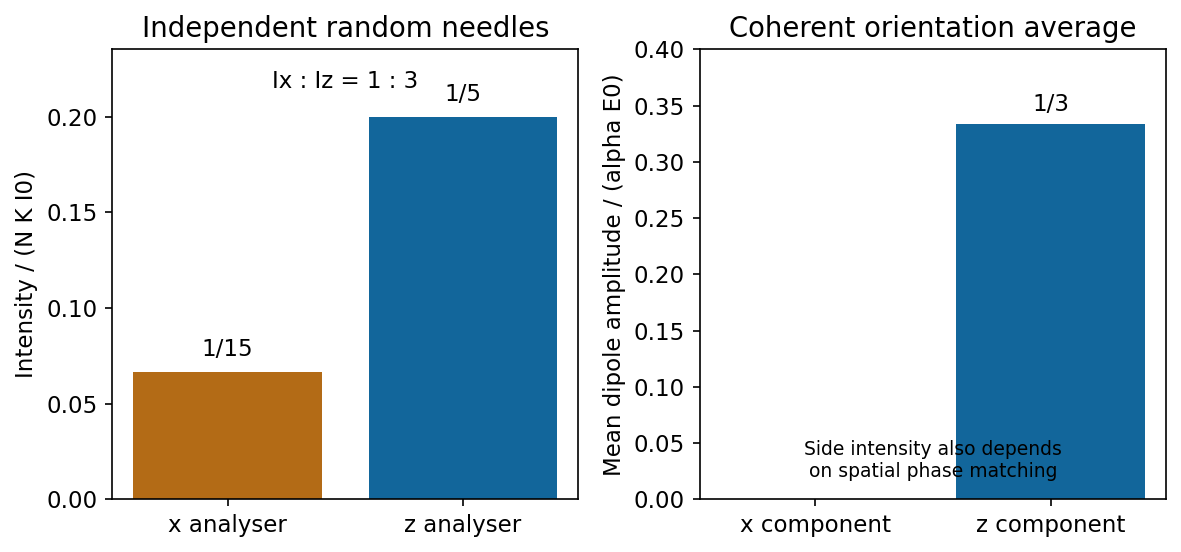
Independent isotropically oriented needles give the analyser ratio one to three, while coherent mean amplitudes have no x component
. Source. Details. 
Continuous homogeneous dielectric. One must sum amplitudes coherently and include their spatial phases, rather than retain the preceding sum of intensities. Random orientations give , so the averaged response is isotropic and its induced polarization is along . Its coherent radiation toward , when allowed by the sample geometry, is therefore purely polarized, with . The independent-needle prefactor is no longer a quantitative dense-medium model; local-field and collective effects determine the effective permittivity.
There is also coherent continuum phase matching: a uniform bulk driven by a plane wave has no arbitrary outgoing plane-wave component. In an ideal infinite homogeneous medium there is no diffuse side scattering at all; propagation, refraction and reflection are determined by the medium and its interfaces. A finite sample's coherent side signal depends on its shape and boundaries. Thus the old diffuse ratio is replaced by a coherent isotropic-medium response, not by a universal nonzero side-scattering intensity.
Using the needle definitions in the question-level solution, . The scattered field is parallel to , andThe light is linearly polarized along the needle's projection into the observation plane. Its Jones vector in the basis is whenever the intensity is nonzero. A needle perpendicular to the incident electric field, or pointing directly at the observer, has zero leading-order signal.
Now , soWhenever nonzero, the scattered light has the same linear polarization along as in (a). Although the incident field points toward the observer, the tilted anisotropic needle can induce a dipole component perpendicular to that direction. An isotropic sphere would instead have an axial radiation zero for this incident polarization.
Choose one circular convention as with time dependence . Reversing the handedness convention changes the sign of but not the result here. The scattered complex amplitude isThe scalar factor contributes a common phase to both output components. Consequently the scattered wave is linearly polarized along , rather than circular or elliptical, withThe dominant longitudinal needle response has rank one, so both incident circular components emerge in the same real output direction.
Unpolarized incident light has equal, mutually incoherent - and -polarized intensities. Both components scatter into the same direction , so their coherency matrices add toThis matrix has rank one when the signal is nonzero. The light is therefore fully linearly polarized along , withA fixed highly anisotropic needle can act as a polarizing scatterer even for unpolarized input. The equality of total intensities with (c) does not mean the incident states were identical. These conclusions use the leading longitudinal-polarizability approximation; finite transverse response can change the polarization purity.
Articles by others on the same topic
There are currently no matching articles.