Molecules in clean air are much smaller than visible wavelengths. Their induced electric dipole moments undergo Rayleigh scattering. Away from molecular resonances, the induced dipole amplitude is approximately , with only weak wavelength variation in the polarizability . The radiation-zone electric field is proportional to , so the scattered intensity satisfiesThis is the Rayleigh scattering wavelength dependence. For equal incident intensities, light scatters about times as strongly as light. Thus light scattered out of the direct solar beam and into our line of sight is enriched in blue wavelengths.
The dipole mechanism also determines the Rayleigh scattering angular pattern. For unpolarized light, its angular factor is ; near scattering, the scattered light has strong linear polarization. The sky's perceived colour depends additionally on the solar spectrum, atmospheric transmission and the eye's spectral response, so the law alone does not predict a violet sky. Over a long near-horizontal path the direct beam loses more short-wavelength light, explaining red sunsets. Large aerosol particles instead produce Mie scattering, which is less strongly wavelength-selective and can make haze look whitish.
A phased array uses fixed antennas driven coherently, with adjustable electronic delays or phases. Changing those relative phases changes the direction of constructive interference.
For identical elements at , take time dependence and feed phase . In a far-field direction at angle from the array normal, the array factor isMultiply by the single-element antenna beam pattern to obtain the total angular intensity. All elements add in phase in the selected direction ifThus electronic control of steers the beam to without moving an element. Reciprocity gives the corresponding directionality in reception.
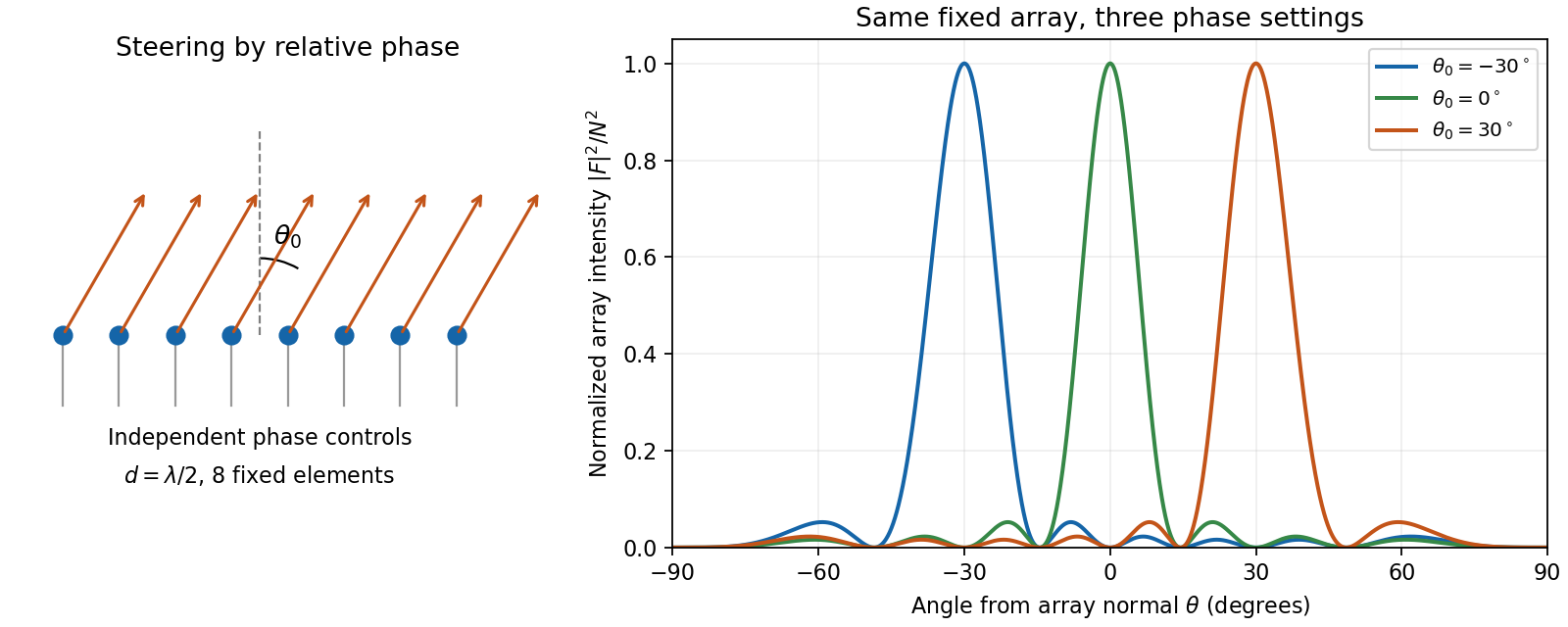
An electronically steered linear array and its normalized array factors
. Details. The aperture controls angular resolution: the nearest nulls obey , giving a main-beam width of order away from endfire. Additional equally strong maxima can occur when ; these are grating lobes. Choosing avoids them for all steering directions, with the usual limiting spacing. Amplitude tapering reduces side lobes at the cost of a wider main beam. For a broad frequency band, true time delays preserve steering more accurately than frequency-independent phase shifts.
A charge moving uniformly through a transparent dielectric can emit Cherenkov radiation if its speed exceeds the phase velocity of light in that medium:It need not exceed the vacuum speed . The passing charge polarizes the medium; the induced response produces radiation that adds coherently along selected directions. Equivalently, phase matching along the trajectory requires . Since ,Here is the angle of the emitted light rays to the forward particle velocity: the rays form a cone around the track. With dispersion, both the threshold and cone angle depend on frequency; only transparent frequency bands satisfying the threshold contribute escaping radiation.
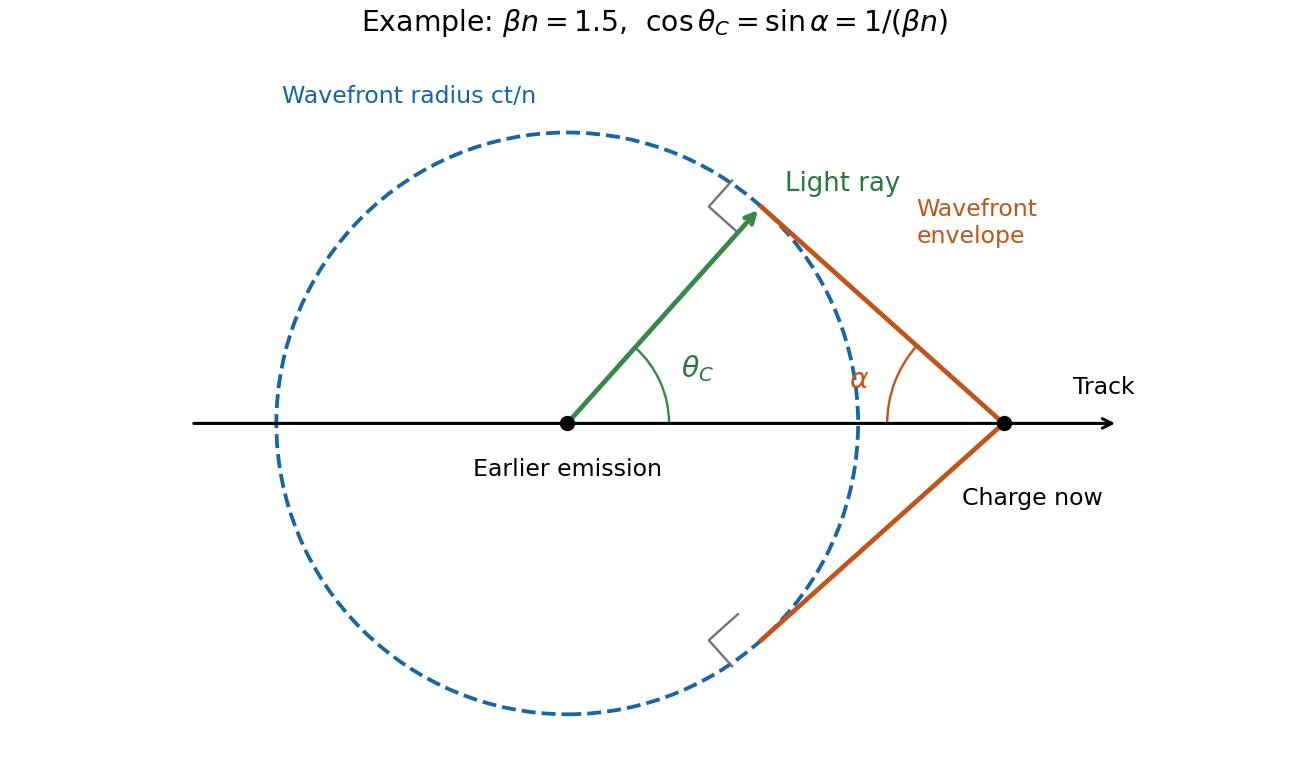


In the wavefront construction, a disturbance emitted a time earlier has radius , while the particle has moved . Tangents from the present particle position to these wavefronts make a backward-opening wavefront cone of half-angle , where . The light rays are normal to this cone. Consequently : the Cherenkov photon-cone and wavefront-cone angles are complementary, rather than identical.
Articles by others on the same topic
There are currently no matching articles.