Colour and identical-quark spin. A spatial ground-state baryon has a symmetric spatial wavefunction. For , or , the quark flavour state is also symmetric, and the total-spin state of three spin-one-half quarks is symmetric. Without another degree of freedom, the whole state would be symmetric under exchange of identical fermions, contrary to the Pauli exclusion principle.
A three-quark colour singlet supplies a completely antisymmetric factor,using the three color charge states. The remaining spatial-spin-flavour factor can then be symmetric. These baryons therefore provide evidence for an additional internal degree of freedom with at least three states, realized as colour in Quantum chromodynamics.
For the pair in , the spatial and quark flavour factors are symmetric under exchange of the two up quarks, while the colour factor is antisymmetric. The pair's spin state must consequently be symmetric. The identical-quark pair spin in a ground-state baryon isa triplet state. This holds whether the complete baryon has total spin or .
Origin of the pair interaction. The terms in the baryon hyperfine mass formula are effective colour-magnetic spin-spin interactions, arising from gluon exchange between the quarks' colour-magnetic moments. Each magnetic moment brings an inverse constituent quark mass, explaining the factor . The constant absorbs the strong coupling constant, colour factors and the spatial overlap. A common is a constituent-model approximation.
Spin algebra and the two masses. Set , so each dimensionless spin angular momentum operator satisfies . Label the two up quarks 1 and 2 and the strange quark 3. Squaring givesNext square the total spin :Substituting these pair sums into the baryon hyperfine mass formula yieldsTheir difference is . Repeating the argument for the identical pair in givesThus the model predicts equal Sigma and Xi hyperfine splittings:For a like-flavour comparison using exactly the supplied masses, the splitting is and the splitting is , giving . Averaging within the supplied isospin multiplets instead gives . The predicted equality captures the common scale but misses the observed ratio by about in this table. Different spatial overlaps, and hence different effective values, can account for departures from the common-coefficient approximation.
Radiative decay and recoil. In a radiative Sigma-to-Lambda transition, both baryons retain valence content . A photon couples to an electrically charged constituent while the final quarks are projected onto the lower baryon's spin-flavour wavefunction. The leading up- and down-quark diagrams are shown below; their contributions must be combined coherently. In the simplest model, the strange-quark spin operator alone cannot change the pair from its Sigma triplet to the Lambda singlet. The transition is an multipole radiation transition, consistent with .
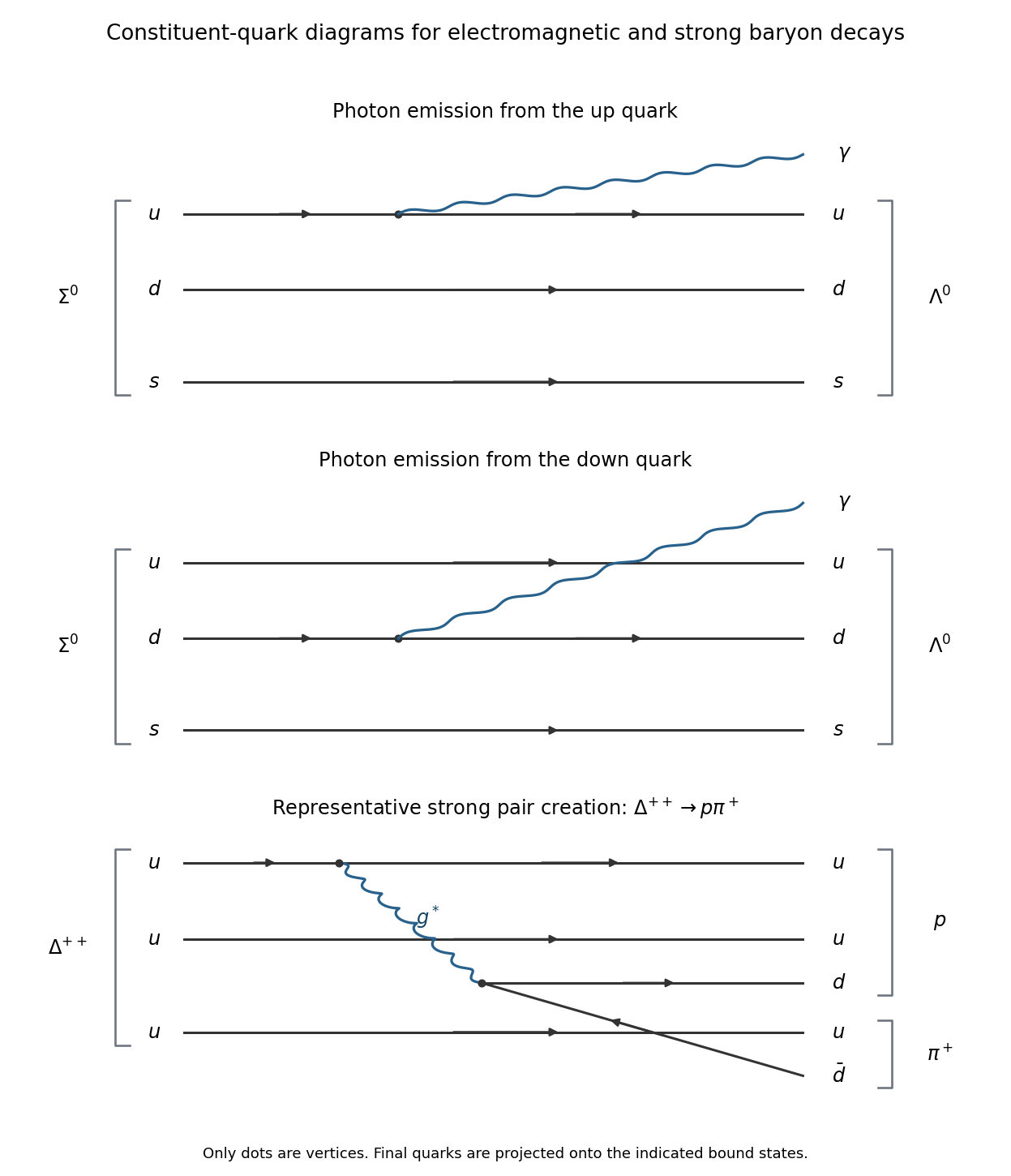
Quark diagrams for Sigma-to-Lambda photon emission and an example strong Delta decay
. Details. 
For the photon energy, let and in natural units. Four-momentum conservation gives equal opposite final momenta of magnitude , soThe recoil kinetic energy of the Lambda baryon is ; assigning the entire mass difference to the photon would miss it.
Which baryons decay strongly? The open strong-decay thresholds for baryons require both sufficient energy and conserved quark flavour, including strangeness. The dominant strong decayers in the supplied table areThe Delta baryon channels have threshold near , below . The excited Sigma baryons can decay as or , and the excited Xi baryons as , all with open thresholds and conserved strangeness. Their positive-parity baryon states can emit the negative-parity pion in an odd relative orbital angular momentum, with already allowing total .
The last diagram illustrates : a gluon creates a pair and the quarks regroup into the two hadrons. No quark changes flavour at the gluon vertices. This is a representative strong pair-creation topology; quantitative hadronic decay rates require bound-state dynamics.
The Omega baryon is an important exception among the spin- states. Its cannot become the of through the strong interaction. Its flavour-conserving threshold is at least , above its mass, so it decays weakly. The ground-state strange octet also has no open strong channel: for example needs at least , and or needs still more than the relevant initial mass. The neutral Sigma decays electromagnetically as above; the neutron and the other unstable octet members decay weakly, while the proton is stable within these processes.
Articles by others on the same topic
There are currently no matching articles.