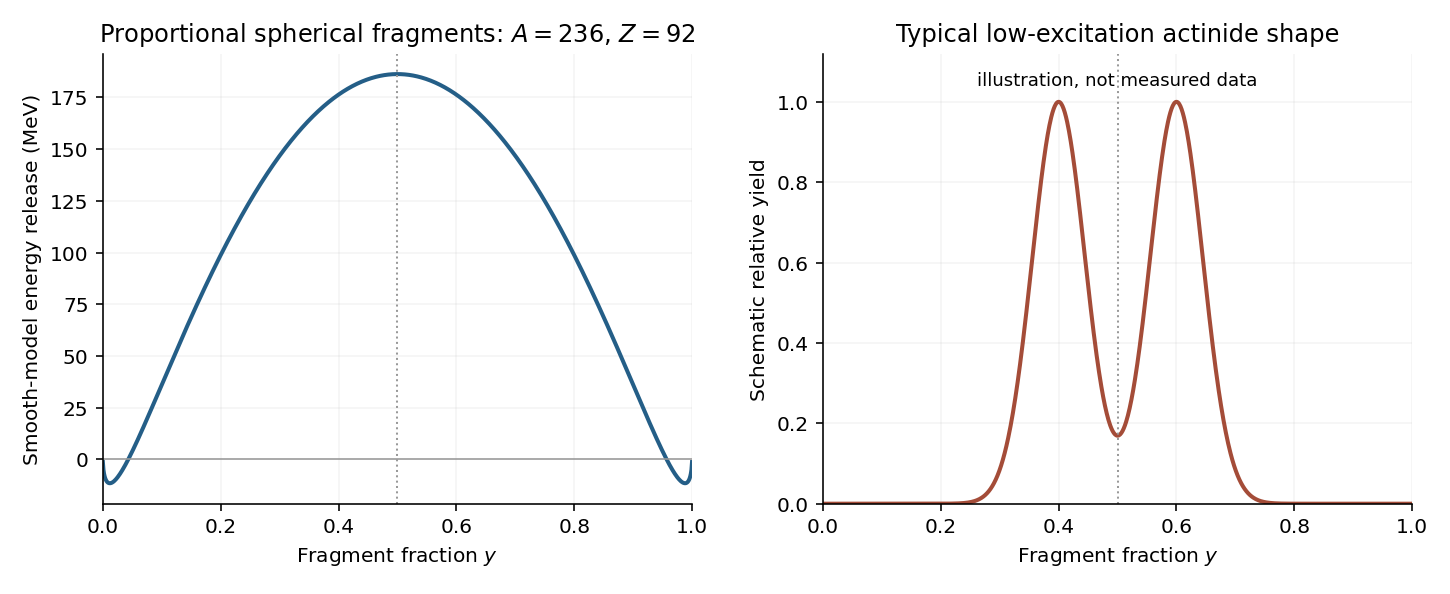
Smooth-model fission energy. Use natural units , so the quoted nuclear masses are expressed as rest energies. Conservation of mass number and atomic number fixes the second fragment to . First omit nuclear pairing to compare a continuous range of . Pairing can subsequently add for integer fragments; it has no smooth parity assignment for arbitrary real .
In the parent-minus-daughters mass difference, the nucleon rest energy and volume terms cancel. The nuclear symmetry energy also cancels because both fragments have the same :The remaining liquid-drop fission energy isSplitting increases the surface energy cost, but reduces nuclear Coulomb energy. Both contributions are symmetric under , so the symmetric split is stationary. Symmetry alone would not establish a maximum, since the two contributions compete.
For a full check, put , and . On , increases from to . Expressing the two fractional-power sums through givesThe derivative can change sign only from negative to positive, so any interior stationary point in is a minimum. The largest value is therefore either the no-split endpoint or the symmetric split. Thus symmetric fission maximizes the positive liquid-drop energy release: whenever this smooth model permits an exothermic split, its largest release occurs at .
There is a qualification to the paper's unqualified wording. For arbitrary low , the symmetric split need not maximize ; indeed it is a local minimum when . The symmetric-maximum conclusion is valid in the heavy, fission-favorable regime relevant here, rather than a universal property of the formula.
Barrier and fragment yields. Positive final-state Q value does not remove the fission barrier along a deformation path. Surface energy initially rises as the nucleus deforms; spontaneous fission then requires collective quantum tunnelling unless enough excitation is present. Its rate is exponentially sensitive to barrier height, width and collective inertia. Thus nuclei close to the exothermicity threshold can have immeasurably long spontaneous-fission mean lifetimes, while sufficiently heavier nuclei have smaller effective fission barriers or larger quantum tunnelling probabilities.
The fission-fragment mass distribution of low-excitation actinide fission is usually double peaked: complementary fragments have mass fractions roughly and rather than both exactly . Nuclear shell model effects and the fission dynamics help favor asymmetric fragments. Maximizing the final smooth-model energy release is not a calculation of the fragment yield. The following yield curve is schematic, with no measured counts implied:
Capture excitation energies. Capturing a negligible-energy neutron forms a compound nucleus with the rest energy of the target plus the free neutron. Relative to the compound ground state, the neutron-capture excitation energy is thereforewhere is positive nuclear binding energy and the compound nucleus's neutron separation energy. The free neutron rest energy cancels in the binding-energy difference. With the supplied semi-empirical mass formula,At , uranium-235 has odd , while uranium-236 is even-even. The pairing contribution is . By contrast uranium-238 is even-even and uranium-239 has odd , giving . The individual contributions areThus the model predictsOf the predicted difference, comes from the change in nuclear pairing. It is the primary reason the even-even capture product is more strongly excited; the smooth terms account for the remaining .
Thermal versus fast-neutron fission. The last comparison uses the supplied observed capture excitations, and , rather than replacing them by the preceding smooth-model estimates. Interpreting the quoted and activation energies as the barriers in the respective capture channels givesA simple neutron-induced fission threshold estimate for the second channel requires about additional centre-of-mass kinetic energy. Sub-barrier tunnelling is possible, but it does not give the large thermal-neutron fission probability of the first channel.
The barrier labels in the original PDF need care: it assigns them to and , whereas the states formed after capture are and . The comparison above uses the intended capture-channel interpretation. If the quoted numbers are literally barriers of the uncaptured target nuclei, the compound-nucleus barriers are missing and this numerical comparison does not follow from those data alone.
In a thermal reactor, neutron moderation slows fission neutrons so the large low-energy fission cross section of uranium-235 can support a nuclear chain reaction. Fuel composition, moderator choice and geometry must balance production against capture and leakage; capture resonances of uranium-238 during slowing are important losses from that neutron population. The reaction rate per target nucleus depends on the spectrum through , where is differential neutron flux per unit energy. A fast spectrum can access the uranium-238 fission channel and changes this balance. Also, uranium-238 is a fertile material: capture followed by two beta-minus decays can produce plutonium-239, a fissile material, so capture can contribute to breeding even when it causes no immediate fission.
Colour and identical-quark spin. A spatial ground-state baryon has a symmetric spatial wavefunction. For , or , the quark flavour state is also symmetric, and the total-spin state of three spin-one-half quarks is symmetric. Without another degree of freedom, the whole state would be symmetric under exchange of identical fermions, contrary to the Pauli exclusion principle.
A three-quark colour singlet supplies a completely antisymmetric factor,using the three color charge states. The remaining spatial-spin-flavour factor can then be symmetric. These baryons therefore provide evidence for an additional internal degree of freedom with at least three states, realized as colour in Quantum chromodynamics.
For the pair in , the spatial and quark flavour factors are symmetric under exchange of the two up quarks, while the colour factor is antisymmetric. The pair's spin state must consequently be symmetric. The identical-quark pair spin in a ground-state baryon isa triplet state. This holds whether the complete baryon has total spin or .
Origin of the pair interaction. The terms in the baryon hyperfine mass formula are effective colour-magnetic spin-spin interactions, arising from gluon exchange between the quarks' colour-magnetic moments. Each magnetic moment brings an inverse constituent quark mass, explaining the factor . The constant absorbs the strong coupling constant, colour factors and the spatial overlap. A common is a constituent-model approximation.
Spin algebra and the two masses. Set , so each dimensionless spin angular momentum operator satisfies . Label the two up quarks 1 and 2 and the strange quark 3. Squaring givesNext square the total spin :Substituting these pair sums into the baryon hyperfine mass formula yieldsTheir difference is . Repeating the argument for the identical pair in givesThus the model predicts equal Sigma and Xi hyperfine splittings:For a like-flavour comparison using exactly the supplied masses, the splitting is and the splitting is , giving . Averaging within the supplied isospin multiplets instead gives . The predicted equality captures the common scale but misses the observed ratio by about in this table. Different spatial overlaps, and hence different effective values, can account for departures from the common-coefficient approximation.
Radiative decay and recoil. In a radiative Sigma-to-Lambda transition, both baryons retain valence content . A photon couples to an electrically charged constituent while the final quarks are projected onto the lower baryon's spin-flavour wavefunction. The leading up- and down-quark diagrams are shown below; their contributions must be combined coherently. In the simplest model, the strange-quark spin operator alone cannot change the pair from its Sigma triplet to the Lambda singlet. The transition is an multipole radiation transition, consistent with .
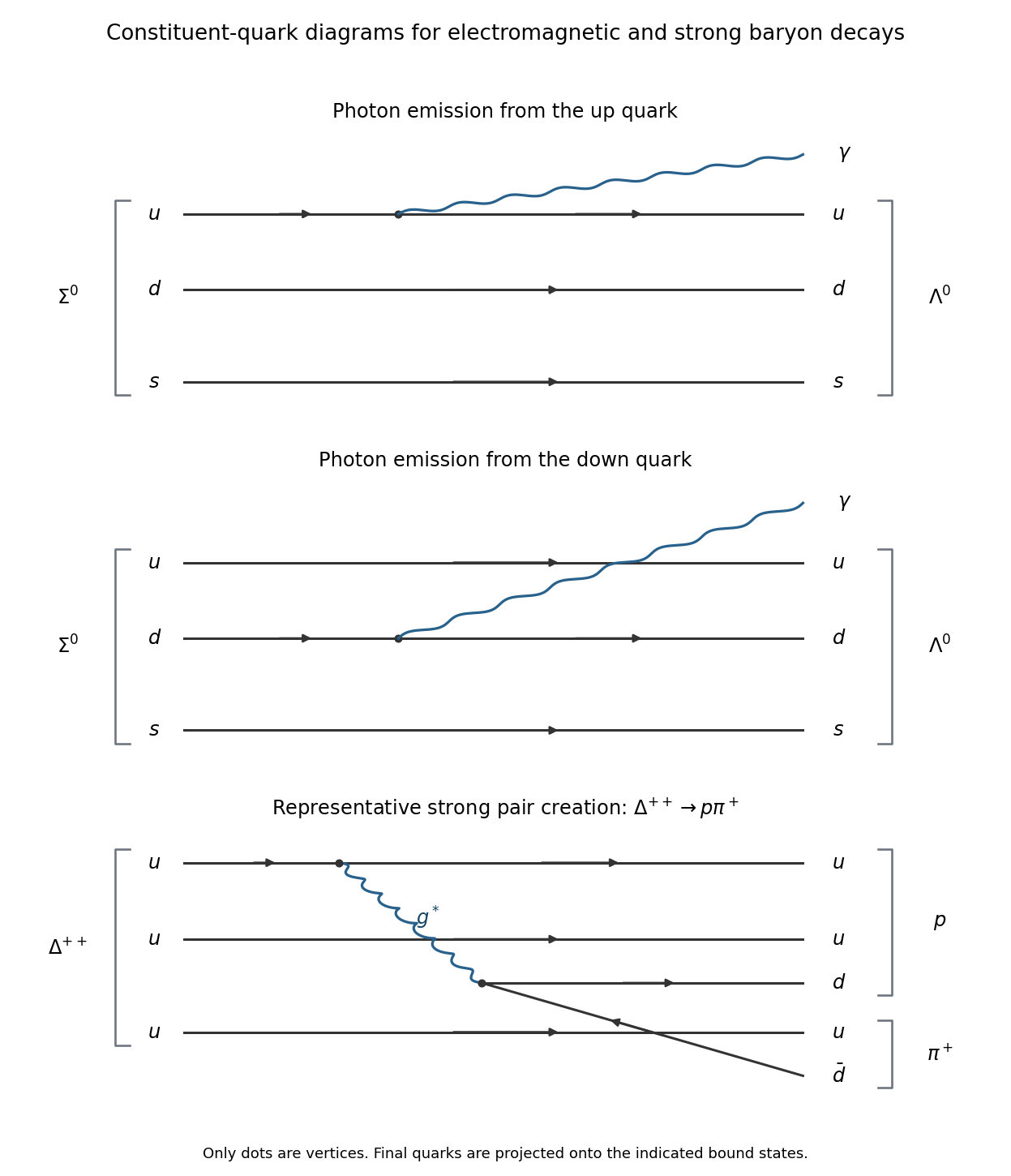
Quark diagrams for Sigma-to-Lambda photon emission and an example strong Delta decay
. Details. For the photon energy, let and in natural units. Four-momentum conservation gives equal opposite final momenta of magnitude , soThe recoil kinetic energy of the Lambda baryon is ; assigning the entire mass difference to the photon would miss it.
Which baryons decay strongly? The open strong-decay thresholds for baryons require both sufficient energy and conserved quark flavour, including strangeness. The dominant strong decayers in the supplied table areThe Delta baryon channels have threshold near , below . The excited Sigma baryons can decay as or , and the excited Xi baryons as , all with open thresholds and conserved strangeness. Their positive-parity baryon states can emit the negative-parity pion in an odd relative orbital angular momentum, with already allowing total .
The last diagram illustrates : a gluon creates a pair and the quarks regroup into the two hadrons. No quark changes flavour at the gluon vertices. This is a representative strong pair-creation topology; quantitative hadronic decay rates require bound-state dynamics.
The Omega baryon is an important exception among the spin- states. Its cannot become the of through the strong interaction. Its flavour-conserving threshold is at least , above its mass, so it decays weakly. The ground-state strange octet also has no open strong channel: for example needs at least , and or needs still more than the relevant initial mass. The neutral Sigma decays electromagnetically as above; the neutron and the other unstable octet members decay weakly, while the proton is stable within these processes.
The nuclear determination of . A beta decay transition has no nuclear parity change and can proceed with zero lepton orbital angular momentum. The allowed scalar operator gives a Fermi transition; the rank-one Gamow-Teller transition operator cannot connect total nuclear spins zero to zero. The strong isobaric-analog transitions used for precision measurements are superallowed beta decays. A generic assignment alone would not guarantee superallowed strength if the states were nonanalog.
At the quark level the weak charged current converts and carries in the amplitude. The nuclear Fermi operator is an isospin ladder operator, givingHere denotes the known phase space dependence, with the dimensional factors included in the proportionality constant. In the isospin-symmetric limit, between analog states is fixed by isospin algebra, for example for the usual analog transitions. A measured partial half-life and the computed phase space factor give the comparative half-life; after radiative corrections and isospin breaking corrections, its inverse determines . The decay rate measures a magnitude squared, not the complex phase of .
Ds decay diagrams and CKM comparisons. The original PDF has , with . The local TeX drops that overbar; using instead would give a different flavour channel. Use the PDF's neutral antikaon throughout.
In the representative Ds nonleptonic tree amplitudes, the Ds meson spectator is . The elementary weak transitions are
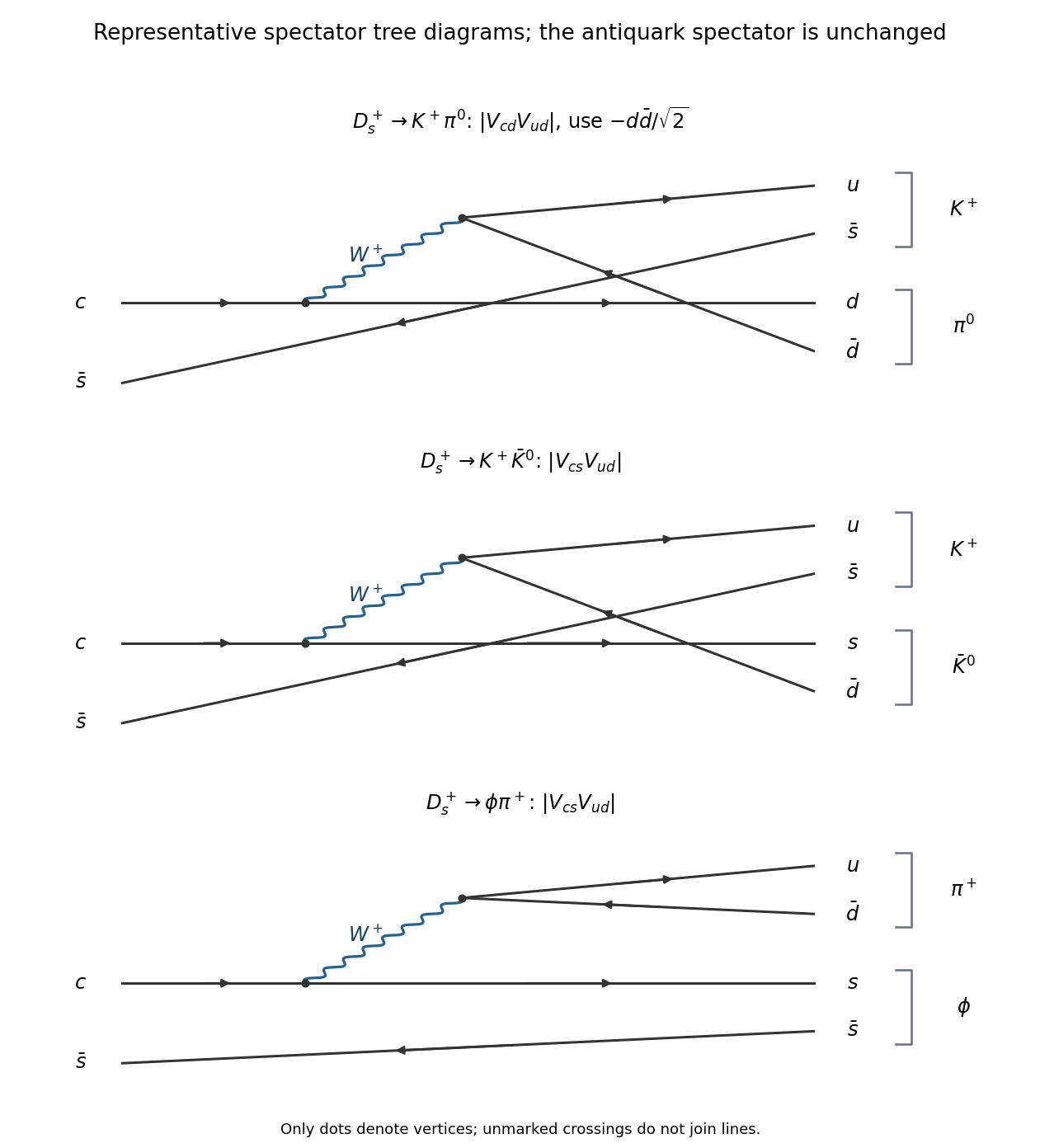


In the first two channels, the produced joins the spectator to form ; the other quark joins . For the first channel this uses the component of the neutral pion. In the third, forms the phi meson and forms . The two possible final pairings have different colour contractions and hadronic matrix elements even when their weak CKM factors coincide.
The purely CKM rate suppression of relative to isThus is singly Cabibbo suppressed, while and are Cabibbo-favored at this level. If reduced hadronic strengths and phase space effects were equal, including the neutral-pion component would giveThe supplied branching fractions instead giveThe first observed ratio is times the neutral-pion-corrected simple estimate, requiring only an order-one remaining hadronic and phase space factor. Relative to , that remaining factor is . The two Cabibbo-favored channels differ by a factor despite equal CKM magnitudes. The CKM hierarchy therefore explains why one channel is much rarer, but it does not calculate the three exclusive branching fractions; spin, phase space, color charge and strong interaction final-state effects also matter.
What spin and parity establish. In either pseudoscalar-pseudoscalar final state, the total intrinsic spin is zero. Conservation of angular momentum for a spin-zero parent forces , so the final parity isopposite to the parent Ds meson. ConsequentlyFor a vector meson plus a pion, the intrinsic final spin is one. Coupling to total requires , giving , equal to the parent parity. Thus spin and parity alone permit a parity-conserving transition. That is the limited sense in which it is not necessarily weak from this information alone. In reality it is also weak: the initial charm flavour disappears, which the strong interaction and electromagnetic interaction conserve.
W branching fractions. In the massless-daughter, tree-level estimate, each leptonic channel contributes one common unit of decay width. Each accessible quark pair contributes because of the three final colours. The charged-current W branching-fraction counting denominator isOnly and are accessible up-type quarks; the large is irrelevant because a W boson cannot decay into the heavier top quark. HenceA final bottom quark arises in or , soThis counts the primary decay channels; finite daughter masses and QCD corrections refine the approximation.
The requested top-lifetime estimate and its limitation. Under the instructed equal-coefficient Sargent's rule scaling, and the mean lifetime is inversely proportional to that fifth power. Converting both masses to GeV givesThis is the requested order-of-magnitude estimate, assuming the same effective coefficient for the two total decay rates. It corresponds to and is longer than the hadronization time, roughly a few . Taken literally, it would allow top-flavored hadrons to form; it does not establish the physical statement that the top decays before hadronizing.
The extrapolation fails because Sargent's rule uses a low-energy Fermi interaction approximation, whereas permits with an on-shell W boson. The physical leading decay width instead scales asUsing , the Fermi constant and gives about at the supplied top mass. Then , with , gives . This corrected regime explains top-quark decay before hadronization.[ref]
Articles by others on the same topic
There are currently no matching articles.