In the pion rest frame, write its four-momentum as and the charged lepton's as . By four-momentum conservation, the massless antineutrino has , with . ThereforeIts energy is , and for a massless antineutrino, . The final momenta are equal and opposite, soThe expression is positive precisely when the two-body decay is energetically allowed, , neglecting the neutrino mass.
The variable initial energy replaces in the kinematic expression before differentiation. The charged-lepton mass remains fixed:Thus the required Jacobian determinant in this one-dimensional change of variables isEquivalently, gives , so , the same result. It is dimensionless in natural units.
In the simple box-state counting used here, the final three-momentum lies in a spherical shell: , where the common constant contains the normalization volume and angular factor. Momentum conservation fixes the other final particle's momentum. Hence the density of states isCombining parts (a) and (b) givesWith the paper's rounded masses,By Fermi's golden rule, equal squared matrix elements make the rate ratio equal to this density ratio. Thus the naive constant-matrix-element estimate is , which favours the electronic decay by about to one.
This is the particular noncovariant state-counting convention in the question. A calculation with the Lorentz-invariant phase-space measure places factors in the measure and correspondingly normalizes its decay amplitude differently. Only the complete product of phase space and squared matrix element is convention-independent; mixing the two conventions would give a wrong rate.
The charged pion has valence content . Its constituents annihilate into a virtual W boson, followed by the lepton pair:
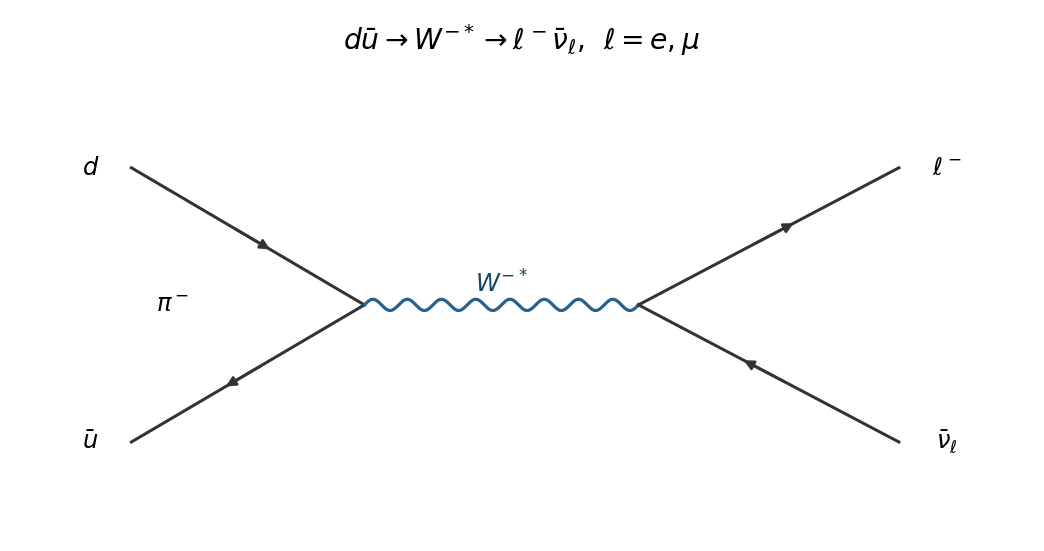
The quark vertex carries the -- Cabibbo-Kobayashi-Maskawa matrix element, and the leptonic vertex is the weak charged current. The pion's nonperturbative spatial structure is encoded in the pion decay constant when evaluating the decay amplitude.
A spin-zero pion has no preferred emission direction. Choose the antineutrino momentum along . A massless antineutrino has positive helicity, so its spin points along . The muon moves along , and total requires its spin to point along :
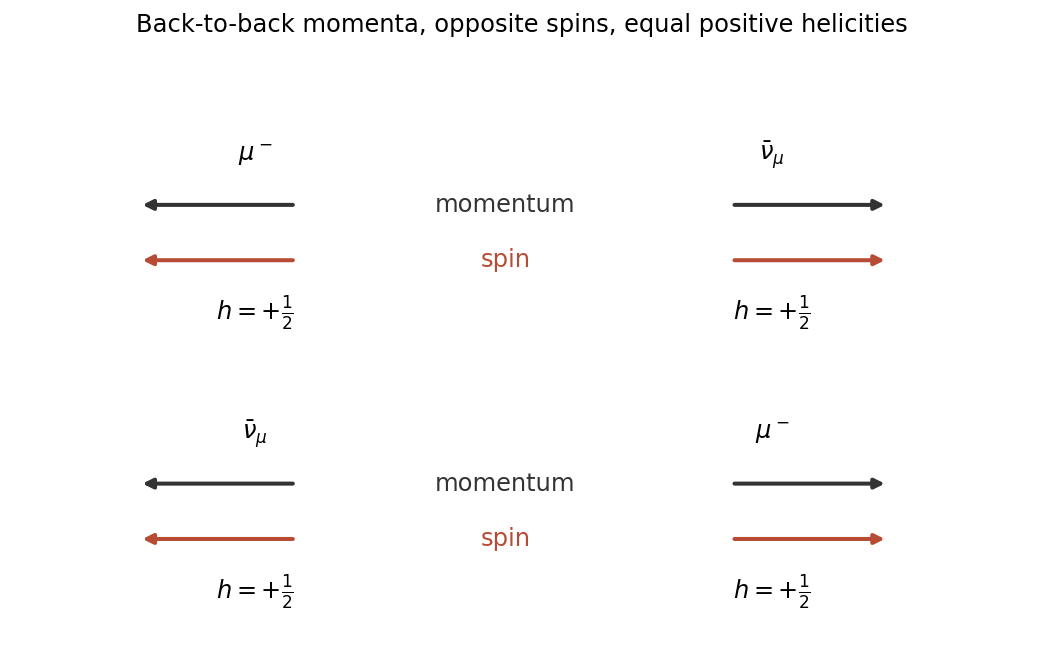
The reversed configuration is obtained by rotating the entire event and is equally allowed. The two spins are opposite, while each is aligned with its own particle's momentum; both outgoing helicities are positive. A negative-helicity muon with this fixed antineutrino direction would give a nonzero total spin projection and is forbidden for this two-body decay of a spin-zero parent. The required positive-helicity charged lepton is the suppressed component of the weak charged current.
For the charged lepton, and . Their ratio is therefore its speed in natural units. Using part (a),Numerically,The Electron is almost ultrarelativistic, while the muon is relatively slow. In ordinary units these are approximately and .
The weak charged current creates a negative charged lepton in a left-chiral state. For a massless particle, that would have negative helicity; part (e) instead requires positive helicity. A nonzero mass supplies the necessary wrong-helicity component. This helicity suppression is extremely strong for the fast Electron, but much weaker for the slow muon.
For a positive-helicity charged lepton with spinors normalized to unit probability, the left-chiral weight is . With the box-state normalization of part (c), this gives the useful consistent rate ratioIndeed cancels the extra energy-dependent factor in that density ratio, leaving the standard pion electron-to-muon decay ratio in inverted form:Using the rounded masses in this paper gives , close to the stated order of . Precision predictions require more accurate masses and electromagnetic radiative corrections. The essential mechanism is the charged-lepton-mass dependence of the decay amplitude; simply counting available final momenta misses it.
Use a high-energy proton beam on a target to produce secondary pions, then select and focus the negative ones. A magnetic horn and a charge-selecting dipole system remove positive pions, limiting wrong-sign contamination. Select a narrow range of magnetic rigidity; if additional species rejection is available, velocity or mass discrimination reduces negative kaon contamination at the same momentum.
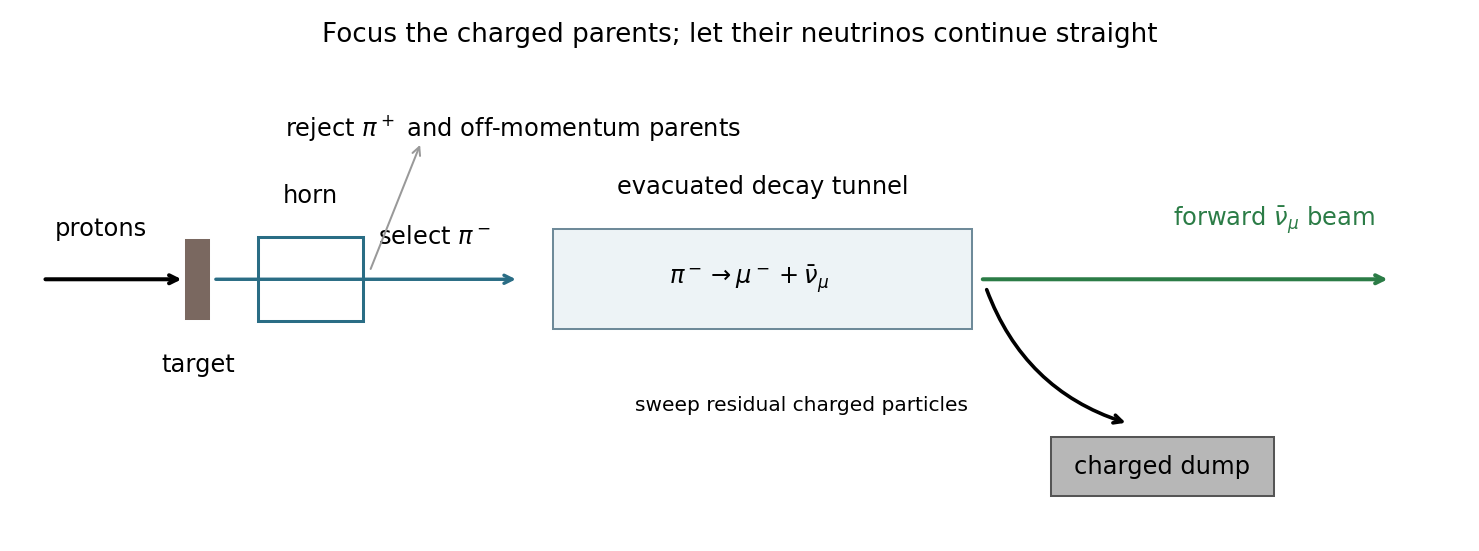


The selected travel through an evacuated decay tunnel and undergo . Their forward Lorentz boost concentrates the antineutrinos within an angle of order . Choose a tunnel long enough for substantial pion decay but short compared with the boosted muon decay length. Since is much longer than , this reduces secondary contamination.
Downstream magnets sweep the remaining charged particles into absorbers, and shielding stops residual hadrons and muons. The antineutrino beam continues straight through. Parent-particle collimation, charge selection, and a forward detector improve purity; neutral-kaon decays, remaining wrong-sign parents, and muon decays prevent perfect purity. Neutrinos themselves cannot be focused or charge-selected by these magnets. Neutrinos produced after stopped-muon decay or capture are much less forward and can be reduced by directional and energy selection.
Articles by others on the same topic
There are currently no matching articles.