The squared invariant amplitude weights each accessible final configuration. The final on-shell momentum measure counts the available states, and the four-dimensional delta function imposes energy and momentum conservation:To prove its Lorentz invariance for proper orthochronous transformations, writeThe four-volume measure has unit Lorentz Jacobian, is invariant, and the future mass shell is preserved. Likewise because . The product therefore proves that is invariant. Spin averages and sums belong in the amplitude as appropriate; identical final particles require a symmetry divisor if the integration covers a fully labelled phase space.
The initial factors come from relativistic normalization of the incoming states. They are not individually invariant, so the displayed coordinate-time transition rate must not be called a Lorentz scalar merely because its final phase space is invariant. A one-particle decay has proper width in its rest frame, while its laboratory rate is . A scattering cross section instead uses the invariant incident flux . This distinguishes invariance of phase space from transformation of a measured rate.
Write and factor the three-body phase space through the pair , with :A scalar parent permits integration over the overall orientation. In its rest frame let the pair have momentum magnitude , and in the pair rest frame let particle 3 have magnitude . After integrating the azimuth of its direction, the two-body factors giveIn that pair rest frame, particle 2 has momentum magnitude , so . The Jacobian cancels both momentum factors, leavingThe physical domain is bounded by the requirement that the relative cosine lie between and . The phase-space density is uniform within that domain; the event density is uniform only for a constant squared amplitude. Scalar parent spin alone does not forbid resonance-dependent amplitudes. A factor is a concrete nonuniform example. For two identical pions, a conventional overall compensates integration over both labelings without changing the local flatness of phase space.[ref]
Review of Particle Physics by Particle Data Group (2022). Kinematics, equations (49.22)–(49.23): three-body Dalitz density and its bounds
The three on-shell spatial momenta have nine components. Four conservation constraints leave five, and an unobserved overall spatial rotation removes three for the scalar decay, leaving two internal kinematic variables. The pair invariants obeyThus two determine the third. They also determine each rest-frame daughter energy,and hence all momentum magnitudes and pairwise angles. The momentum triangle is fixed up to overall orientation. The Dalitz plot describes this internal kinematics, rather than claiming to record three independently oriented Four-vectors. Polarized parents or additional measured spin information can require orientation variables beyond the two invariant axes.
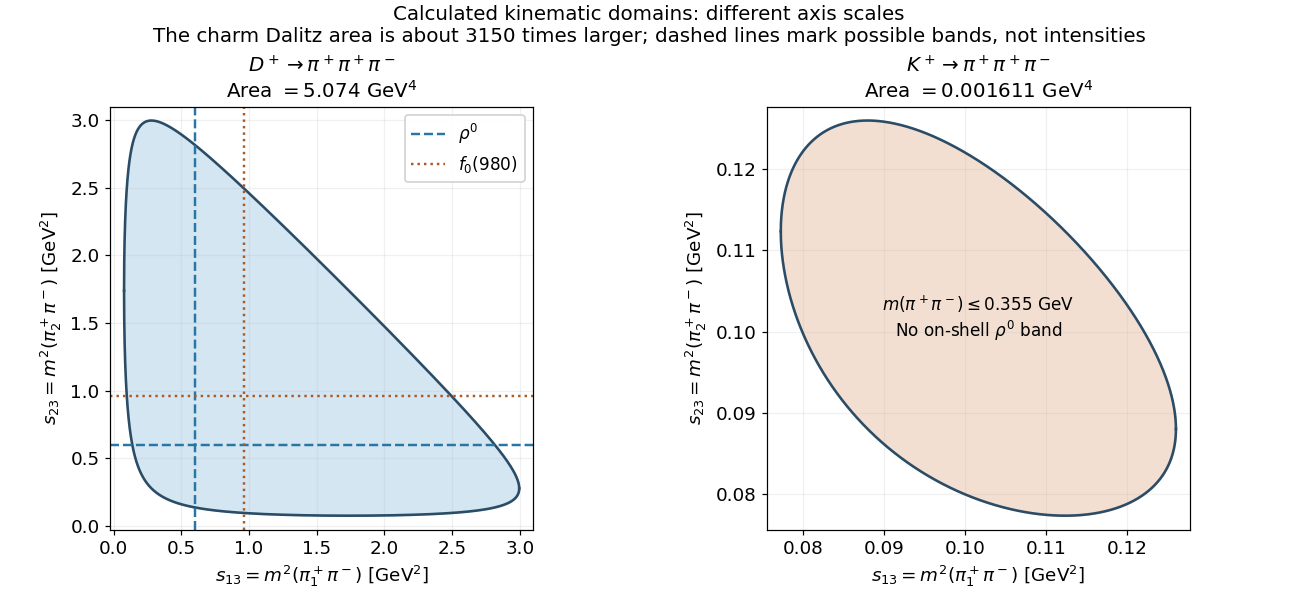
Use the explicit charged channels and , labeling the two positive pions as 1,2 and the negative one as 3. With , the opposite-charge pair mass squares have the rangesTheir exact correlated boundaries follow by taking the pair rest-frame angle to its endpoints. For general daughter masses, define . At fixed ,The charged-pion thresholds give the following numerical comparison:
| Parent | | Allowed single-axis interval, | Dalitz area, \ | | | to | approximately \ | | | to | approximately |
|---|
The area is about times smaller for the kaon. Including the phase-space prefactor, its integrated labelled three-body phase space is about times smaller; neither comparison predicts a ratio of weak decay widths without the matrix elements.
A intermediate state produces horizontal or vertical bands near or in the charm decay. Scalar pion-pair amplitudes, including broad low-mass -wave contributions and accessible , can also populate the plot. The kaon pair mass cannot exceed , so it cannot contain an on-shell or band; smooth nonresonant and rescattering effects remain possible. Channels containing neutral pions use their supplied mass and shift these boundaries slightly without changing the conclusion. The figure shows kinematic domains and representative accessible bands, not an assumed measured intensity.

The charged two-pion and three-pion channels can be assigned to the same spin-zero kaon by their parent mass and lifetime. For two spinless pions, total angular momentum zero forces their relative orbital angular momentum to zero, so the product of their intrinsic parities givesFor three spinless pions, use Jacobi orbital angular momenta . Coupling them to total zero requires , and henceThus both channels cannot conserve parity in decays of one parent with a definite parity. The weak decay interaction permits the observed coexistence.
Dalitz plots identify the three-body events, determine their internal kinematics, and allow amplitude and angular-momentum analyses through their populations and resonance structures. Together with the spin and parent-identity evidence, they support the parity assignment. They are not a standalone parity-odd observable: reversing all three momenta leaves every , and therefore every point on the plot, unchanged. A flat distribution by itself cannot establish parity violation without the channel and spin information.
Articles by others on the same topic
There are currently no matching articles.