Source paper: www.whatdotheyknow.com/request/oxford_physics_past_papers_2/response/2340696/attach/5/Physics%20Papers%202016.pdf?cookie_passthrough=1. The held cover dates this paper to 15 June 2017; the annual bundle's filename does not determine the year. We use unless displaying unit conversions. Unlettered requests are indexed consecutively; the two separately marked requests within 5a have subscopes 1 and 2. All six questions are covered.
For nonzero momentum, physical helicity is the spin projection along the direction of motion,The convention without labels the same two eigenspaces by . Write . Normalized two-component eigenvectors areEach can carry an arbitrary phase. Before imposing an energy equation, the general four-component helicity eigenvector is , with arbitrary complex ; unit Norm imposes . For a positive-energy free electron, the Dirac equation fixes their ratio and givesMultiplying by an arbitrary overall amplitude and the common plane wave supplies the corresponding free helicity eigenstate. Helicity has no preferred direction at . For a massive particle a boost can overtake its momentum and change its helicity; it should not be identified with Lorentz-invariant chirality.
Let , so . The Pauli identity givesusing . Thus unit spinor probability density is obtained withAn arbitrary constant phase is immaterial. For the alternative Lorentz normalization , choose . Neither convention makes an infinite plane wave square-integrable; a box-normalized state includes an additional , or one forms a normalizable wave packet.
In the supplied Dirac representation, exchanges the upper and lower blocks. ThereforeDefine . Acting with this projector givesFor completeness, its two independent components areThe equal-and-opposite block structure verifies . Projection isolates a chiral component of the massive Dirac solution; that component alone generally does not satisfy an independent massive Dirac equation, since the mass couples both chiralities.
Expand the original two-spinor as . Orthogonality givesLet and . These are normalized, left-chiral helicity eigenvectors. ThenThe two contributions have squared normsThese are weights relative to the original normalized state; divide by their sum if conditioning on a normalized left-chiral projection. In the ultrarelativistic limit , , the positive-helicity amplitude is suppressed as , while the negative-helicity amplitude tends to . HenceFor momentum specifically along , and : the original helicity probabilities are , the left-chiral Norm is , and its limiting weight is . The source does not specify that momentum direction, so these numerical probabilities are a specialization, not the general answer.
The charged weak current contains . For an ultrarelativistic external fermion, it selects negative helicity; its antifermion partner has positive helicity. Wrong-helicity charged-current amplitudes vanish in the massless limit and are suppressed by powers of at finite mass. The active neutrino is consequently left-helicity and its antineutrino right-helicity in this limit.
This is a charged-current statement, not a prohibition on every right-helicity Standard Model fermion. Electromagnetic and strong vector interactions act on both chiralities and conserve helicity along a massless fermion line. A neutral-current vertex also couples to both charged-fermion chiralities with unequal strengths. For example, a right-helicity electron can scatter electromagnetically: it is not excluded from the Standard Model. In vector-current pair annihilation the massless fermion and antifermion have opposite helicities; a purely charged-current vertex keeps only the left-fermion/right-antifermion choice. Yukawa interactions connect left and right fields and must be distinguished from these vector-current selection rules.
The squared invariant amplitude weights each accessible final configuration. The final on-shell momentum measure counts the available states, and the four-dimensional delta function imposes energy and momentum conservation:To prove its Lorentz invariance for proper orthochronous transformations, writeThe four-volume measure has unit Lorentz Jacobian, is invariant, and the future mass shell is preserved. Likewise because . The product therefore proves that is invariant. Spin averages and sums belong in the amplitude as appropriate; identical final particles require a symmetry divisor if the integration covers a fully labelled phase space.
The initial factors come from relativistic normalization of the incoming states. They are not individually invariant, so the displayed coordinate-time transition rate must not be called a Lorentz scalar merely because its final phase space is invariant. A one-particle decay has proper width in its rest frame, while its laboratory rate is . A scattering cross section instead uses the invariant incident flux . This distinguishes invariance of phase space from transformation of a measured rate.
Write and factor the three-body phase space through the pair , with :A scalar parent permits integration over the overall orientation. In its rest frame let the pair have momentum magnitude , and in the pair rest frame let particle 3 have magnitude . After integrating the azimuth of its direction, the two-body factors giveIn that pair rest frame, particle 2 has momentum magnitude , so . The Jacobian cancels both momentum factors, leavingThe physical domain is bounded by the requirement that the relative cosine lie between and . The phase-space density is uniform within that domain; the event density is uniform only for a constant squared amplitude. Scalar parent spin alone does not forbid resonance-dependent amplitudes. A factor is a concrete nonuniform example. For two identical pions, a conventional overall compensates integration over both labelings without changing the local flatness of phase space.[ref]
Review of Particle Physics by Particle Data Group (2022). Kinematics, equations (49.22)–(49.23): three-body Dalitz density and its bounds
The three on-shell spatial momenta have nine components. Four conservation constraints leave five, and an unobserved overall spatial rotation removes three for the scalar decay, leaving two internal kinematic variables. The pair invariants obeyThus two determine the third. They also determine each rest-frame daughter energy,and hence all momentum magnitudes and pairwise angles. The momentum triangle is fixed up to overall orientation. The Dalitz plot describes this internal kinematics, rather than claiming to record three independently oriented Four-vectors. Polarized parents or additional measured spin information can require orientation variables beyond the two invariant axes.
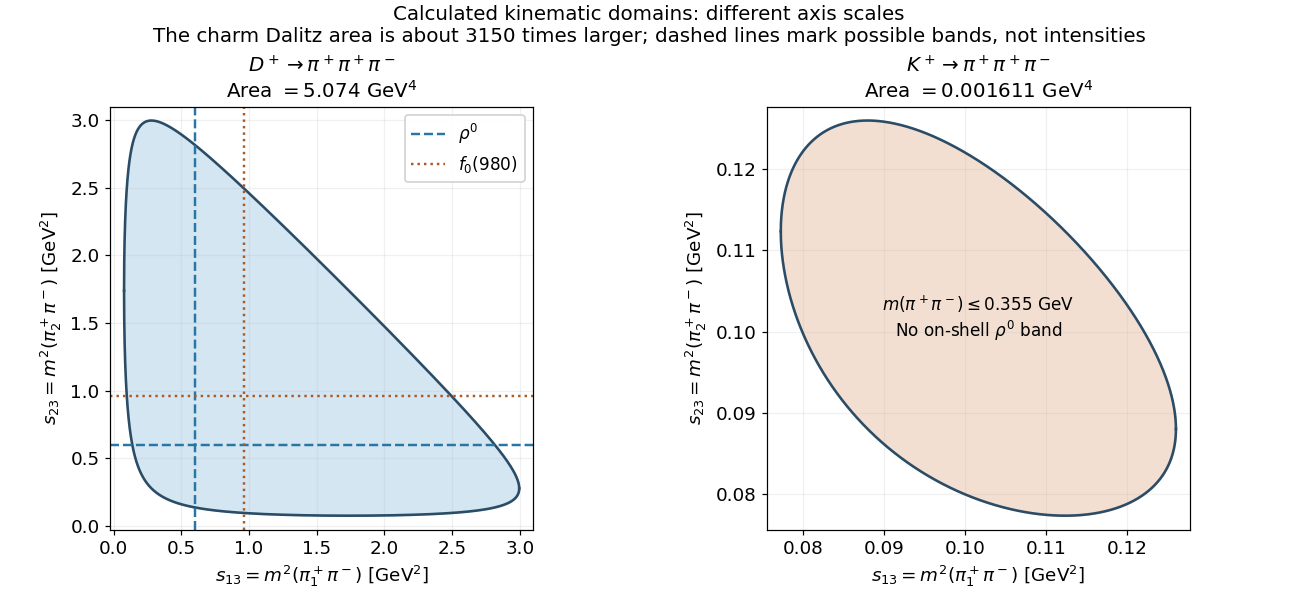
Use the explicit charged channels and , labeling the two positive pions as 1,2 and the negative one as 3. With , the opposite-charge pair mass squares have the rangesTheir exact correlated boundaries follow by taking the pair rest-frame angle to its endpoints. For general daughter masses, define . At fixed ,The charged-pion thresholds give the following numerical comparison:
| Parent | | Allowed single-axis interval, | Dalitz area, \ | | | to | approximately \ | | | to | approximately |
|---|
The area is about times smaller for the kaon. Including the phase-space prefactor, its integrated labelled three-body phase space is about times smaller; neither comparison predicts a ratio of weak decay widths without the matrix elements.
A intermediate state produces horizontal or vertical bands near or in the charm decay. Scalar pion-pair amplitudes, including broad low-mass -wave contributions and accessible , can also populate the plot. The kaon pair mass cannot exceed , so it cannot contain an on-shell or band; smooth nonresonant and rescattering effects remain possible. Channels containing neutral pions use their supplied mass and shift these boundaries slightly without changing the conclusion. The figure shows kinematic domains and representative accessible bands, not an assumed measured intensity.
The charged two-pion and three-pion channels can be assigned to the same spin-zero kaon by their parent mass and lifetime. For two spinless pions, total angular momentum zero forces their relative orbital angular momentum to zero, so the product of their intrinsic parities givesFor three spinless pions, use Jacobi orbital angular momenta . Coupling them to total zero requires , and henceThus both channels cannot conserve parity in decays of one parent with a definite parity. The weak decay interaction permits the observed coexistence.
Dalitz plots identify the three-body events, determine their internal kinematics, and allow amplitude and angular-momentum analyses through their populations and resonance structures. Together with the spin and parent-identity evidence, they support the parity assignment. They are not a standalone parity-odd observable: reversing all three momenta leaves every , and therefore every point on the plot, unchanged. A flat distribution by itself cannot establish parity violation without the channel and spin information.
The lepton mixing matrix relates charged-current neutrino flavour fields to mass eigenfields: . Nondegenerate masses then give relative propagation phases and flavour oscillations. This is the three-massive-neutrino extension of the minimal massless-neutrino Standard Model.
A unitary three-by-three matrix has nine real parameters: three rotation angles and six phases. For Dirac leptons, the independent field rephasings remove five phases, because one common phase acts trivially. Three angles and one physical Dirac phase remain. For Majorana neutrinos two additional phases cannot be removed, but they cancel from ordinary oscillation probabilities.
The phases printed in the lower two rows do not give a unitary matrix for general . A consistent convention is , where the real rotations use the indicated mixing angles andThe lower-row phase factors in the resulting full matrix are , opposite to the in . For the source's all-minus assignment, the scalar product of the electron row with the conjugated muon row is , which is nonzero at and nonzero mixing. This supplies an explicit counterexample. The electron-row moduli used below are unaffected by this correction.[ref]
Review of Particle Physics by Particle Data Group (2022). Neutrino Masses, Mixing, and Oscillations, §14.3 and equation (14.34): opposite signs of the physical phase in the standard matrix
Use . With , the source's is precisely . The electron-row probabilities are , , and . ThereforeNeither nor the Dirac phase appears in vacuum electron-flavour survival. The same vacuum survival expression applies to reactor electron antineutrinos. A sufficiently large matter effect would require a different propagation calculation, but is negligible at the short reactor baselines used for measuring .
Restore the unit conversion in the phase,Equivalently use mass units and energies in , with . The numerical conversion factor isThusThe familiar coefficient uses in metres and in MeV, or kilometres and GeV; it would be a factor of one thousand too small with the units requested here.[ref]
Review of Particle Physics by Particle Data Group (2022). Neutrino Masses, Mixing, and Oscillations, equation (14.40): the coefficient 1.267 uses metres per MeV
The quoted differences with units are interpreted as squared-mass differences, despite the source's abbreviated notation.With the supplied angles, and . At and with the two atmospheric-scale splittings approximated by a common , the requested sketch is represented byThe fast period is and its first disappearance maximum is at . The slow period is , giving slow minima near and . At each baseline the fast oscillations lie between and that value minus . Averaging over unresolved fast oscillations subtracts half that amplitude, rather than erasing the slow oscillation.
The equal atmospheric splittings are an approximation: exact squared masses require . For example, choosing magnitudes and gives . This changes the fine fast pattern while retaining the two physical scales. The figure deliberately displays the source's common-frequency approximation and labels the fast-averaged curve separately from the monoenergetic result.
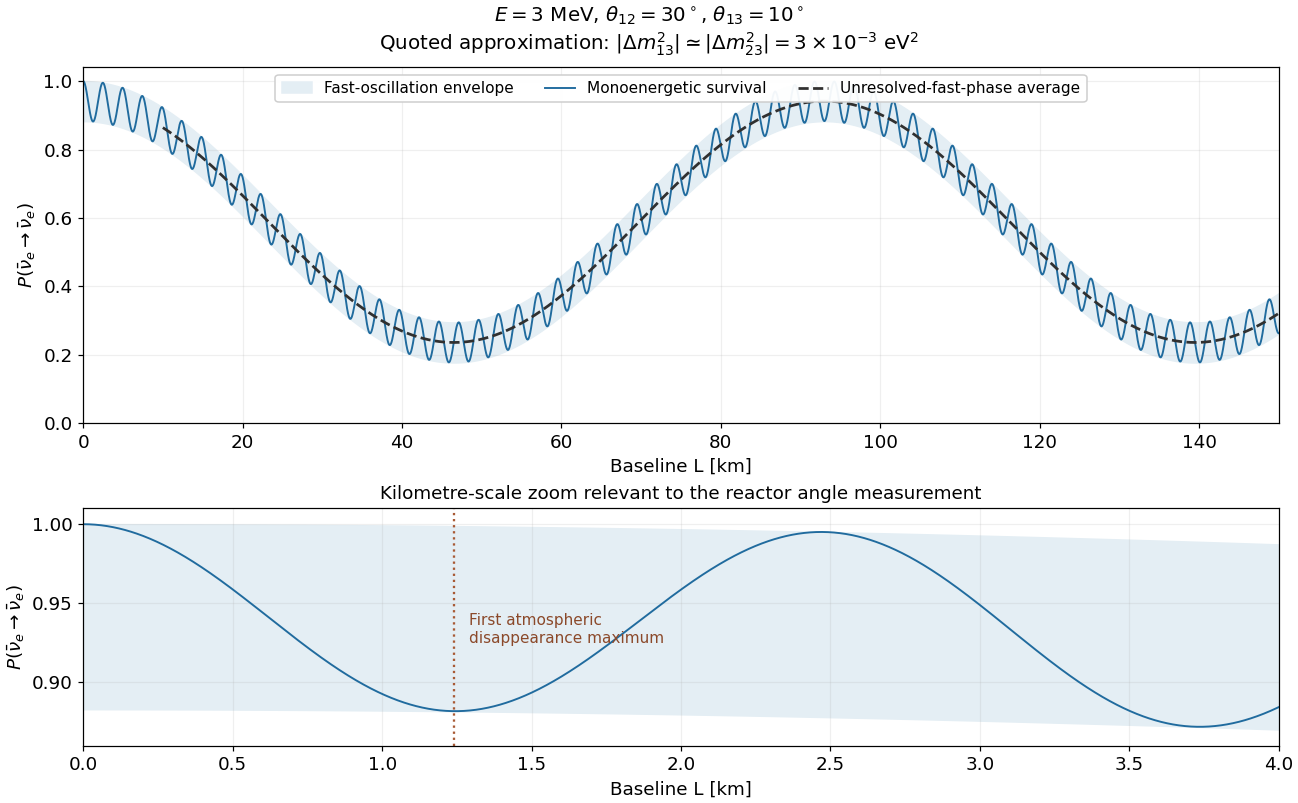
Place a far detector near the first atmospheric disappearance maximum, approximately for the source's monochromatic energy and splitting, and a nearly identical near detector a few hundred metres from the reactor complex. Their flux-corrected comparison largely cancels reactor power, emitted-spectrum and absolute-efficiency uncertainties. For a broad reactor spectrum one fits energy-dependent disappearance instead of treating that single baseline as a universal exact optimum.
Detect in a hydrogen-rich target, for example liquid scintillator with neutron-capture enhancement. The prompt Positron signal estimates neutrino energy; the delayed neutron-capture signal supplies a time-and-position coincidence that strongly reduces random backgrounds. Use sufficient target mass and exposure, low radioactivity, overburden and a muon veto to reduce cosmogenic backgrounds, calibrated relative energy response and efficiency, and monitored reactor powers and baselines. Account for multiple reactor cores, spent-fuel backgrounds and accidental coincidences. At kilometre baselines the slow solar phase is small, so the disappearance depth directly probes with little sensitivity to the CP phase or mass ordering.
Nuclear-field pair creation is . A virtual photon exchanged with the nucleus supplies recoil momentum, while the real photon and virtual photon attach to the electron line joining the outgoing pair. The figure shows a representative graph. The second attachment ordering must be included in the full amplitude. A real photon cannot create a free massive pair in vacuum: its invariant mass is zero, whereas . Nuclear recoil resolves that kinematic obstruction and permits energy-momentum conservation.
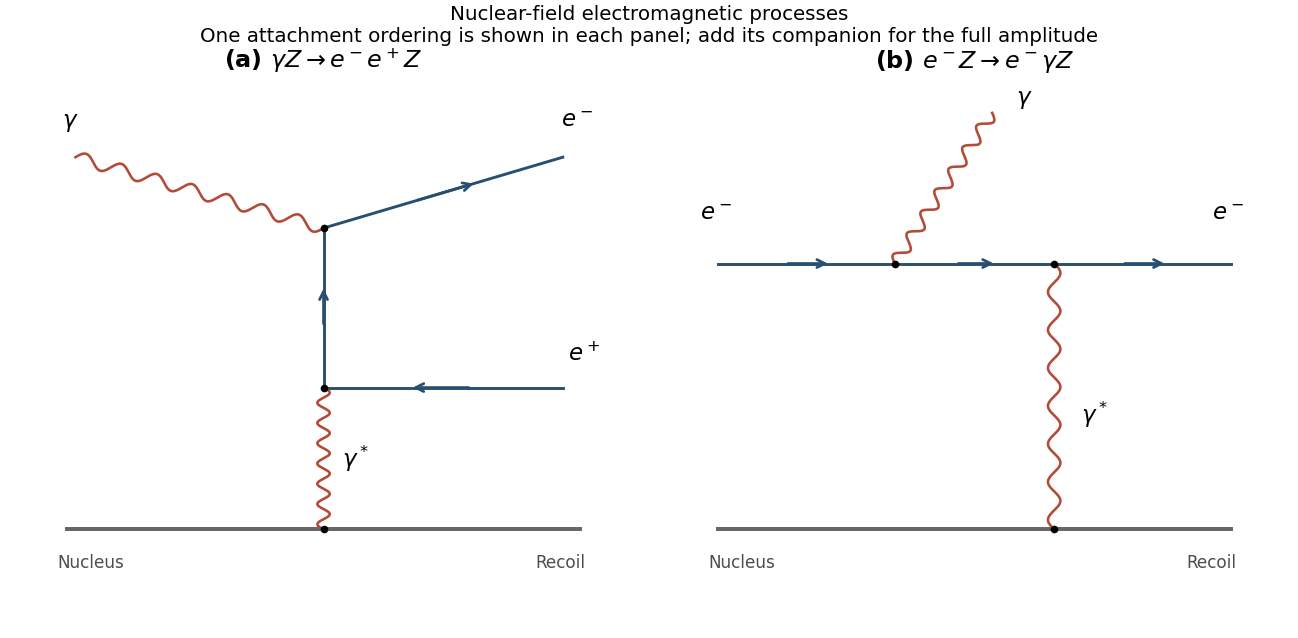


For bremsstrahlung, the electron scatters from the nucleus by virtual-photon exchange and emits a real photon: . The two lowest-order graphs have emission before or after the Coulomb scattering. One is drawn in the figure; interchanging the emission and exchange vertices gives the other. Their sum is needed for the full gauge-consistent amplitude. Reversing the charged-lepton arrows gives Positron bremsstrahlung, with the same underlying electromagnetic mechanism.
At low charged-lepton energy, collisional ionization and excitation dominate over radiation. A slowing Positron also eventually annihilates, usually yielding photons. Low-energy photons lose energy through Compton scattering and, at sufficiently low energy, photoelectric absorption; pair production is kinematically unavailable below its threshold.
The electron critical energy is the energy where mean bremsstrahlung and collisional losses are equal. With and a slowly varying collisional loss,Above this energy, radiation and pair creation multiply shower particles efficiently. Below it, charged particles mainly deposit their energy by collisions and the shower dies out. Critical energy is material dependent; it is not a new photon-production threshold.
In the binary branching model of an electromagnetic shower, after ideal equal-sharing generations, the model has particles of energy , at depth . Stop the branching when . ThusThe continuous estimate is . At 13 generations the particles still have approximately , whereas at 14 they have approximately . The ideal branching model therefore suggests roughly – before multiplication stops.
This is not an accurate containment criterion. Real conversion and radiation distances fluctuate, bremsstrahlung energy sharing is broad rather than always one half, some energetic branches penetrate beyond the average, and particles below critical energy still have stopping and absorption ranges. The simplified stopping depth is closer to its own model's shower-maximum scale than a depth containing all deposited energy. A calorimeter needs additional longitudinal depth to control leakage and event-to-event tails. These effects explain why approximately can be required even though the equal-sharing estimate is smaller. The toy model does not predict the realistic shower maximum or leakage fraction quantitatively.
The principal passive-material requirement is a short radiation length in centimetres, normally obtained using a dense, high-atomic-number absorber such as lead or tungsten. It produces and contains an electromagnetic shower in a compact detector. Mechanical construction, transverse spread, cost, radiation tolerance and inactive gaps also affect the choice, but the absorber is selected for shower formation rather than signal production.
Liquid-argon gaps are a suitable active sampling medium. Ionization electrons drift in an electric field and induce a measurable charge signal. Advantages include radiation tolerance, stable response and useful spatial segmentation. Disadvantages include cryogenic infrastructure, high-voltage and purity requirements, signal collection times and electronic-noise control. Only the active fraction is measured directly, so fluctuations of energy shared between absorber and active gaps introduce a sampling contribution to the resolution. A high active fraction and fine sampling help, at the price of construction complexity and additional channels.
For independent contributions the parametrization meansThe stochastic coefficient includes fluctuations in the sampled shower fraction, the finite number of signal quanta, and intrinsic shower fluctuations. A number of detected quanta proportional to has fluctuations proportional to , giving relative resolution proportional to . The noise coefficient describes an approximately fixed energy-equivalent readout uncertainty, including electronic noise and, for specified running conditions, Pile-up contributions. The constant term represents residual fractional nonuniformity, calibration and response variations, imperfect correction for inactive material, and leakage effects over the fitted range. The simple three-term model is an approximation; leakage and Pile-up need not follow these powers exactly.
A homogeneous calorimeter uses the showering material itself as the active medium, for example a scintillating crystal. It removes the absorber-versus-active sampling fluctuation and can have a much smaller stochastic term, but it does not eliminate signal statistics or intrinsic shower fluctuations. Its noise and constant terms are not automatically smaller: they depend on light collection, calibration, temperature, radiation damage, electronics and geometry. Homogeneous detectors can offer excellent energy resolution and compact construction, but large crystal volumes can be costly and fine longitudinal segmentation difficult. Sampling detectors often provide economical large coverage and flexible segmentation with robust absorbers, at the cost of sampling fluctuations and inactive material. If energy is expressed in GeV, has units , has units GeV and is dimensionless.
Assume first an ultrarelativistic charged-current interaction with negligible electron mass in the centre-of-mass spin analysis. Choose the incident antineutrino along . Its right helicity gives spin ; the interacting left-helicity electron moves along and also has spin . The total initial projection is . The final antineutrino and selected electron likewise have total spin along the outgoing antineutrino direction. The spin-one rotation therefore givesAn unpolarized electron target changes the normalization through the spin average, not this selected-current shape. For electron antineutrinos the charged-current diagram is the -channel graph. A contact approximation further requires .
The full Standard Model also has neutral-current exchange. In the contact limit it supplies a right-electron contribution as well as interference in the left-electron channel. With , , the full high-energy shape is proportional to . Thus the pure squared angular form is an explicitly stated charged-current approximation, not an exact prediction for all Standard Model contributions. At momentum transfers comparable to the weak-boson masses, propagators must also be retained.[ref]
Electroweak Model and Constraints on New Physics by J. Erler and A. Freitas (2024). §10.3.1, equation (10.30) and following electron-neutrino charged-current shift: both left- and right-electron weights
Neglecting the electron mass in the centre-of-mass kinematics, take , , and . Then and . HenceThe constant Jacobian givesIncluding both Standard Model chiral channels in the contact approximation instead gives . The right-electron term is flat in .
In the electron-rest laboratory frame , the invariant definition immediately givesThis last equality is exact. With electron mass retained in the centre-of-mass relation, the angular formula becomes , approaching the boxed massless relation at high energy.
Treat a nucleon as incoherent collinear spin-half quarks and antiquarks carrying fractions of its momentum. Neglect their masses and transverse motion, use a charged-current four-fermion interaction, and take . The subprocess energy is . Antineutrino scattering on a quark has the same selected-current helicity factor as in part a; crossing to an antiquark changes the allowed spin pairing and gives a flat distribution. Multiplying the elementary strength by the respective parton densities givesHere are the effective weak flavour combinations with the isoscalar proton-neutron average and CKM weights absorbed into their definitions. With only light flavours and charge symmetry, the relevant up and down combinations coincide on an isoscalar target. Rescaling those density definitions requires rescaling the prefactor consistently.
The equation is a leading-order scaling result: it neglects logarithmic QCD evolution, heavy-quark thresholds, higher-twist and target-mass corrections, nuclear modifications, and weak-propagator suppression. The current produces for an incident muon antineutrino. At higher momentum transfer the weak propagator supplies a factor approximately , and at low energy resonance and quasielastic scattering invalidate a pure DIS description.
For a nucleon at rest and beam energy well above its mass scales, . If the leading parton distributions are approximately independent of beam energy, integration over therefore makes both total cross sections approximately proportional to . The plotted plateaus are evidence for scattering on approximately pointlike constituents in this range, with the departures expected from QCD evolution and threshold effects.
Define the momentum-weighted contents and . Since , the two cross sections obeyRead the original high-energy plateaus as approximately and in the plotted units. With and ,Using the literal readings gives , so twenty percent is an appropriate graphical estimate, not a precision fit. A purely valence target would have , while a fully symmetric sea would give .
The neutrino-antineutrino DIS sea momentum ratio is a ratio of momentum fractions in the effective flavour combinations, not an unweighted count of antiquarks. The cross-section integral contains : it cannot determine without additional assumptions about their shapes. A distribution growing at small can have a large number integral while its momentum integral remains finite.
The dominant semileptonic decay is . Replacing by or weights the amplitude by or rather than . Neglecting the down-type masses,with the source's rounded matrix entries. For the , three leptonic widths and two open up-type quark rows with three colours give nine common width units. Thus, ignoring QCD and final-mass corrections,Summing all three flavours gives approximately one third; summing only electron and muon modes gives approximately . These are per-top branching ratios, not the separate branching ratio of a specified two-top event topology.
An isolated high-transverse-momentum charged lepton, missing transverse momentum from the neutrino, and a tagged bottom jet form a much cleaner signature than an entirely hadronic final state amid QCD jets. Electrons and muons are the easiest charged-lepton flavours to identify cleanly. Tau decays add neutrinos and often hadrons, making identification and reconstruction more difficult. The figure contains the quark/lepton-level charged-current diagram as well as the rare-loop examples used below.
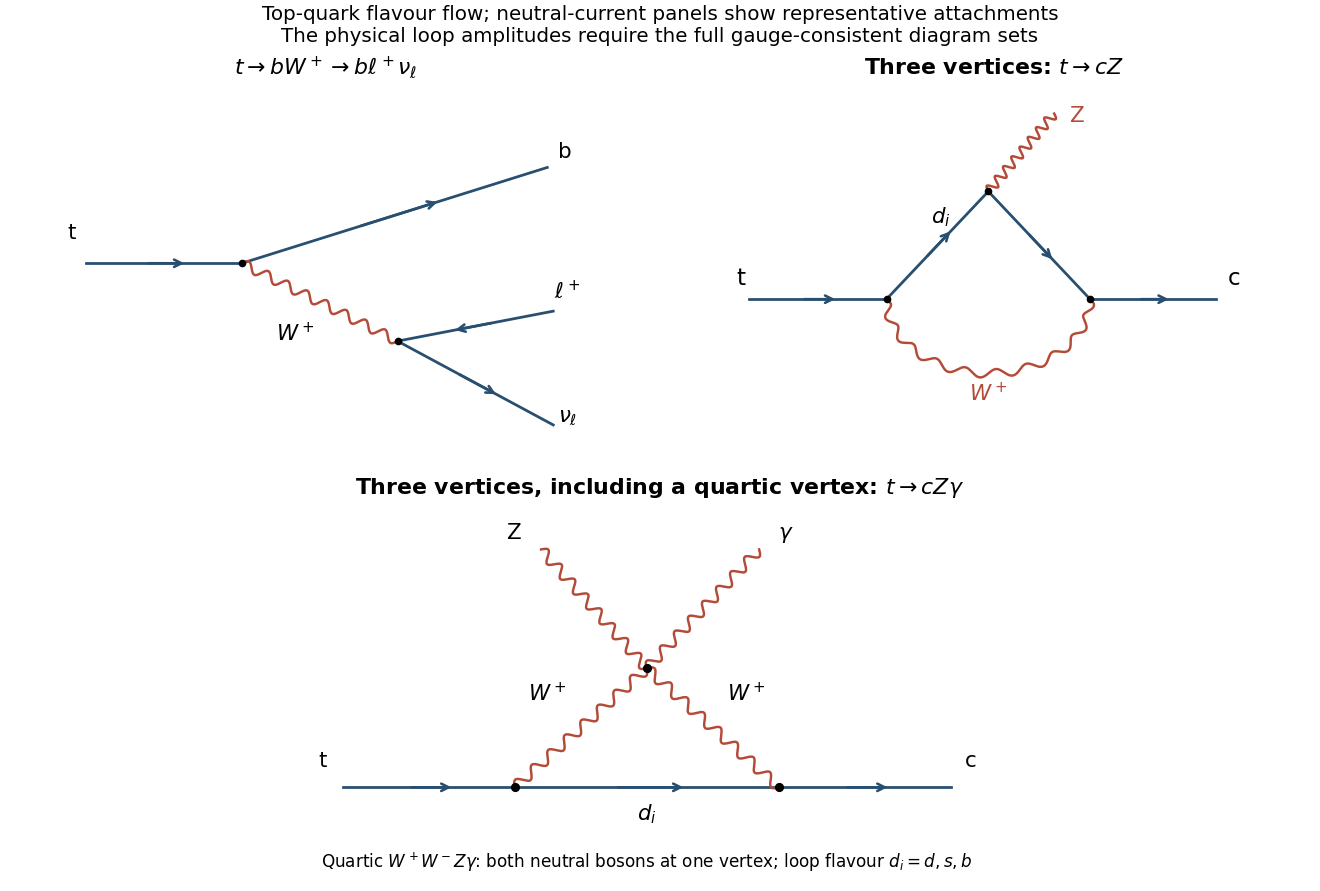
Dominant semileptonic top decay and representative flavour-changing neutral-current loop diagrams
. Details. 
Top decay occurs before a colour-bound hadron can form. Using representative scales – and ,Thus top quarks do not live long enough to form ordinary top-containing mesons. The decay products still participate in QCD radiation and hadronization, so “free decay” here means decay before binding, not a stable observable free coloured asymptotic particle.
The weak charged current couples an up-type quark to the rotated down field . A neutral current is flavour universal within equal-charge quarks. Rotating it into the mass basis therefore givesThe off-diagonal terms vanish by CKM unitarity, so no tree-level flavour-changing neutral current is generated. In the two-generation description, the orthogonal strange-charm partner completes the rotation whose single down-strange combination alone would have produced an off-diagonal neutral coupling. The complete multiplet supplies the cancellation.
At loop level, a flavour-changing amplitude has the structureIf all internal masses were equal, would be common and . Subtracting an arbitrary common value makes the suppression explicit:This is the Glashow-Iliopoulos-Maiani mechanism. Unequal masses leave small loop-level flavour-changing neutral currents, so the statement that they are never observed would be too strong: the mechanism suppresses them and forbids them at tree level. The cancellation requires complex CKM products; the rounded table of absolute values alone must not be summed as if every phase were positive.
The literal final state has a three-vertex loop using the Standard Model quartic vertex . The two other vertices are and , with . The internal down-type quark joins those two vertices, while two charged-vector propagators join them through the quartic vertex emitting both neutral bosons. The bottom panel of the figure shows this topology, satisfying the three-vertex hint without dropping the photon. Its additional electromagnetic coupling is contained in the four-leg vertex; counting vertices alone does not determine coupling order.
The companion single- penguin diagram illustrates : it instead attaches the neutral boson to the internal quark line and has three cubic vertices. These are different final states. A complete gauge-invariant amplitude requires all companion attachments; for these include photon radiation from charged lines as well as the quartic graph.
Both flavour sums have the formwhere the loop function also depends on the final-state kinematics. After cancellation of a mass-independent part by GIM mechanism, the bottom-quark mass gives the largest surviving contribution: , while is not unusually small compared with the strange combination. The larger than then favours final charm. Schematically,The same flavour preference applies to the separate two-body modes and . This estimates a relative flavour preference, not an absolute branching ratio. Loop factors and mass-difference suppression remain, so these channels are fully compatible with GIM. A resolved extra photon also introduces another electromagnetic coupling and three-body phase space; an experimental definition needs photon-energy and isolation cuts to distinguish hard radiation from the soft limit.
For a search, the cleanest neutral-boson reconstruction is or : require an isolated opposite-sign same-flavour pair near the mass and a jet forming the top mass with that pair. In top-pair events, tagging the other top through its ordinary decay provides a bottom jet and, if its is leptonic, another isolated lepton and missing transverse momentum. Kinematic reconstruction and heavy-flavour information help reject vector-boson-plus-jets and other backgrounds. Hadronic or invisible decays have higher rate but less distinctive backgrounds or incomplete mass reconstruction.
For the literal channel, additionally require a prompt isolated photon and reconstruct the top with jet. For the alternative , use an isolated energetic photon and jet near the top mass, again exploiting the other top as a tag. These are search signatures; no present-day observation claim is needed to interpret the historical question.
Articles by others on the same topic
There are currently no matching articles.