The dominant semileptonic decay is . Replacing by or weights the amplitude by or rather than . Neglecting the down-type masses,with the source's rounded matrix entries. For the , three leptonic widths and two open up-type quark rows with three colours give nine common width units. Thus, ignoring QCD and final-mass corrections,Summing all three flavours gives approximately one third; summing only electron and muon modes gives approximately . These are per-top branching ratios, not the separate branching ratio of a specified two-top event topology.
An isolated high-transverse-momentum charged lepton, missing transverse momentum from the neutrino, and a tagged bottom jet form a much cleaner signature than an entirely hadronic final state amid QCD jets. Electrons and muons are the easiest charged-lepton flavours to identify cleanly. Tau decays add neutrinos and often hadrons, making identification and reconstruction more difficult. The figure contains the quark/lepton-level charged-current diagram as well as the rare-loop examples used below.
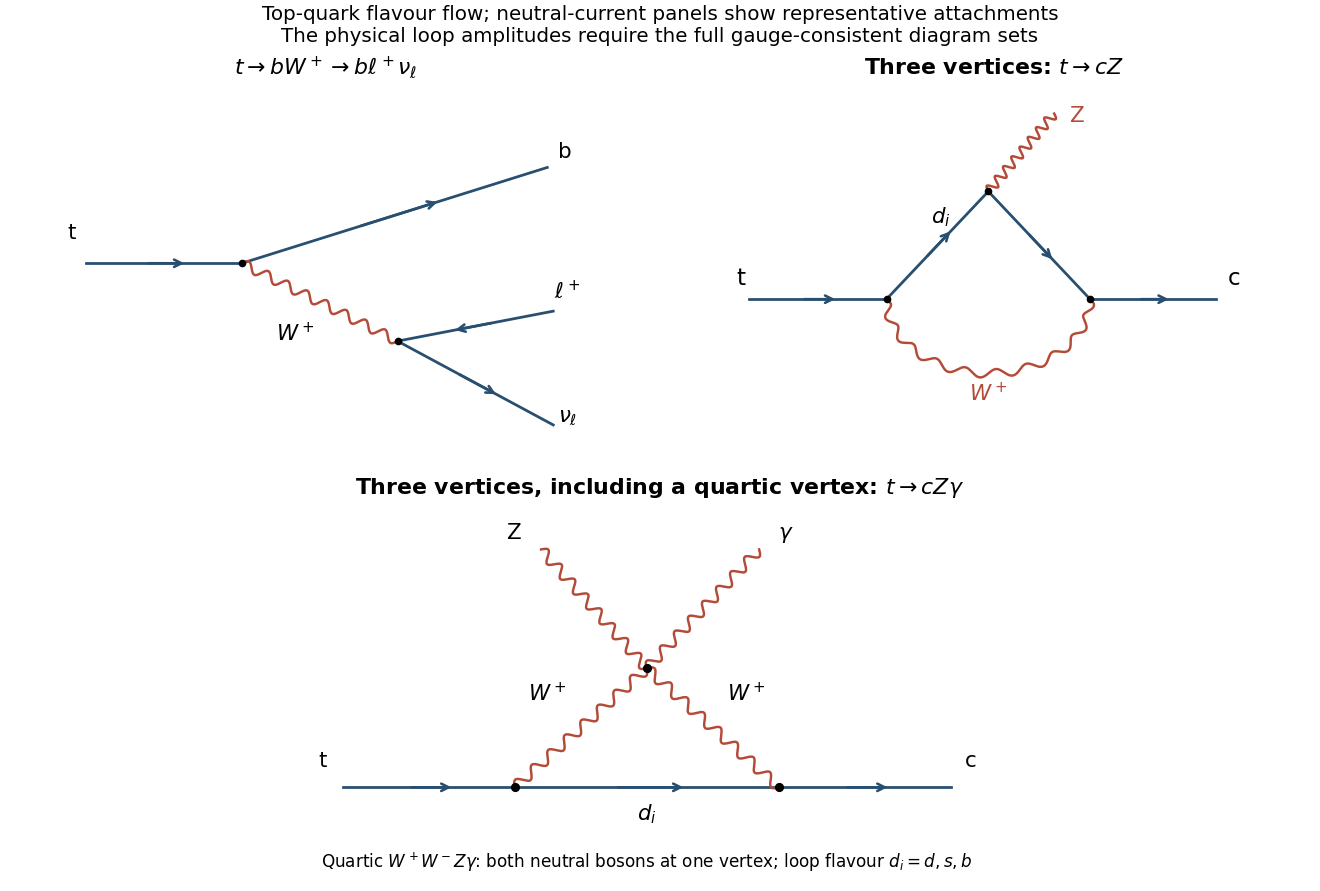
Dominant semileptonic top decay and representative flavour-changing neutral-current loop diagrams
. Details. 
Top decay occurs before a colour-bound hadron can form. Using representative scales – and ,Thus top quarks do not live long enough to form ordinary top-containing mesons. The decay products still participate in QCD radiation and hadronization, so “free decay” here means decay before binding, not a stable observable free coloured asymptotic particle.
The weak charged current couples an up-type quark to the rotated down field . A neutral current is flavour universal within equal-charge quarks. Rotating it into the mass basis therefore givesThe off-diagonal terms vanish by CKM unitarity, so no tree-level flavour-changing neutral current is generated. In the two-generation description, the orthogonal strange-charm partner completes the rotation whose single down-strange combination alone would have produced an off-diagonal neutral coupling. The complete multiplet supplies the cancellation.
At loop level, a flavour-changing amplitude has the structureIf all internal masses were equal, would be common and . Subtracting an arbitrary common value makes the suppression explicit:This is the Glashow-Iliopoulos-Maiani mechanism. Unequal masses leave small loop-level flavour-changing neutral currents, so the statement that they are never observed would be too strong: the mechanism suppresses them and forbids them at tree level. The cancellation requires complex CKM products; the rounded table of absolute values alone must not be summed as if every phase were positive.
The literal final state has a three-vertex loop using the Standard Model quartic vertex . The two other vertices are and , with . The internal down-type quark joins those two vertices, while two charged-vector propagators join them through the quartic vertex emitting both neutral bosons. The bottom panel of the figure shows this topology, satisfying the three-vertex hint without dropping the photon. Its additional electromagnetic coupling is contained in the four-leg vertex; counting vertices alone does not determine coupling order.
The companion single- penguin diagram illustrates : it instead attaches the neutral boson to the internal quark line and has three cubic vertices. These are different final states. A complete gauge-invariant amplitude requires all companion attachments; for these include photon radiation from charged lines as well as the quartic graph.
Both flavour sums have the formwhere the loop function also depends on the final-state kinematics. After cancellation of a mass-independent part by GIM mechanism, the bottom-quark mass gives the largest surviving contribution: , while is not unusually small compared with the strange combination. The larger than then favours final charm. Schematically,The same flavour preference applies to the separate two-body modes and . This estimates a relative flavour preference, not an absolute branching ratio. Loop factors and mass-difference suppression remain, so these channels are fully compatible with GIM. A resolved extra photon also introduces another electromagnetic coupling and three-body phase space; an experimental definition needs photon-energy and isolation cuts to distinguish hard radiation from the soft limit.
For a search, the cleanest neutral-boson reconstruction is or : require an isolated opposite-sign same-flavour pair near the mass and a jet forming the top mass with that pair. In top-pair events, tagging the other top through its ordinary decay provides a bottom jet and, if its is leptonic, another isolated lepton and missing transverse momentum. Kinematic reconstruction and heavy-flavour information help reject vector-boson-plus-jets and other backgrounds. Hadronic or invisible decays have higher rate but less distinctive backgrounds or incomplete mass reconstruction.
For the literal channel, additionally require a prompt isolated photon and reconstruct the top with jet. For the alternative , use an isolated energetic photon and jet near the top mass, again exploiting the other top as a tag. These are search signatures; no present-day observation claim is needed to interpret the historical question.
Articles by others on the same topic
There are currently no matching articles.