Let be the common drop height in the small-gap, small-ball approximation and put . Use upward positive velocity. Just before ground impact both balls have velocity . The massive fixed ground reverses the lower ball's velocity elastically, so immediately before the ball-ball encounterOne-dimensional conservation of momentum and reversal of relative velocity in an elastic collision giveThe sequence is shown for the optimal ratio in b. At that ratio the lower ball stops and the upper ball departs upward, so no immediate third encounter needs to be included. Finite gaps introduce unequal contact times and gravitational corrections; no gap or ball radii are supplied to calculate those corrections.
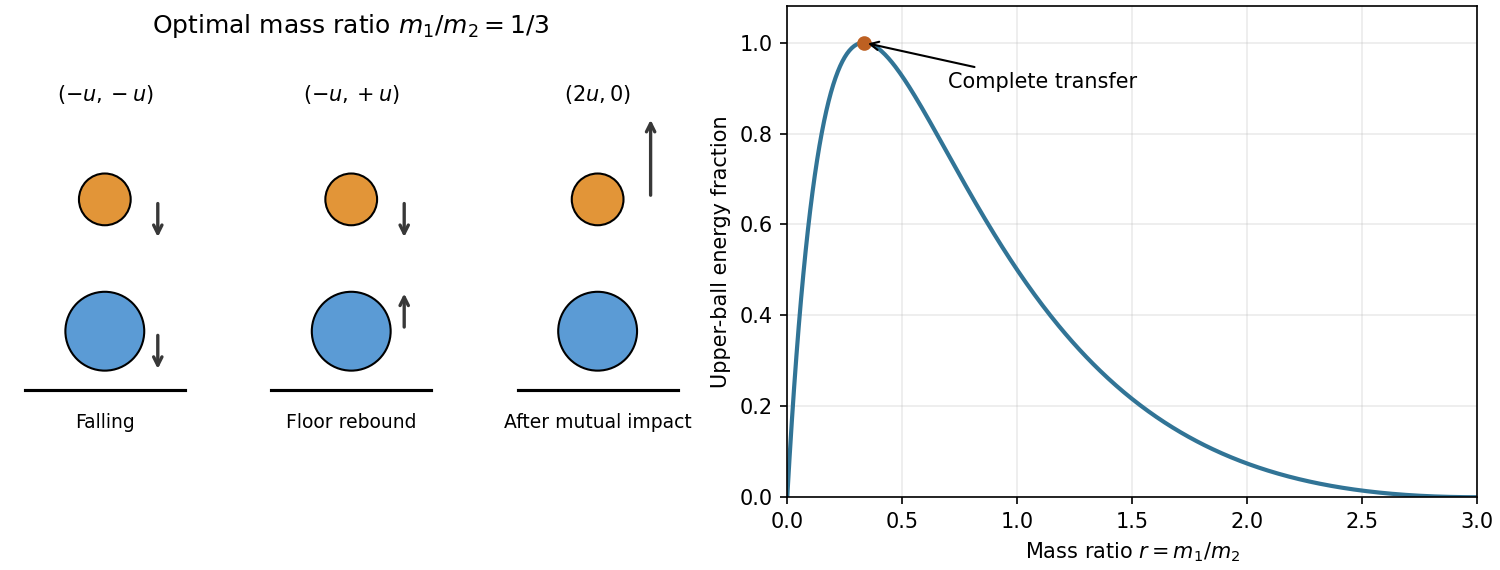
Separated elastic impacts and the energy transfer to the upper ball
. The arrows show the velocities immediately before ground impact, after the lower ball rebounds, and after the mutual collision for the optimal mass ratio. The neighbouring curve gives the upper ball's fraction of the total initial kinetic energy. Details.
Write . The upper ball's fraction of the available kinetic energy after the separated elastic collisions isThus the maximal possible fraction is unity, attained atThe identity proves the global bound without selecting a spurious stationary point. At the optimum the upper ball receives all the initial translational kinetic energy. Its subsequent rise is above the mutual-collision level. For arbitrary large mass ratios further ground encounters may occur; the unity bound is already attained in the stated two-impact sequence.
As , a gives . The upper ball then rises through height above the near-ground mutual encounter:The rise above its original release level is therefore in this idealization. Although its speed triples, the light ball's fraction of the total energy tends to zero, . This distinguishes maximum rebound height from the maximum energy-transfer fraction in b. With finite radii, is the leading approximation in drop height relative to the collision height.
Articles by others on the same topic
There are currently no matching articles.