Source paper: www.whatdotheyknow.com/request/physics_preliminary_examinations/response/1162943/attach/3/Twain.7z?cookie_passthrough=1
Solutions for the sitting of 9 September 2013, including all four alternatives in Section B. Lettered subsections also separate unlettered requests in the source.
Take the upward velocity as positive during ascent. Newton's second law with linear drag givesMultiplication by the integrating factor and integration giveThe maximum height occurs at the first zero of this velocity, henceHere has units of inverse time. The limit gives , and positive drag shortens the ascent relative to motion in a vacuum. The expression applies only up to the turning point; the drag force opposes the subsequent downward motion.
Let and . Incoming material has zero horizontal momentum, while incorporation requires horizontal momentum . Thus the engine supplies force , and its power isNo duration or loading distance is given, so a single total work cannot be assigned. Over an interval in seconds,The remaining becomes internal energy in the inelastic collision that brings the falling material to the wagon's horizontal velocity. Vertical falling kinetic energy, if any, is a separate contribution to dissipation; it does not alter this horizontal work balance. The source alternates between stone and coal; the calculation depends only on the given loading rate.
Use the angle from the vertical as the generalized coordinate. For a uniform ladder, its centre of mass is , so . Its central moment of inertia is . With ideal contact constraints that do no work, the Lagrangian, conjugate momentum, and Euler-Lagrange equation areRelease from rest at also gives by conservation of energy. These results hold while both contacts persist. The ideal wall reaction is normal to the wall; an unspecified tangential wall friction would require an additional generalized force and would prevent determination from the supplied data alone.
The Lorentz factor is and . Traversal of the height takes proper time . Using the exponential decay law with the given muon lifetime,The laboratory flight lasts about , while the elapsed proper time is about . This is the probability of surviving decay to the surface, with atmospheric energy loss and detector efficiency neglected.
Let be the outgoing velocities. In the nonrelativistic elastic collision, equal masses giveby conservation of momentum and conservation of energy. Squaring the first relation and comparing with the second yieldsIf both particles move, their paths are perpendicular. If either velocity vanishes, its direction is undefined and the other particle carries all the incident momentum and kinetic energy. This conclusion depends on the stated approximation.
The external work equals the change in relativistic kinetic energy, . With ,The rest energy cancels between endpoints. At these speeds, the nonrelativistic estimate is close but slightly smaller.
Applying the same work-energy theorem at the higher pair of speeds givesThe identical increment now needs about two thousand times as much work. The growth follows from the rapidly increasing Lorentz factor near the speed of light.
Treat the carriage as translating along the circular track, neglecting wheel rotational kinetic energy and its finite size. At the top, gravity and the inward normal force supply the centripetal acceleration:For unilateral contact, , so the limiting speed is . Conservation of energy from rest at height then givesThis top contact condition is the most restrictive: at angle measured from the bottom, , whose minimum occurs at the top. A mechanically captive carriage able to sustain an outward rail reaction has a different constraint; the result here uses the usual requirement of positive normal contact.
Choose parallel axes along , one through the centre of mass and one displaced transversely by . Write the perpendicular position as . Direct expansion of the moment of inertia givesThe integral in the cross term is zero by the definition of the centre of mass. Therefore the parallel axis theorem isThe axes must be parallel and the reference axis must pass through the centre of mass; the formula is not generally valid between arbitrary parallel axes using either axis as the reference.
Let place the centre of mass vertically below a horizontal pivot axis. The restoring torque and rotational kinetic energy are and , soFor small angles, , and the equation reduces to simple harmonic motion. Thus the physical pendulum hasThis assumes negligible friction and a horizontal axis, with . For a tilted axis the projected gravitational restoring torque changes; an axis through the centre of mass has no gravitational restoring torque.
For the shorter uniform rod, the parallel axis theorem gives . Its equivalent simple pendulum length is . The rod of length pivoted at an end has equivalent length . Matching the periods therefore requiresA pivot on the shorter rod requires , leavingEither side of the rod's centre of mass gives this distance. The other algebraic root is beyond the rod and would require a support extension of negligible mass.
For a frame moving at velocity , put . The Lorentz transformation of the energy-momentum four-vector isExpansion givesThe transverse components are unchanged, hence . For a particle of rest mass this invariant is ; the same algebra also applies to the total four-momentum of a system.
Let be the incident momentum and the outgoing magnitudes in the laboratory frame. Transverse conservation of momentum gives . For the nondegenerate symmetric scattering, , and the two outgoing energies are equal, . ThenCombining these mass shell relations yieldsHere includes the incident electron's rest energy. As the limiting angle is , consistent with the nonrelativistic equal-mass elastic collision; at large the outgoing tracks become forward directed.
For , the result in b gives , hence . Acceleration from rest supplies only the change in kinetic energy:The accelerating electric potential difference is a magnitude; its sign depends on which electrode is taken as the reference, since the electron has negative electric charge.
About a chosen origin , a particle has angular momentum . A body has , or the corresponding integral for a continuous mass distribution. For a fixed origin in an inertial frame,Internal central pair forces cancel in the total torque. About a fixed origin, a central force conserves a particle's angular momentum; zero net force alone is insufficient if an external couple remains.
Put . At the turning point of a radial launch the speed vanishes, so conservation of energy givesThis result is exact within the exterior Newtonian gravitational potential. The condition means is just below the escape velocity: . Replacing gravity by a constant would be inappropriate in this regime.
For a tangential launch, conserved specific angular momentum is . At the outer turning point the radial velocity vanishes but the tangential speed is . ThusUsing a eliminates the gravitational potential difference and givesThe expression printed in the source is the leading correction for , rather than an exact identity. Equivalently, , so the launch speed exceeds the circular value and the surface is the periapsis of the nonintersecting ideal orbit.
At a fixed launch radius the escape threshold is zero total mechanical energy. It depends on the initial speed alone:A direction aimed into the planet can of course cause impact before escape. If the planet rotates, the ground-relative launch velocity must be added to to obtain the inertial velocity. The condition becomes : prograde launch needs less ground-relative speed than retrograde launch. For a spherical planet the threshold expressed as inertial speed at the same radius remains independent of direction.
Let be the common drop height in the small-gap, small-ball approximation and put . Use upward positive velocity. Just before ground impact both balls have velocity . The massive fixed ground reverses the lower ball's velocity elastically, so immediately before the ball-ball encounterOne-dimensional conservation of momentum and reversal of relative velocity in an elastic collision giveThe sequence is shown for the optimal ratio in b. At that ratio the lower ball stops and the upper ball departs upward, so no immediate third encounter needs to be included. Finite gaps introduce unequal contact times and gravitational corrections; no gap or ball radii are supplied to calculate those corrections.
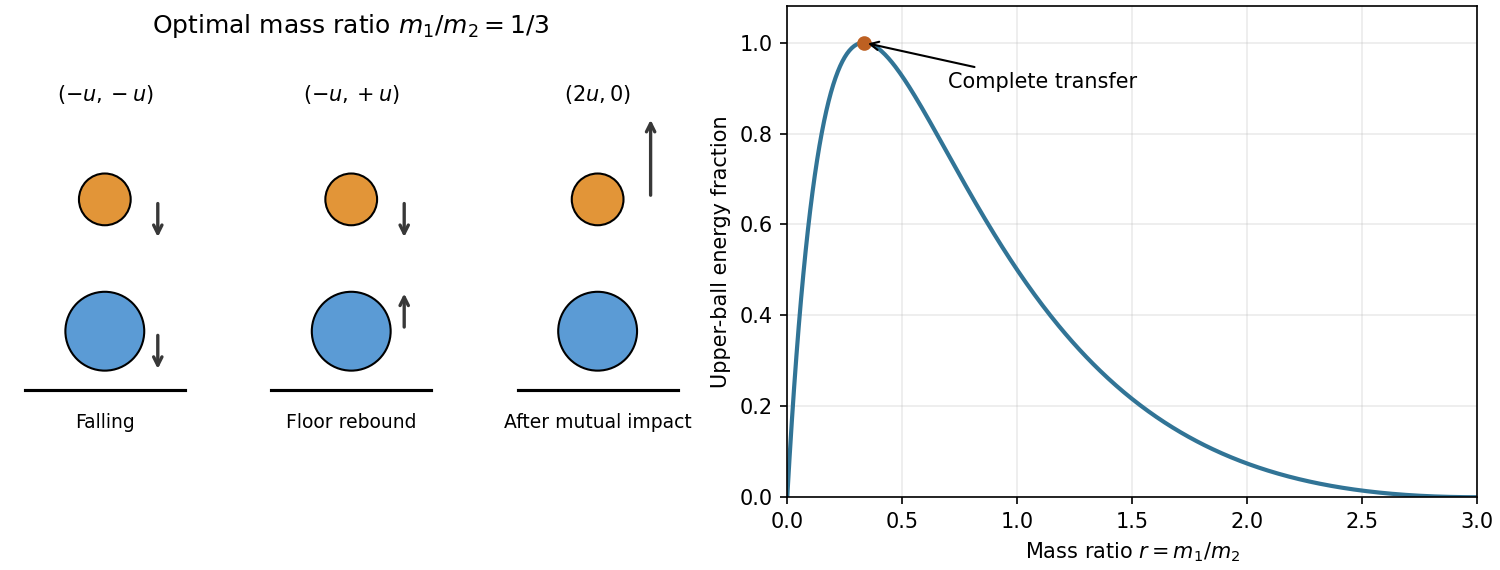
Separated elastic impacts and the energy transfer to the upper ball
. The arrows show the velocities immediately before ground impact, after the lower ball rebounds, and after the mutual collision for the optimal mass ratio. The neighbouring curve gives the upper ball's fraction of the total initial kinetic energy. Details.
Write . The upper ball's fraction of the available kinetic energy after the separated elastic collisions isThus the maximal possible fraction is unity, attained atThe identity proves the global bound without selecting a spurious stationary point. At the optimum the upper ball receives all the initial translational kinetic energy. Its subsequent rise is above the mutual-collision level. For arbitrary large mass ratios further ground encounters may occur; the unity bound is already attained in the stated two-impact sequence.
As , a gives . The upper ball then rises through height above the near-ground mutual encounter:The rise above its original release level is therefore in this idealization. Although its speed triples, the light ball's fraction of the total energy tends to zero, . This distinguishes maximum rebound height from the maximum energy-transfer fraction in b. With finite radii, is the leading approximation in drop height relative to the collision height.
Articles by others on the same topic
There are currently no matching articles.