Einstein's postulates state that the laws of physics have the same form in every inertial frame, and that light in vacuum has the same speed of light in every inertial frame, independently of the motion of its source. For a primed frame moving with velocity relative to an unprimed frame, with coincident origins at , the Lorentz transformations areThe following worldlines use Earth-frame time in years and distance in light years, so numerically . The instantaneous turnaround is the idealized limit of a short acceleration stage; the elapsed proper time is calculated along each inertial segment.
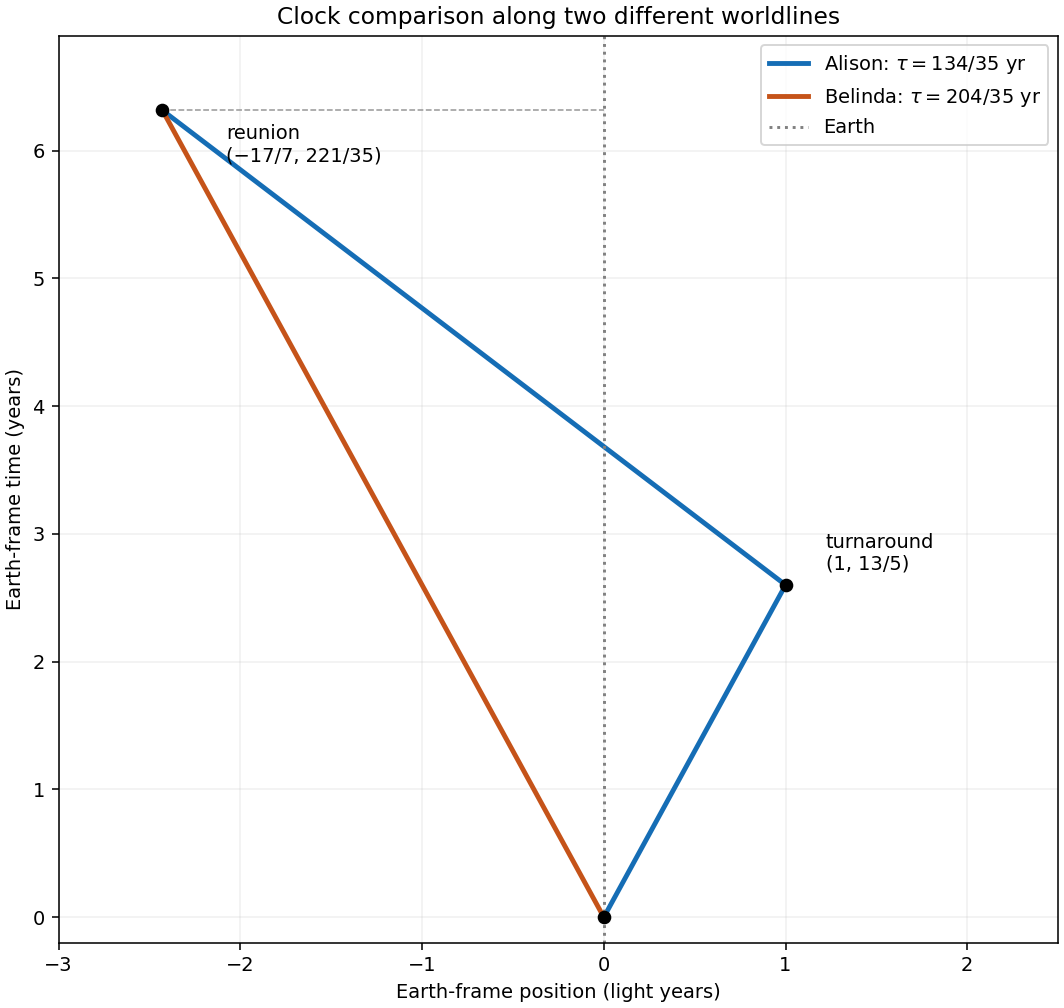

Alison reaches the station at years. Her return worldline iswhile Belinda's is . Equating them givesThis is the elapsed Earth-frame time, measurable by synchronized clocks in that inertial frame. A signal announcing the reunion reaches a clock physically on Earth later; its light-travel delay is not part of the requested frame-time comparison.
Belinda remains in one inertial frame with , so the time dilation factor is . Her elapsed proper time isThe reunion event is shared by both twins, making their clock readings directly comparable without any convention for synchronizing separated moving clocks.
Alison's outbound proper time is years. Her return Earth-frame duration is years, with time dilation factor . Adding the two segments,Alison is two years younger than Belinda at reunion. Her turnaround changes inertial frames, and the faster return segment accumulates less proper time per unit Earth-frame time. The twin paradox is resolved by comparing the complete worldlines, not by applying one constant time dilation factor to Alison's whole journey.
Articles by others on the same topic
There are currently no matching articles.