Take horizontal, upward and . Resolve Newton's second law into components for projectile motion with linear drag:For , let . An integrating factor givesThe relaxation time is , and the terminal velocity is . For fixed finite , expanding the exponential function as gives the continuous limit and ; the two terms proportional to cancel before taking the limit.
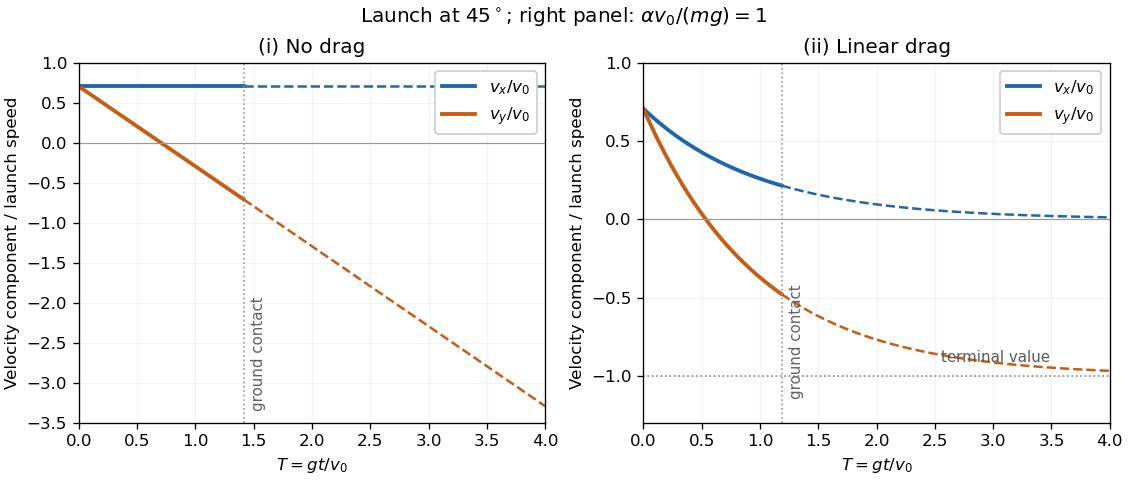
With no drag force, the horizontal velocity graph is a horizontal line at . The vertical velocity graph is a straight line with initial value and gradient :For an upward launch, it crosses zero at the highest point, . The ground-to-ground flight ends at , where . The left panel below shows these components; any continuation after ground contact is only the formal free-flight model.
For positive linear drag, decays exponentially toward zero. The vertical velocity decreases monotonically toward , with an initially steeper gradient and positive second time derivative for an upward launch. It crosses zero atThe right panel shows the two components and the formal terminal velocity. To identify the end of the physical flight, integrate the vertical velocity once:The first positive root of is ground contact. The terminal velocity need not be reached before that event; dashed portions in the sketch are mathematical extensions without a ground surface.

Articles by others on the same topic
There are currently no matching articles.