The held cover dates CP1 to 5 June 2017, despite the source archive's filename. All questions and both projectile motion cases are covered. Lettered or Roman divisions are inferred where separate tasks have no printed labels.
Measure from the downward vertical. The falling mass loses gravitational potential energy . The fixed pivot does no work, so conservation of energy gives its incident speed :At the bottom, the rod is vertical and the impact is horizontal. Its impulsive reaction therefore has no horizontal component. Let and be the subsequent horizontal velocities of the heavy and light balls. Horizontal momentum conservation and unit coefficient of restitution giveThus , and the light ball's outgoing speed isThe calculation neglects the sizes of the balls, treats the rod as massless, and uses an elastic collision. The expression vanishes for release at the bottom; a ball placed exactly at the unstable upright equilibrium requires a perturbation before it can fall.
Write the electron electric charge as , with the elementary charge, and choose and initial velocity . In the nonrelativistic approximation, Newton's second law with the magnetic Lorentz force givesThe magnetic force is perpendicular to the velocity, so it does no work: . Setting , the solution with isConsequently , where : this is a cyclotron orbit. Its frequency and cyclotron radius areThe accelerating voltage changes and but cancels out of . Using and givesOnly the magnitude of the magnetic field is determined; its direction is perpendicular to the orbital plane, with the sense of rotation fixed by the negative electric charge. The claimed voltage independence is a nonrelativistic result: exactly, and . At the correction is about . The stated model also neglects the energy lost to emitted electromagnetic radiation.
Let be the instantaneous total mass of the rocket, including its remaining rocket propellant. During a short ejection it changes by . The expelled mass has velocity to first order in a fixed inertial frame. With no external force, momentum conservation readsDiscarding the second-order product gives . Integrate from initial total mass to rocket dry mass :For constant mass flow rate , the same rocket equation gives and until . The final result depends on the rocket mass ratio, not on how rapidly the fuel is ejected. These are Newtonian velocities; a very large rocket mass ratio would require a relativistic treatment even if the exhaust is slow in the instantaneous rocket frame.
Use the inertial frame in which the departure point and destination are stationary, with separation . The astronauts' elapsed proper time is , whereas . HenceThe Earth-frame travel time is and the speed is approximately . The spacecraft's relativistic kinetic energy is thereforeThe five years are not the time to use in in the departure frame. This is the cruising kinetic energy, with departure and arrival acceleration intervals omitted, rather than a complete propulsion energy budget.
Choose zero potential energy at the equilibrium position. For the simple harmonic oscillator, the kinetic energy and elastic potential energy give the LagrangianIts canonical momentum is . The Legendre transform defining the Hamiltonian consequently givesThe Euler-Lagrange equation is . Thus along the motionThis proves conservation of energy. Equivalently, the Lagrangian has no explicit time dependence, so . The Lagrangian itself need not be constant: the kinetic energy and potential energy exchange periodically.
The parallel axis theorem relates the moment of inertia about an axis to about a parallel axis through the centre of mass, separated by perpendicular distance :In the defining mass integral, expanding the squared distance produces a cross term whose first mass moment about the centre of mass is zero.
For a thin planar rigid body, the perpendicular axis theorem applies to two perpendicular axes in its plane and the perpendicular axis , all meeting at the same point:Indeed, , , and . The planar condition is essential; this is not an identity for an arbitrary three-dimensional rigid body.
Use the usual dumbbell geometry: the uniform thin rod joins the disc centres and is perpendicular to both disc faces. The required axis through the rod midpoint lies in a direction parallel to a diameter of each disc. For either disc, rotational symmetry and the perpendicular axis theorem giveEach disc centre lies a distance from the requested axis. The parallel axis theorem therefore gives a disc contribution . The rod contributesAdd the two disc contributions and the rod's moment of inertia:Using for each disc's central contribution would instead use an axis perpendicular to its face, which is parallel to the rod and is not the requested axis.
Take horizontal, upward and . Resolve Newton's second law into components for projectile motion with linear drag:For , let . An integrating factor givesThe relaxation time is , and the terminal velocity is . For fixed finite , expanding the exponential function as gives the continuous limit and ; the two terms proportional to cancel before taking the limit.
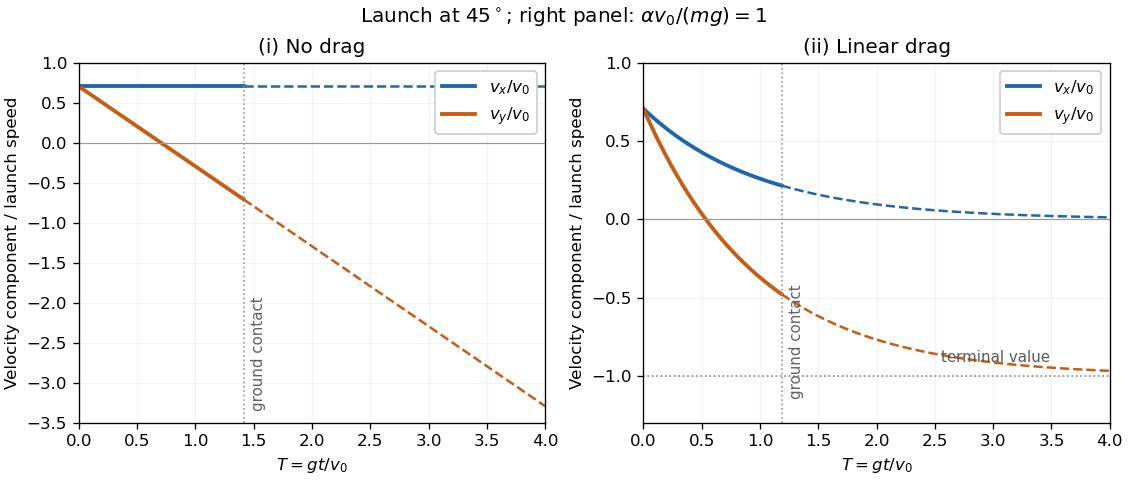
With no drag force, the horizontal velocity graph is a horizontal line at . The vertical velocity graph is a straight line with initial value and gradient :For an upward launch, it crosses zero at the highest point, . The ground-to-ground flight ends at , where . The left panel below shows these components; any continuation after ground contact is only the formal free-flight model.
For positive linear drag, decays exponentially toward zero. The vertical velocity decreases monotonically toward , with an initially steeper gradient and positive second time derivative for an upward launch. It crosses zero atThe right panel shows the two components and the formal terminal velocity. To identify the end of the physical flight, integrate the vertical velocity once:The first positive root of is ground contact. The terminal velocity need not be reached before that event; dashed portions in the sketch are mathematical extensions without a ground surface.

For a uniform thin disc, the surface mass density is . An annulus of radius and thickness has mass , all at distance from the normal central axis. Its contribution to the moment of inertia is , soThis establishes the moment of inertia of a uniform disc; the normal axis and uniform surface mass density are part of the result.
Take the rotation axis as . A slice of the uniform sphere at coordinate is a disc of radius and mass , where is its mass density. Applying a to the slice givesThe slices' axes coincide, so no displaced-axis correction is needed. Integrating,Thus the moment of inertia of a uniform solid sphere isThe sphere's rotational symmetry makes this valid about every central axis. A thin spherical shell would have a different mass distribution and a different moment of inertia.
Choose positive horizontal velocity to the right and positive spin angular velocity anticlockwise, as in the source drawing. At the bottom of the sphere, the rotational velocity is then to the right: the initial tangential contact-point velocity isFor the illustrated positive , the contact slips to the right, so the tangential contact force acts leftward. The upward normal force acts through the sphere centre and produces no spin torque. The tangential contact force acts at lever arm and produces a clockwise torque, reducing the positive spin. The weight acts vertically downward through the centre of mass.
During the short impact the contact impulses dominate the weight's impulse. In an ideal elastic rough contact, the tangential deformation can store and return energy; its contact force need not be a dissipative sliding-friction law throughout the collision. For other signed incoming states, reverse the initial tangential force if ; if , no tangential impulse is required.
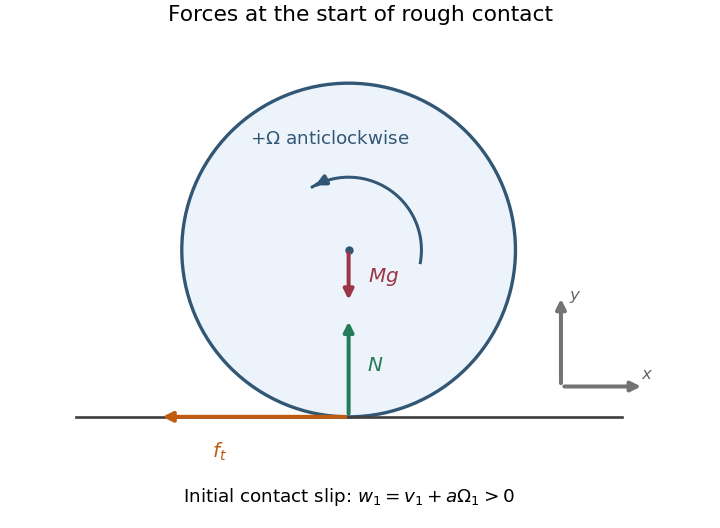

Write the sphere's mass as and use from b. Let and be the upward and rightward contact impulses. The initial vertical velocity is and the outgoing vertical velocity is . Perfect normal elasticity givesThe tangential and angular impulse equations areFor the ideal elastic rough-sphere bounce, the tangential translational plus rotational kinetic energy is restored on separation. Substituting these two equations into that requirement givesThe interacting rough-contact branch, rather than the smooth branch , therefore hasConsequently, with all tangential quantities signed in the convention of c,In particular, : the tangential contact-point velocity reverses. The outgoing may be negative; the sphere rebounds backward when . Substitution also checks both total kinetic energy and angular momentum about the contact point, .
This result uses the conventional perfectly elastic, fully rough contact idealization. The word rough alone, with an unspecified finite coefficient of friction, would not determine the outgoing tangential state. For example, imposing sticking at separation would instead give and dissipate , contradicting total elasticity unless . The displayed elastic branch requires enough tangential impulse; a Coulomb bound would at least require .
For a massive free particle with rest mass and velocity ,The relativistic energy-momentum relation follows directly:This is the squared Minkowski norm of the four-momentum multiplied by . The Lorentz transformation preserves that norm, so it has the same value in every inertial frame. In the particle's rest frame, the momentum is zero and the total energy is its rest energy .
Choose particle 1's incoming velocity positive and particle 2's negative. The final particle is stationary, so four-momentum conservation requires zero total incoming momentum:It follows that . Squaring gives , henceThe initial total energy becomes the final rest energy. ThereforeThe extra invariant mass is the incoming kinetic energy retained as internal energy of the merged particle: . It does not violate conservation of energy or four-momentum conservation; the sum of the separate rest masses is not a conserved quantity in an inelastic collision.
Let move at along relative to . The Lorentz transformation of energy and momentum, from primed to unprimed components, isThe inverse equations have replaced by and the primes interchanged. A photon making angle with in has . Thus its general Doppler factor isThe requested blueshifted expression assumes propagation parallel to the boost, :The propagation-direction assumption matters: for an oppositely travelling photon, , the reciprocal of the displayed factor. Relative frame speed alone does not select the longitudinal relativistic Doppler effect.
For the forward ray of i, the ultrarelativistic longitudinal Doppler factor follows from the exact expression in terms of the Lorentz factor:Indeed, for a positive boost. If , the exact formulas and their consistent asymptotic expansions areEquivalently,The printed equality is not exact. For a concrete ultrarelativistic example, gives the correct , whereas . The latter expands as , with the wrong first correction.
One can obtain the printed expression by using but replacing by only its leading approximation . This retains a constant term in the first equation while discarding a same-order term in the second. Thus is admissible only as a leading relative-accuracy estimate, of the same order as ; it is not the stated identity or a correct next-order approximation.
Let the incident photon energies be and , meeting at angle in the laboratory frame. Add their four-momenta; because each is null, the squared total invariant energy isFor photon-photon pair production, its threshold value is : the electron and Positron have zero relative momentum in their centre-of-momentum frame. The minimum possible occurs for a head-on collision, , soWith and ,The quoted background photon energy is used directly, without substituting a different characteristic value of the cosmic microwave background. A less opposed collision has a higher threshold; parallel photons cannot produce this massive pair.
At the threshold found in i, both products are stationary in the centre-of-momentum frame, so they have the same velocity in the laboratory frame. Take the energetic incident photon along . The total energy is and total momentum is , so the centre-of-momentum frame moves atFor the numerical threshold,This is extremely close to, but strictly below, the speed of light. Each product has energy in the laboratory frame. Above threshold the same ratio of total momentum to total energy determines the motion of the pair's centre-of-momentum frame, but the individual electron and Positron need not have a common velocity.
For independent generalized coordinates , their generalized velocities and a Lagrangian , the Euler-Lagrange equations areHere the partial derivatives treat as independent arguments, whereas follows the motion. For a conservative mechanical system, choose coordinates satisfying the mechanical constraints, express the kinetic energy and potential energy in those coordinates, set , and evaluate these equations to obtain the equations of motion. If nonconservative generalized forces are present, they appear on the right-hand side.
A cyclic coordinate is absent explicitly from : , even though may depend on . Its canonical momentum is consequently conserved,This does not require or even that be constant; the relation between canonical momentum and generalized velocity depends on the Lagrangian.
Take positive horizontally toward the downhill end of the plane, with . The normal force is , since there is no acceleration perpendicular to the stationary plane. Along the plane, the only tangential force is , so Newton's second law gives .
Its horizontal projection is thereforeEquivalently, the normal force has horizontal component while gravity has none, giving . For a plane whose height increases in the positive direction, the answer instead carries a minus sign. A horizontal plane gives zero acceleration; the horizontal projection also tends to zero for a vertical plane.
Model the cart as a particle on a fixed plane curve, remaining constrained to the track. Its vertical velocity is , so its kinetic energy, gravitational potential energy and Lagrangian areConsequently the canonical momentum conjugate to the horizontal coordinate isIt is not simply the horizontal component of the mechanical momentum, because a change in also moves the cart vertically. Differentiate carefully in the Euler-Lagrange equation:Subtracting yieldsThe term involving accounts for the changing track geometry. An independent check is conservation of energy:
If over the subsequent segment, its slope is a constant and the equation of motion reduces toThere is uniform horizontal acceleration, not generally zero acceleration. Starting that segment at ,For a downhill straight track with , this gives , agreeing with b. Only gives constant horizontal velocity.
The condition must describe an actually straight limiting segment, with bounded velocity, for that subsequent constant-acceleration conclusion. If vanishes only at an isolated inflection point, the boxed expression describes the instantaneous acceleration there; it does not make the rest of the track straight. Likewise, a vanishing alone does not make the product negligible in a limit where diverges.
Use a reference frame moving with Jupiter, neglect the spacecraft's effect on the planet and neglect the Sun during the short encounter. The Newtonian central force makes the orbit planar and conserves the angular momentum . In plane polar coordinates, the kinetic energy is . Choosing zero gravitational potential energy at infinity givesThe terms are respectively radial kinetic energy, transverse kinetic energy, and attractive gravitational potential energy. The second term is often combined with the third into the radial effective potential. Far from Jupiter,Here is the perpendicular impact parameter of the incoming asymptote, not the eventual periapsis distance.
Put . At the periapsis distance, the radial velocity vanishes. Insert and into a:The positive root isRationalizing gives the numerically stable alternative . Attraction makes . This is a point-planet scattering calculation; a noncolliding physical encounter must also have outside Jupiter's surface. At , the limiting formula gives a radial collision, not a flyby.
Let be the specific angular momentum, and measure the orbital angle from periapsis. Set . From , differentiating gives . The radial equation of motion becomes the Binet equationIts solution symmetric about periapsis isFor example, the expression for the orbital eccentricity follows by substituting and into the energy equation: . Since , this is a hyperbolic Kepler orbit.
The outgoing asymptote occurs at with , where . The incoming velocity points inward along the incoming radial asymptote, whereas the outgoing velocity points outward. Therefore the change in velocity direction is , not . It follows thatFor , this gives : a large impact parameter produces a small deflection, and the ideal point-mass limit approaches a reversal.
A gravitational scattering angle has . ThusThe denominator uses the squared speed in , not its numerical value in . From b, the corresponding periapsis distance is ; this differs substantially from the impact parameter because of gravitational focusing.
Take Jupiter's heliocentric velocity as . Conservation of energy in the Jupiter frame makes the incoming and outgoing asymptotic speeds both . For the encounter, an outgoing velocity in Jupiter's direction requires the incoming Jupiter-frame velocity to be perpendicular to it:Use a Galilean transformation back to the Sun frame:The heliocentric speeds are thereforeThe incoming direction makes an angle with Jupiter's motion; its two signs describe mirror-image encounter planes. The gravitational assist transfers orbital energy from Jupiter to the spacecraft: the spacecraft's specific kinetic energy increases by , or, using the unrounded squared incoming speed, exactly . There is no gain in asymptotic speed in the Jupiter frame; the gain is a consequence of changing frames while the planet is moving.
Articles by others on the same topic
There are currently no matching articles.