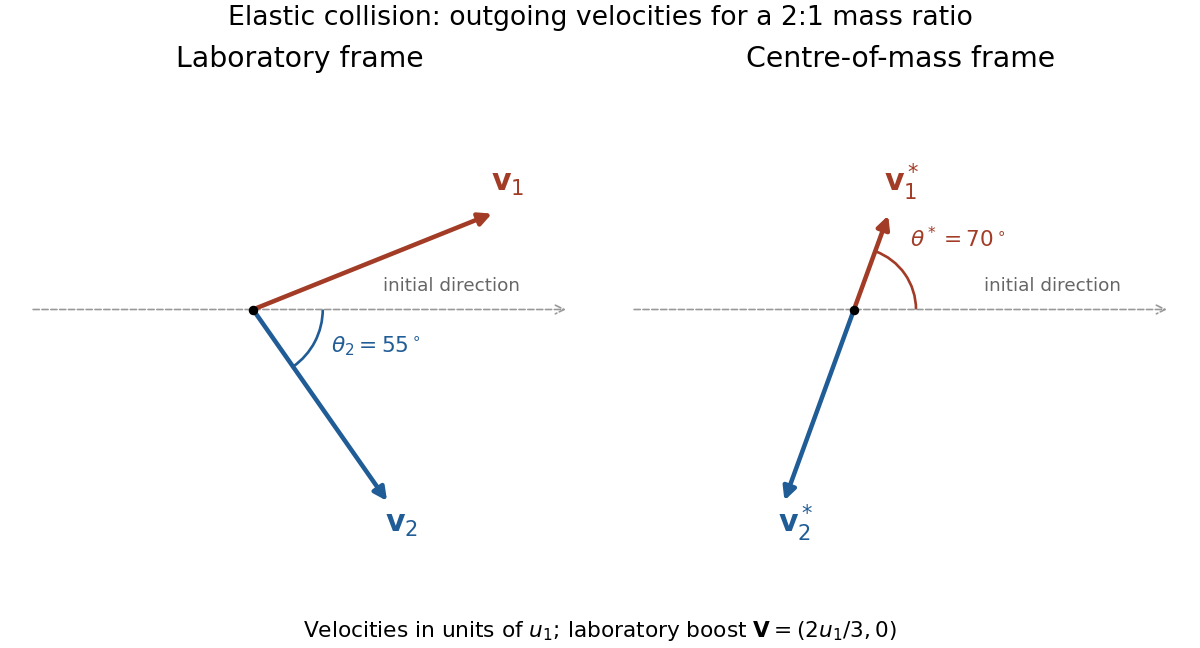
Choose the initial incident velocity as . The centre-of-mass velocity in the laboratory frame isIn the centre-of-mass frame, the initial velocities are and . Conservation of momentum and kinetic energy in an elastic collision preserves these two speed magnitudes. Let be the outgoing angle of particle 1 in that frame, measured from the initial positive direction. ThenAdding to transform back to the laboratory frame givesThe nonnegative laboratory recoil angle is measured below the incident axis in this choice of scattering plane. Hence the recoil angle in a two-body elastic collision obeysThe source identity therefore uses for the projectile's outgoing direction in the centre-of-mass frame. If instead it denotes particle 2's outgoing direction, the corresponding expression has in the denominator. A signed laboratory angle for the drawn target trajectory would carry a minus sign. At zero deflection the target remains at rest, so its direction is undefined; is a limit.

Articles by others on the same topic
There are currently no matching articles.