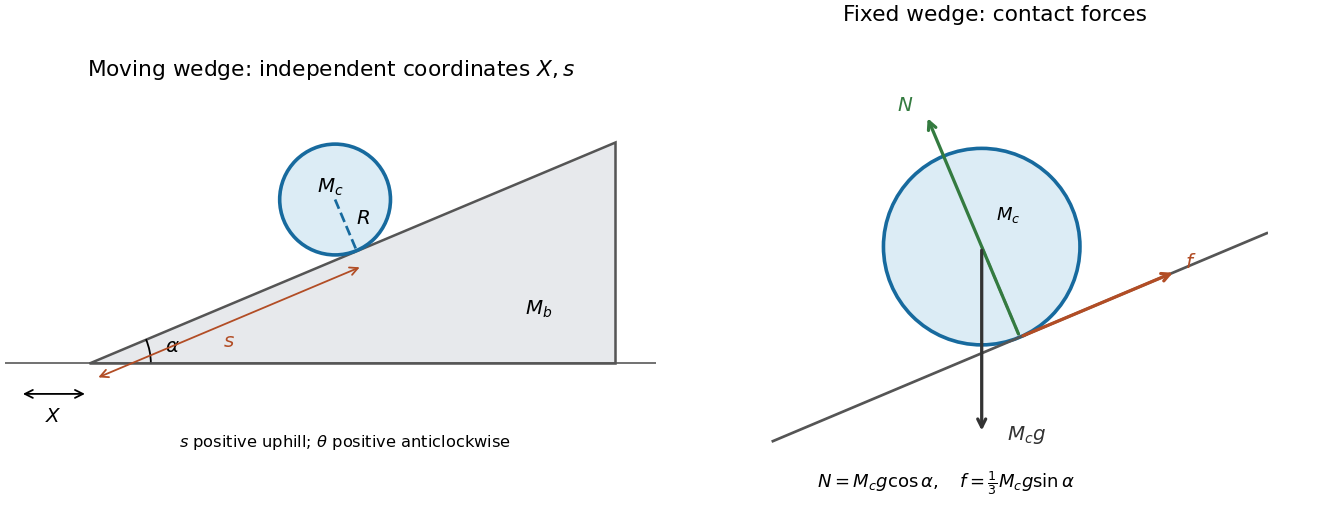
With the wedge fixed, let be the signed gap between the cylinder bottom and the surface, positive outwards. The centre height is . Retaining all three coordinates before imposing constraints givesUse the holonomic constraints and . With the convention , the Lagrange multiplier equations areThe constraint gradients identify , the normal reaction, and , the uphill static friction force. The latter supplies the rolling torque. Setting and yieldsThe static friction condition therefore becomesfor . Static friction is required to create rotation, but does not dissipate energy here because the contact point is instantaneously at rest on the fixed plane.

Articles by others on the same topic
There are currently no matching articles.