For a Lagrangian expressed in independent generalized coordinates, stationary action gives the Euler-Lagrange equationsIdeal constraints can either be incorporated into the independent coordinates or treated using Lagrange multipliers, as in solution.
A cyclic coordinate is absent from the Lagrangian itself: . Its conjugate momentum therefore obeys . In the rolling-wedge calculation, the cyclic horizontal translation gives conservation of the system's horizontal momentum.
A holonomic constraint can be expressed as , rather than as a genuinely nonintegrable relation among velocities. A fixed rod length is an example. Rolling along a single straight incline also gives an integrable relation with the sign convention used below; arbitrary rolling in more dimensions need not be holonomic.
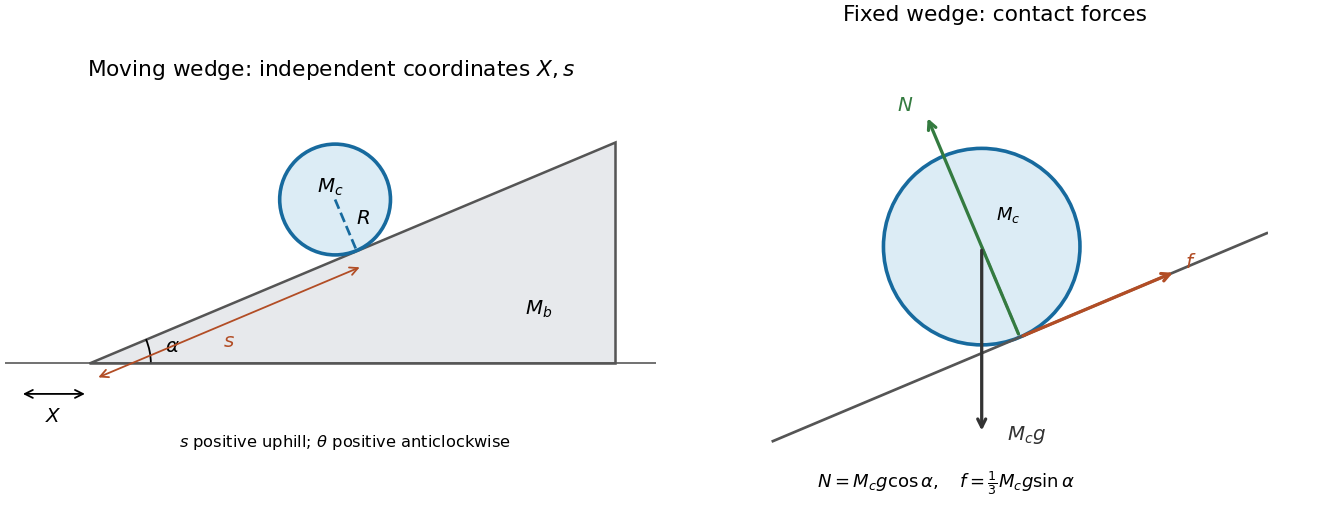
Take positive uphill, positive to the right, and the cylinder's rotation positive anticlockwise. Contact with the fixed-angle surface determines its normal position; no slipping gives . These two constraints leave as the two independent coordinates of the cylinder rolling on a freely translating wedge.
The cylinder centre is at . Since the angle is constant, its squared speed is . Including the block's kinetic energy and , and dropping a constant from the potential, givesThe cyclic coordinate is . Its conserved conjugate momentum is , the total horizontal momentum. The two Euler-Lagrange equations areEliminating the accelerations, with , givesThus the cylinder rolls downhill and the wedge accelerates rightward. For , and , the ordinary fixed-incline result.
With the wedge fixed, let be the signed gap between the cylinder bottom and the surface, positive outwards. The centre height is . Retaining all three coordinates before imposing constraints givesUse the holonomic constraints and . With the convention , the Lagrange multiplier equations areThe constraint gradients identify , the normal reaction, and , the uphill static friction force. The latter supplies the rolling torque. Setting and yieldsThe static friction condition therefore becomesfor . Static friction is required to create rotation, but does not dissipate energy here because the contact point is instantaneously at rest on the fixed plane.

Articles by others on the same topic
There are currently no matching articles.