In matter, Gauss's law for free electric charge isThe area normal points out of . In vacuum , so these become and .
Put charges and on the concentric conductors. Gauss's law gives between them, . The potential difference isThe capacitance of this vacuum spherical capacitor is thereforeThe conductors are equipotentials; a uniform dielectric filling would replace by its permittivity.
At the distances from the two centres are equal:By the electrostatic shell theorem, a uniformly charged spherical shell gives zero field inside and its point-charge field outside. For the point is inside both shells. For only the small, negatively charged shell contributes. For both contribute, soThe requested magnitude isIt jumps from zero to at , decreases to just before , jumps down to just after , and then falls as . The ideal surface charge makes the field discontinuous at each crossing, so the one-sided limits, rather than a unique value on the sheet, specify the graph. The far field is the equatorial field of an electric dipole with electric dipole moment .
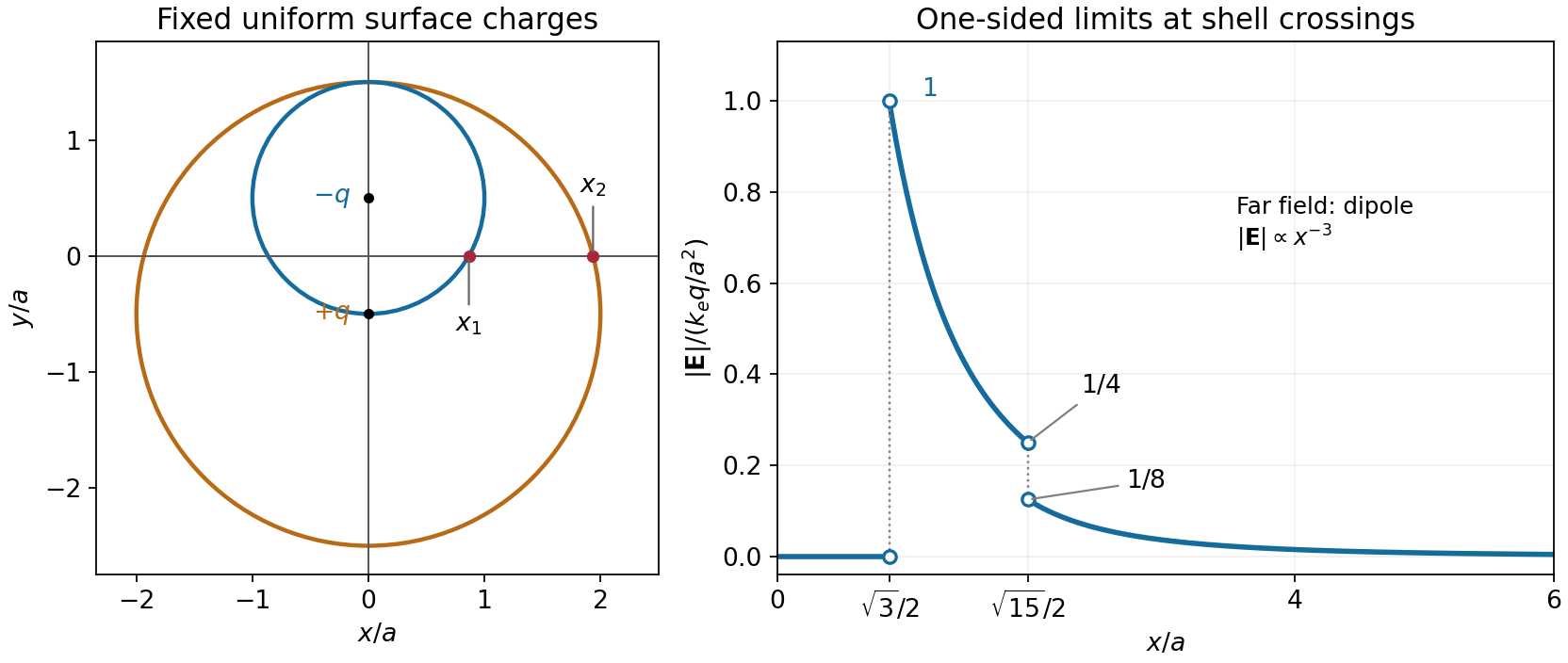
Geometry and electric-field magnitude for the two offset charged shells
. The open endpoints give the one-sided limits at the two surface crossings. The field is zero inside both shells and has a dipolar far-field tail. Details.
Articles by others on the same topic
There are currently no matching articles.