Source paper: Oxford source archive, member
2014/CP2_September_2014.pdf. The cover dates this sitting to 9 September 2014. All ten questions are treated. Unlettered marked blocks use ordinal subparts; printed letters are retained.Put at and at , and write . The electric fields of the two positive point charges can cancel only between them. For , zero Lorentz force on therefore requiresThe force of on points left, so must be negative to pull right. Equating these forces givesFor , the attraction to at separation has magnitude , exactly balancing its repulsion from . Thus all three forces vanish, not only the force on the inserted charge.
Choose the loop axis as , with positive electric current circulating by the right-hand rule. The Biot-Savart law isFor a loop element and an axial observation point, . The transverse components cancel between opposite elements. The axial component of is , soThusReversing the electric current reverses the field. At the centre , while the far field decreases as , as expected for a magnetic dipole.
Let be the angle between the coil's area normal and the uniform magnetic flux density. The linked magnetic flux is . Faraday's law givesThe sign uses the winding direction associated with the chosen normal; reversing the terminal convention changes it. The magnitude is largest when : the coil's normal is perpendicular to the magnetic field, so the plane of the coil is parallel to it. At that orientation the instantaneous magnetic flux is zero but its rate of change has maximum magnitude.
Write and . The electric field isIt has linear polarization, along the fixed line , at angle from toward . For the associated plane electromagnetic wave, Faraday's law gives . HenceIn vacuum . Both fields are transverse, and points along .
Here , so the tip of the electric field traces a circle at constant magnitude: this is circular polarization. At fixed , it starts at when and initially rotates toward . This explicit rotation specifies the sense without relying on competing handedness conventions.
Using , with , givesIn vacuum replace by . The magnetic flux density also has constant magnitude and is perpendicular to at every instant.
For normal incidence, the first-order maximum of a diffraction grating obeys . Differentiating at givesTherefore the positive first-order peaks are separated byThe larger wavelength is diffracted farther from the normal. Both first orders must exist, ; extremely close to grazing incidence the finite difference of the two inverse sines should replace this local approximation.
Let denote the capacitance omitted after the word “capacitance” in the source sentence. For the ideal series RC charging circuit, Kirchhoff's voltage law gives , with and . ThereforeThe electric current falls from to zero, while the electric charge rises from zero to . Their initial slopes are and , respectively.
Reducing shortens the approach to the relevant final values. Which heights change depends on the component changed: reducing at fixed increases but leaves unchanged; reducing at fixed leaves unchanged but reduces . A shorter time constant alone does not specify both endpoint amplitudes.
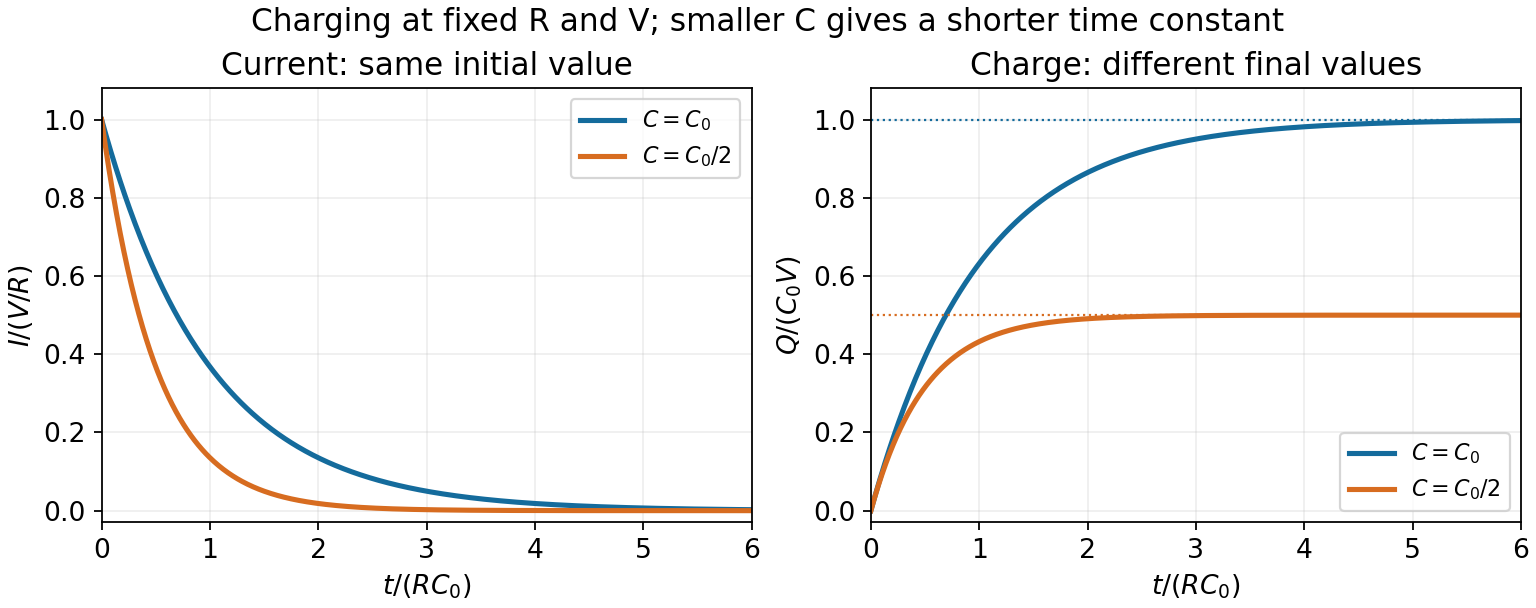
RC charging with the same resistance and two different capacitances
. The reference time is R times the larger capacitance. Reducing capacitance halves the time constant and final charge while keeping the initial current fixed. Details.
The Lorentz force law isIts rate of work is , because . Thus, with , the kinetic energy cannot increase: a static magnetic field changes the direction of motion but does no work.
Take the initial velocity perpendicular to a uniform magnetic field. The magnetic Lorentz force is perpendicular to the motion, has constant magnitude , and supplies the centripetal force:The rotation sense is fixed by . A component of velocity parallel to the field remains constant and produces a helical motion in a uniform magnetic field; a circle requires that component to vanish. The speed-independent cyclotron frequency here assumes nonrelativistic motion.
For a proton, the fundamental cyclotron resonance condition isA half-orbit takes , during which the applied voltage reverses sign once. The proton then crosses the gap in the opposite direction and receives another accelerating impulse. The electric force in the gap, rather than the magnetic bending inside a dee, provides the kinetic energy. The injection phase must be chosen so the first crossing accelerates the proton.
At the largest admitted orbit, and . ConsequentlyUsing and with the specified and yieldsThis is about ; the displayed results use the nonrelativistic approximation explicitly requested by the paper. The drive amplitude controls the energy gain per gap crossing and hence the number of turns, but the ideal orbit-radius limit is set by and .
In matter, Gauss's law for free electric charge isThe area normal points out of . In vacuum , so these become and .
Put charges and on the concentric conductors. Gauss's law gives between them, . The potential difference isThe capacitance of this vacuum spherical capacitor is thereforeThe conductors are equipotentials; a uniform dielectric filling would replace by its permittivity.
At the distances from the two centres are equal:By the electrostatic shell theorem, a uniformly charged spherical shell gives zero field inside and its point-charge field outside. For the point is inside both shells. For only the small, negatively charged shell contributes. For both contribute, soThe requested magnitude isIt jumps from zero to at , decreases to just before , jumps down to just after , and then falls as . The ideal surface charge makes the field discontinuous at each crossing, so the one-sided limits, rather than a unique value on the sheet, specify the graph. The far field is the equatorial field of an electric dipole with electric dipole moment .
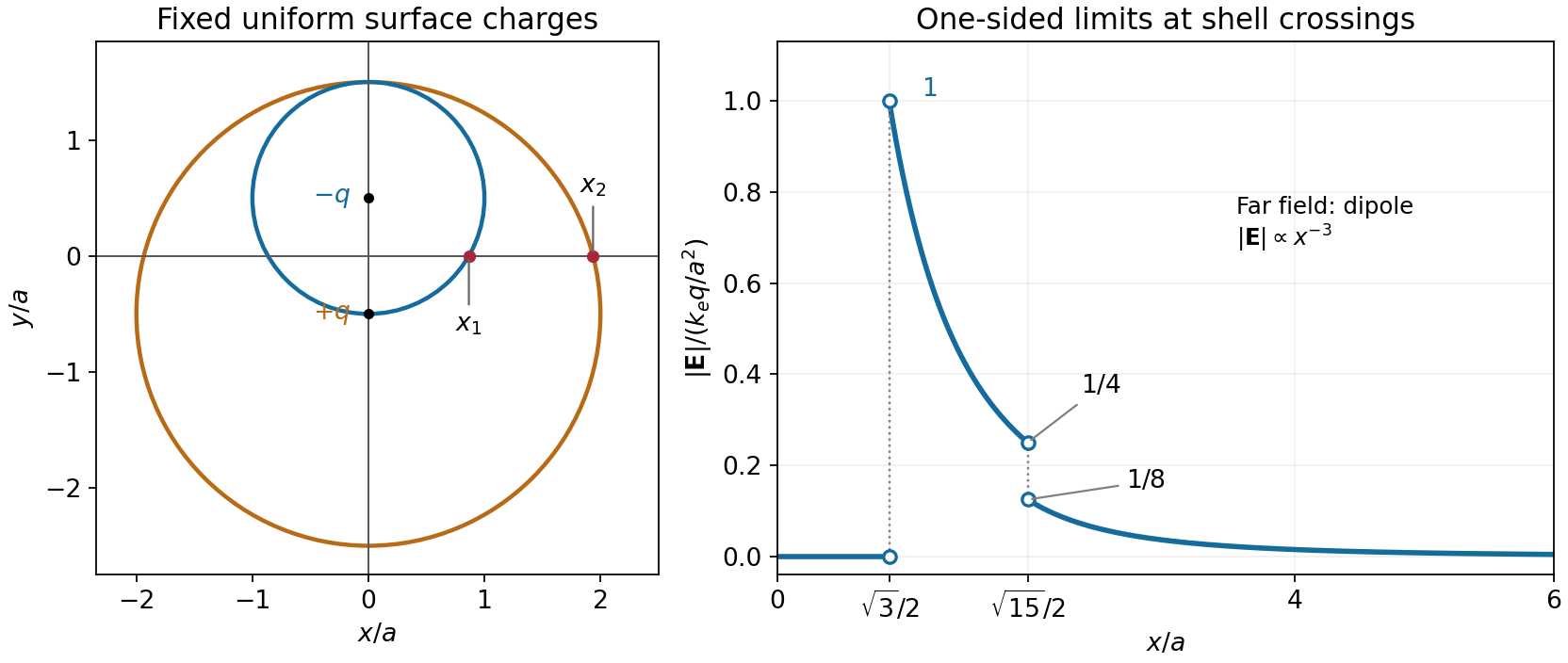
Geometry and electric-field magnitude for the two offset charged shells
. The open endpoints give the one-sided limits at the two surface crossings. The field is zero inside both shells and has a dipolar far-field tail. Details.
Use the phasor convention . The complex impedance is in sinusoidal steady state. From , , and ,For this convention an ideal inductor has voltage leading current by , while an ideal capacitor has current leading voltage by .
The source diagram has in series with two parallel branches: above and below. With , their complex impedances are and . Their parallel combination isThusThe input electric current is in phase with even though the two branch currents separately have nonzero, opposite phase shifts.
Put and , with . The source current is and the parallel-network voltage is . HenceThe voltage from X to each branch midpoint is its resistor drop, soSince ,Equal amplitude does not mean equal phase.
Relative to the real positive source phasor ,Thus lags . Reversing the voltage ordering to would add .
Fermat's principle states that the actual ray makes the travel time stationary under small variations of its path with endpoints fixed. Equivalently, for a stationary medium it makes the optical path length stationary. “Stationary” allows minima, maxima, or other stationary paths; it does not require a strict minimum in every optical system.
In the thin-lens approximation, the geometric path length isThe glass replaces approximately length of air, rather than adding a further geometric segment. Its excess optical path length is therefore . With ,The approximations retain terms quadratic in the small ray height and neglect products of lens thickness with the squared ray slope. The distinction between geometric and optical path length explains why the glass contribution contains , not .
For nonzero small , stationarity of the travel time givesTo focus a bundle, this must hold for neighbouring off-axis rays, not merely for the automatically stationary axial ray . Comparing with the thin lens equation, , givesFor parallel incident rays , the image is at . A centre-thick lens with and is converging.
In wave optics, a finite lens aperture produces diffraction. Contributions interfere constructively near the geometric focus but form a finite point spread function, rather than a point of infinite intensity. For a uniformly illuminated circular aperture of diameter , the paraxial focal pattern is an Airy disk, with first dark-ring radius approximately . Aberrations can broaden or distort it further; even an ideal lens retains the finite diffraction scale.
Articles by others on the same topic
There are currently no matching articles.