The source diagram has in series with two parallel branches: one containing then , and the other containing . Let their common voltage be , measured from the upper node to the lower return. Kirchhoff's current law and the branch laws giveUsing in the source equation yields . Substitution into the coil branch givesThe switch was open for a long time, so . Inductor current continuity gives for a finite applied voltage.
The constant particular solution is , and the homogeneous equation has decay rate . Imposing givesAs a separate check, the Thévenin equivalent seen by has open-circuit voltage and resistance , again giving .
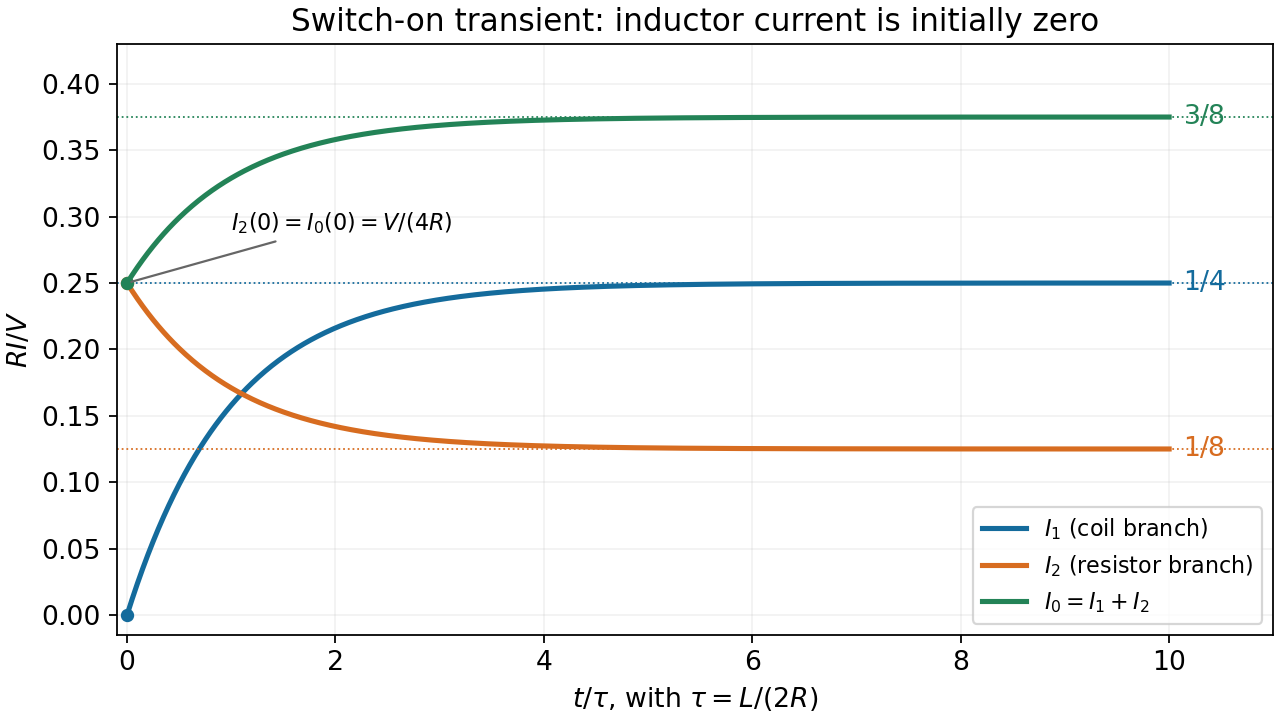
Put . From and ,At the three values are and . At late times they are , , and . Thus and increase monotonically while decreases; every transient has the same time constant. By , the exponential correction is only of its initial amplitude.

Articles by others on the same topic
There are currently no matching articles.