For a long air-cored solenoid, Ampère's law applied to a rectangular loop running inside and outside the winding gives , with the external magnetic field negligible away from the ends. Hence along the winding axis, where . Each turn links magnetic flux with , so the total magnetic flux linkage is . It follows thatHere , and , so andThe value uses the stated long-solenoid approximation and ignores end corrections and winding resistance.
The original diagram places in parallel with the inductor; connects their common node to the source only when the switch is in position 2. Let be their shared voltage and the downward inductor electric current. Since and a finite voltage cannot change it instantaneously, the inductor initially behaves as an open branch. ThusAt long times, an ideal inductor carrying constant electric current has , shorting . Therefore and .
For the full transient, Kirchhoff's current law gives with . Equivalently, the source seen by the inductor has the Thévenin equivalentSolving givesThe relevant resistance is the parallel combination with the ideal voltage source suppressed, not and not alone.
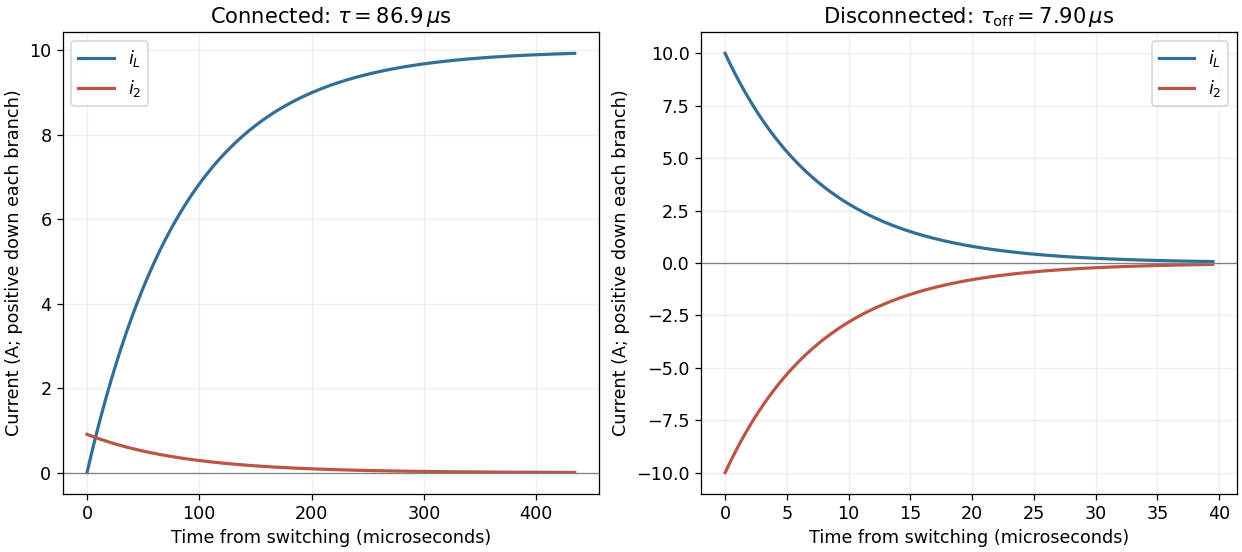
Current redistribution when the solenoid is connected and disconnected
. The two panels use their own time origins. On connection the inductor current grows while the parallel-resistor current decays. On disconnection both branches carry equal and opposite currents as stored magnetic energy dissipates. Details.
During switch-on, the Joule heating in has instantaneous power . Integrating the finite transient givesAlthough the source continues supplying power to indefinitely, is eventually shorted and its heat integral converges. It would be incorrect to identify this heat with the final stored magnetic energy, because the source and also participate during switch-on.
Opening the switch removes the source and but leaves a closed path through the inductor and . Set the new time origin at switch-off. Inductor current continuity gives . Since the two parallel branches are now isolated, Kirchhoff's current law gives , and . ThusAll the initially stored magnetic energy is ultimately converted to Joule heating in :Direct integration of gives the same result. The initial shared voltage is ; its reversal drives the return current. The ideal circuit permits this transient voltage; real switching would also be limited by stray capacitance, breakdown and other parasitic effects.
Articles by others on the same topic
There are currently no matching articles.