The wavelength at is . For an ideal circular aperture of diameter , the Rayleigh criterion places one source at the first minimum of the other's Airy disk:The customary full-ring packing estimate for the number of resolvable positions in a geostationary orbit isThis is an ideal angular-packing estimate. It identifies apparent angular spacing with spacing around the orbital ring and disregards Earth's occultation and station location. An individual ground station cannot see the whole ring; exact conversion from orbital longitude to sky direction requires its location and the orbital radius. Also, a practical tapered antenna illumination changes the ideal circular-aperture response.
A distant satellite supplies an approximately collimated incident beam. A concave spherical mirror of radius of curvature has paraxial focal length . Put the receiving feed at the principal focus, on the optical axis in front of the dish:The radius of curvature relation is a paraxial approximation. A practical dish is usually a parabolic reflector, which focuses an on-axis collimated beam without spherical aberration; a literal spherical dish has spherical aberration, so an exact optimum over its full aperture would need a specified focusing criterion.
Two nearby directions separated by focus at transverse separation . To avoid a receiver covering both geometric image centres at once, its diameter should not exceed this separation along the orbital direction:This is the usual receiver-size estimate from angular resolution. The Airy disk first-minimum diameter is , but that is a spot-size definition, not the same as the receiver's allowed angular acceptance. At the Rayleigh criterion, the images already overlap; integrating over a finite receiver further reduces contrast. Consequently is an order-of-resolution upper scale, not a sharp universal boundary for a specified signal discrimination probability. A detailed limit would require the receiver response and a resolving criterion.
Use a two-element radio interferometer: couple two small dishes coherently and align the projected baseline along the angular separation of the neighbouring satellites. Each dish's broad antenna response should include both satellites. Match the electronic delays so that the desired satellite arrives in phase at the combiner. For baseline length perpendicular to the central line of sight, a small angular displacement produces geometric path difference and phase differenceFor equal signal amplitudes from one source, the output wave intensity is . Put one satellite on a maximum and its neighbour on the first null: . The smallest useful projected baseline is thereforeThe angles here are measured near the normal to the baseline. At a general pointing angle , replace in the small-separation estimate by . Longer odd-half-fringe baselines can also null the neighbour but create more angular ambiguity. This arrangement provides discrimination along one direction; two collectors alone have repeated interference fringes and do not produce an unambiguous full image.
The signal phase velocity in the coaxial cables is , so the guided wavelength is . The excess cable length is , adding a relative delay of and a relative wave phase of magnitudeLabel the two inputs so that the first configuration has total phase difference , where is the geometric phase difference. Swapping the unequal cables reverses that added wave phase, giving . For the same single-source received wave intensity in each arm,The two interference patterns are shifted by half a fringe: maxima in one are nulls in the other. At broadside both give , so swapping does not change the strength of every possible source. For small angles, the maximum-to-maximum shift is with the chosen baseline. Near broadside, the maxima of configuration A occur near and those of B near ; the signs are exchanged if the input labels are reversed. Independent satellites contribute separately according to these directional gains; their mutually uncorrelated signals should not be added as coherent amplitudes.
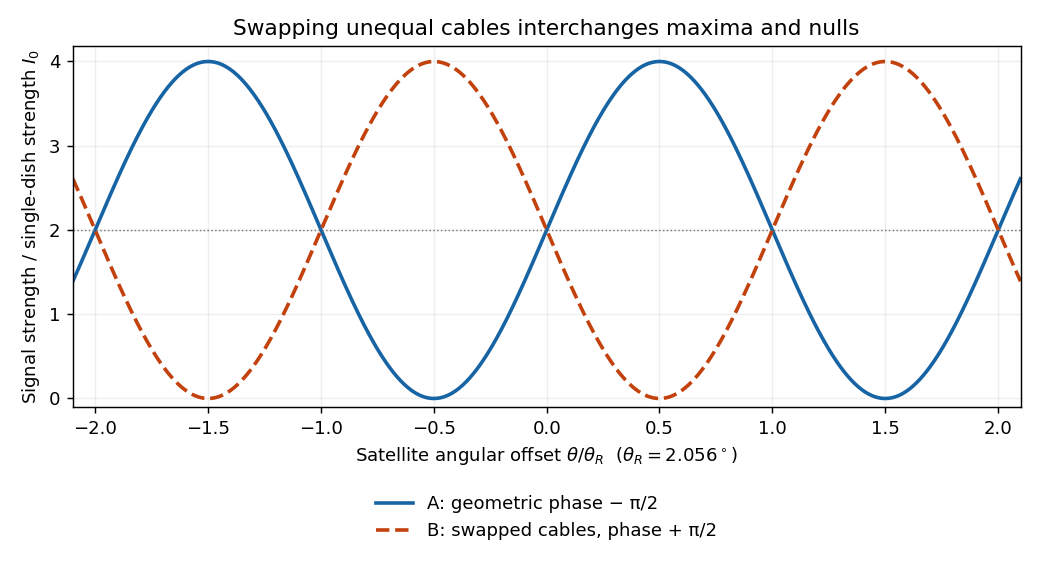
Calculated complementary two-dish signal strengths before and after swapping quarter-wavelength-delay cables
. Details. 
Articles by others on the same topic
There are currently no matching articles.