The restoring, damping and electric forces on the electron give . Dividing by gives a Lorentz oscillator model withFor the convention, substitute . Then andThe time-averaged dissipated power isFor positive frequency the squared term is minimized to zero only at . Thus the power maximum is exactly at the undamped natural frequency, even though the displacement maximum is slightly shifted. Here . The half-power equation is , whose two positive roots areThis is the absorbed-power bandwidth of a viscously damped oscillator, exact within the model. Near resonance the profile is approximately a Lorentzian line shape. With ,For this wavelength linewidth of a damped-oscillator power resonance we used . The half-power wavelength endpoints are not exactly symmetric around , although that distinction is tiny here.
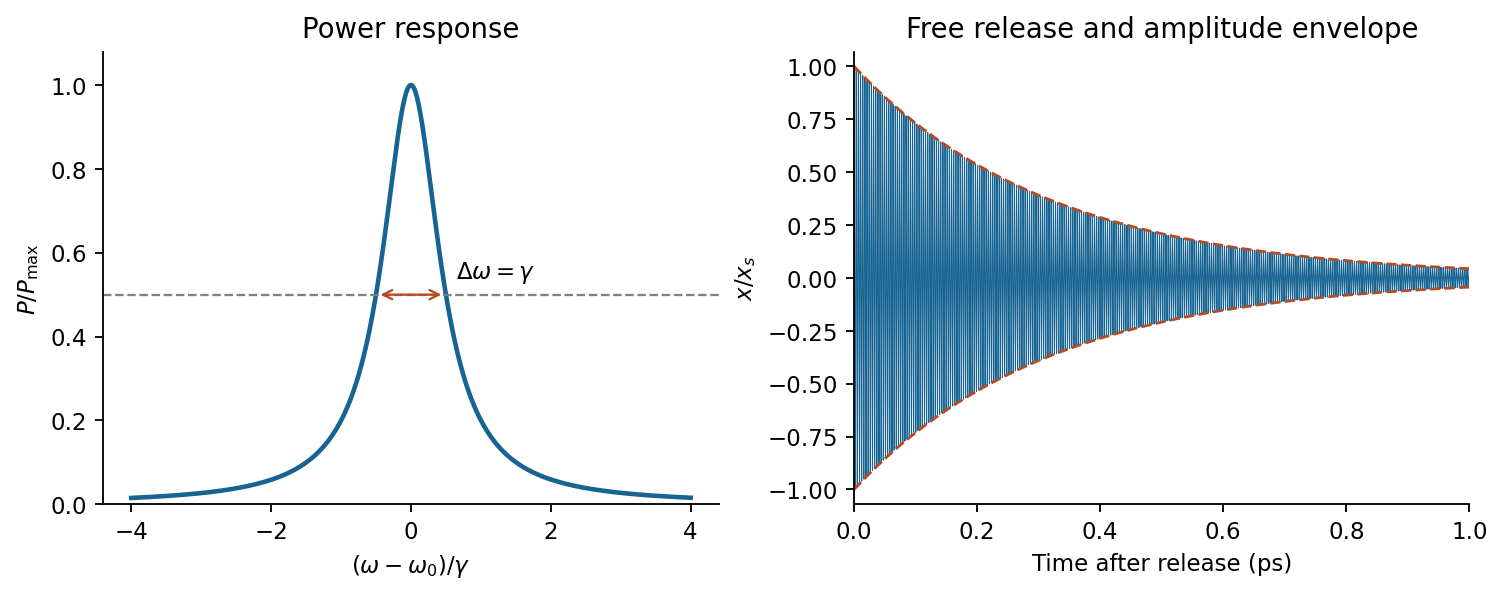

In a constant field the settled displacement is . On sudden removal, with zero initial velocity, the free motion isThe electron oscillates about its original equilibrium, losing the previously stored spring energy. The period is , the amplitude decay time is , and the cycle-averaged energy decay time is . This is the effective classical model supplied, not a prediction of the full hydrogen line radiation spectrum.
Articles by others on the same topic
There are currently no matching articles.