With periodic boundary conditions, each state occupies volume and has two spin states. Filling a sphere gives andHere is density of states per volume and per energy; the extensive is . Both spin states are already included.
For divalent magnesium, , givingAt , only electrons within about of the Fermi surface change occupancy. The Sommerfeld heat capacity isEquivalently , with in kelvin, so at room temperature it is about . A temperature was not specified for the estimate; the linear coefficient is the general result.
At sufficiently low temperature, an ordinary nonsuperconducting metal has : electrons dominate at the lowest temperatures, acoustic phonons produce the cubic contribution, and the lattice approaches per mole as temperature exceeds its characteristic Debye scale. Anharmonic expansion can distinguish measured from . In the room-temperature regime, since , so electron excitation is strongly Pauli-limited. The free-electron estimate is only about of the classical lattice scale. Calling it negligible means small relative to the lattice contribution, not identically zero or negligible as . Real band structure and interactions can alter the coefficient.
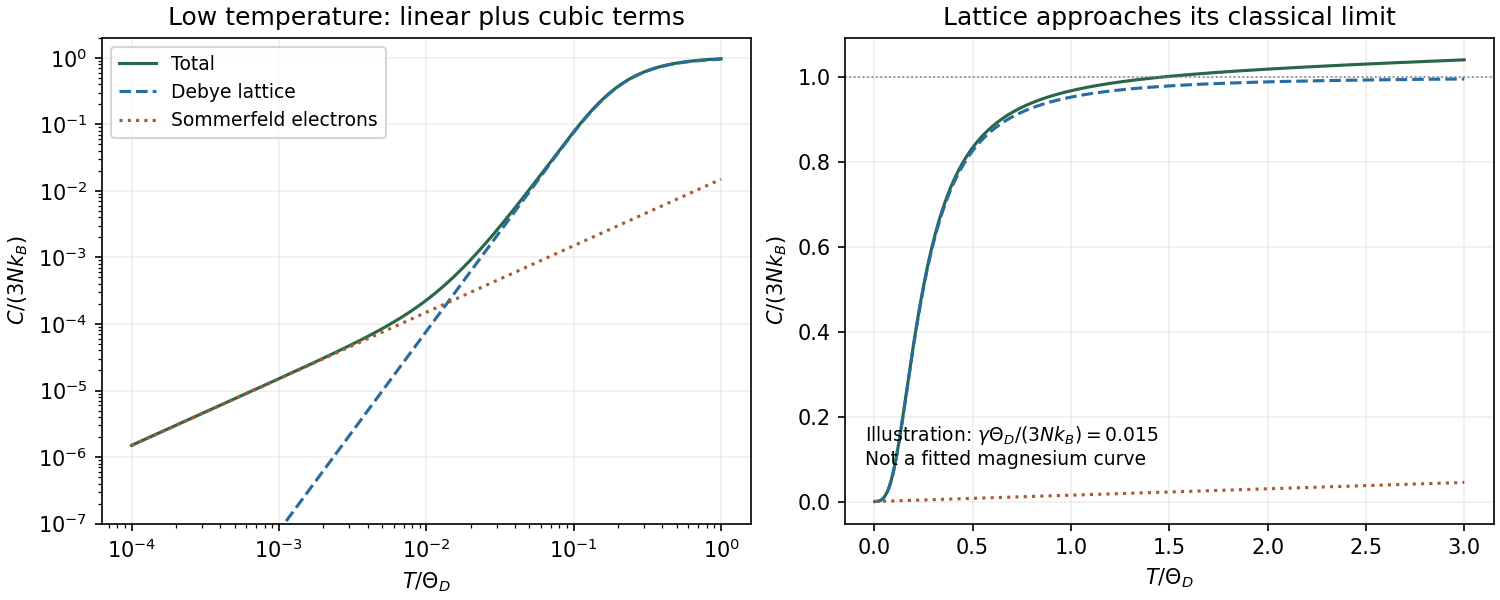
Original illustrative metal heat-capacity regimes: Sommerfeld linear electrons and Debye phonons, with explicit dimensionless model parameters
. Details. 
Articles by others on the same topic
There are currently no matching articles.