In a periodic crystal potential, atomic levels broaden into bands of allowed bloch states. Coupling between states of the same symmetry opens avoided crossings, including Bragg-coupled states in the nearly free-electron picture. Bonding and antibonding combinations provide a complementary tight-binding picture. A semiconductor has a filled valence band and an empty conduction band at zero temperature separated by a forbidden energy interval; thermal excitation, light and doping provide mobile electrons and holes. The gap depends on the crystal's periodic potential, bonding and symmetry, not on a classical collision barrier. In a direct gap, the relevant extrema coincide in wavevector.
For the stated parabolic edges, take and . Negligible photon momentum and no phonon make the transition nearly vertical in versus . parabolic-band optical energy sharing divides the excess photon energy in inverse proportion to the effective masses:Thus the initial and final electron energies, relative to the valence-band maximum, areTheir difference is . The selected is about ; either sign gives the same energy in this symmetric approximation.
A shallow donor supplies an electron in a screened impurity potential, so its localized level lies just below the conduction edge. A shallow acceptor binds a hole and has an electron-occupation level just above the valence edge; thermal ionization supplies mobile holes. The level positions are measured relative to the relevant band edge, and deep impurities need not obey this hydrogenic approximation.
For the supplied bound-carrier mass and unit effective ionic charge, dielectric screening and effective mass change the hydrogen binding energy toThis corresponds to and an effective Bohr radius about . The binding is shallow compared with the band gap and typical atomic binding. Trivalent denotes chemical valence, not an unscreened hydrogenic charge of three. An acceptor physically binds a hole; the question's stated is used as its stipulated bound-carrier mass rather than silently replacing it by the separate band-edge .
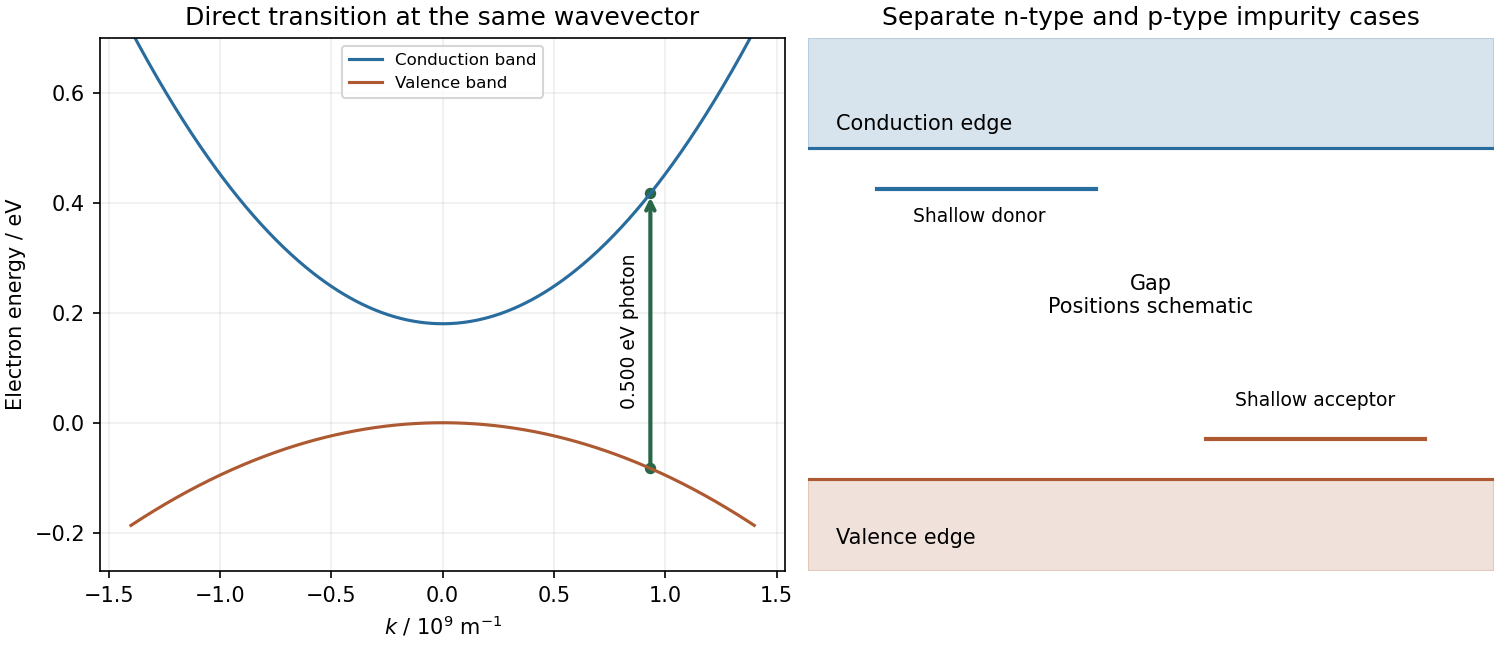
Original direct-gap vertical transition with mass-dependent energy sharing, and separate schematic shallow donor and acceptor levels
. Details. 
With periodic boundary conditions, each state occupies volume and has two spin states. Filling a sphere gives andHere is density of states per volume and per energy; the extensive is . Both spin states are already included.
For divalent magnesium, , givingAt , only electrons within about of the Fermi surface change occupancy. The Sommerfeld heat capacity isEquivalently , with in kelvin, so at room temperature it is about . A temperature was not specified for the estimate; the linear coefficient is the general result.
At sufficiently low temperature, an ordinary nonsuperconducting metal has : electrons dominate at the lowest temperatures, acoustic phonons produce the cubic contribution, and the lattice approaches per mole as temperature exceeds its characteristic Debye scale. Anharmonic expansion can distinguish measured from . In the room-temperature regime, since , so electron excitation is strongly Pauli-limited. The free-electron estimate is only about of the classical lattice scale. Calling it negligible means small relative to the lattice contribution, not identically zero or negligible as . Real band structure and interactions can alter the coefficient.
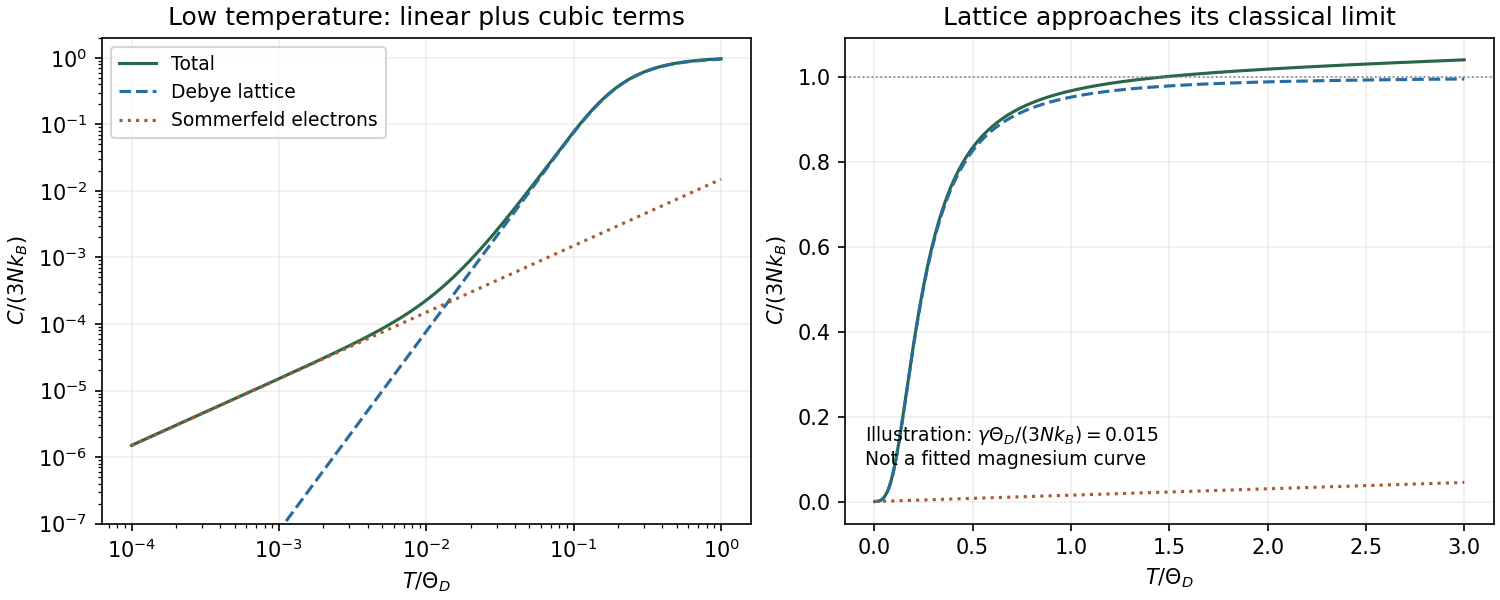
Original illustrative metal heat-capacity regimes: Sommerfeld linear electrons and Debye phonons, with explicit dimensionless model parameters
. Details. 
Articles by others on the same topic
There are currently no matching articles.