Define and use the independent quoted Gaussian errors , with period and exoplanet transit epoch fixed. The model is linear in despite its sinusoidal time dependence. Minimize . With the normal equations areUsing and , the solution isThe residuals in observation order are . Therefore for degrees of freedom, giving reduced . The upper-tail probability is about : the fit is consistent with the stated errors, although five points do not establish a unique physical explanation.
For known errors the covariance matrix is . Equivalently, profiling out the fitted offset givesThis is the one-parameter uncertainty, not the curvature with incorrectly held fixed. Propagating it through the supplied mass relation, and treating its coefficient and as fixed,The symbol in the exoplanet transit epoch denotes periodic copies of the same exoplanet transit phase, not an uncertainty distribution to propagate. No independent error for the empirical mass coefficient was supplied.
Additional independent observations retain positive weight even with twice the error: each has one quarter of the previous per-observation weight. Their information adds to the existing information matrix, so the formal mass uncertainty decreases for informative additional orbital phases and cannot increase under this fixed-error model. It can remain unchanged in a degenerate phase configuration that supplies no further amplitude information after fitting the offset. The conclusion assumes the same correct model and independent errors, not a new fitted error rescaling or unmodelled systematic effects.
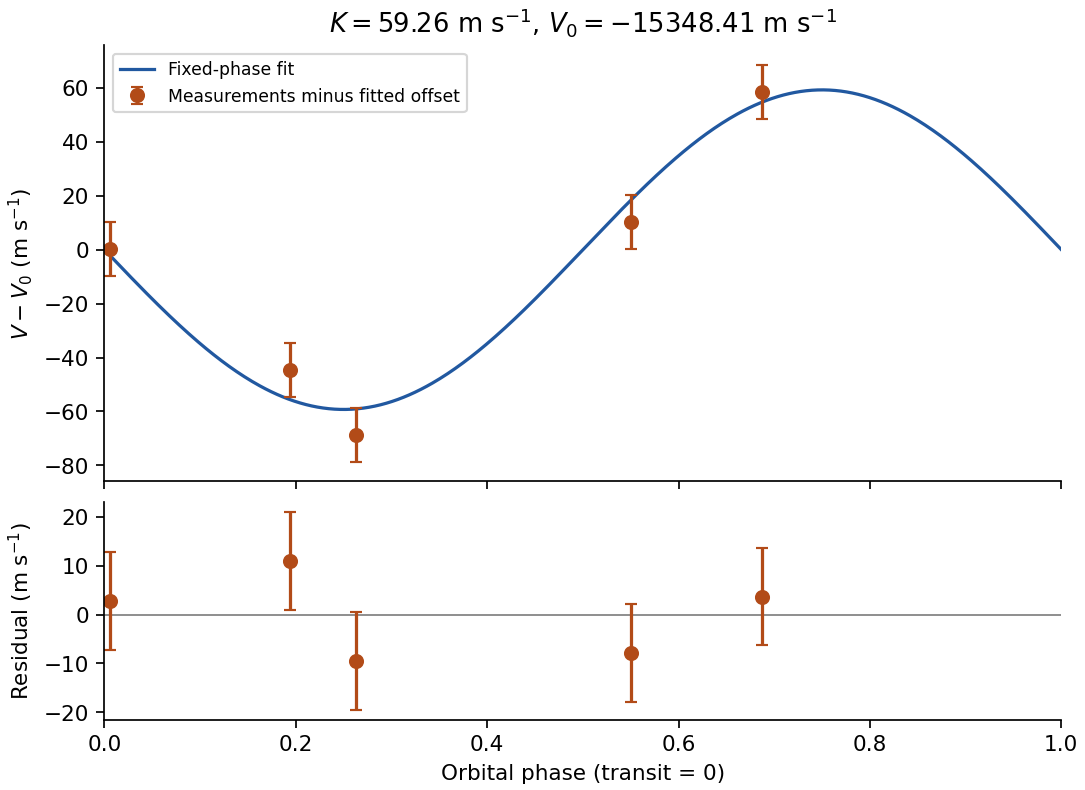
Original plot of the fitted orbital radial-velocity variation and residuals; observed numbers used without reproducing the source table
. Details. 
Articles by others on the same topic
There are currently no matching articles.