The first Brillouin zone is . For one atom per primitive cell and two spin states, a monovalent free-electron gas hasIts circular Fermi surface lies inside the zone and encloses half its area: a partially filled band is conducting. Here odd filling obstructs a spin-degenerate band insulator: a monovalent band insulator is impossible in this spin-degenerate one-atom independent-electron model. It would require changed premises, such as unit-cell enlargement or physics beyond the free-electron picture; no insulating free-electron contour should be invented.
For divalent atoms, . The circle has the same area as the first Brillouin zone but crosses its faces and leaves its corners unfilled. Thus the free-electron case remains conducting: filling capacity alone does not remove band overlap. A nearly free-electron conductor has reconstructed electron and hole pockets; a divalent band insulator instead has one completely filled band separated from all higher bands, with no Fermi surface in the gap.
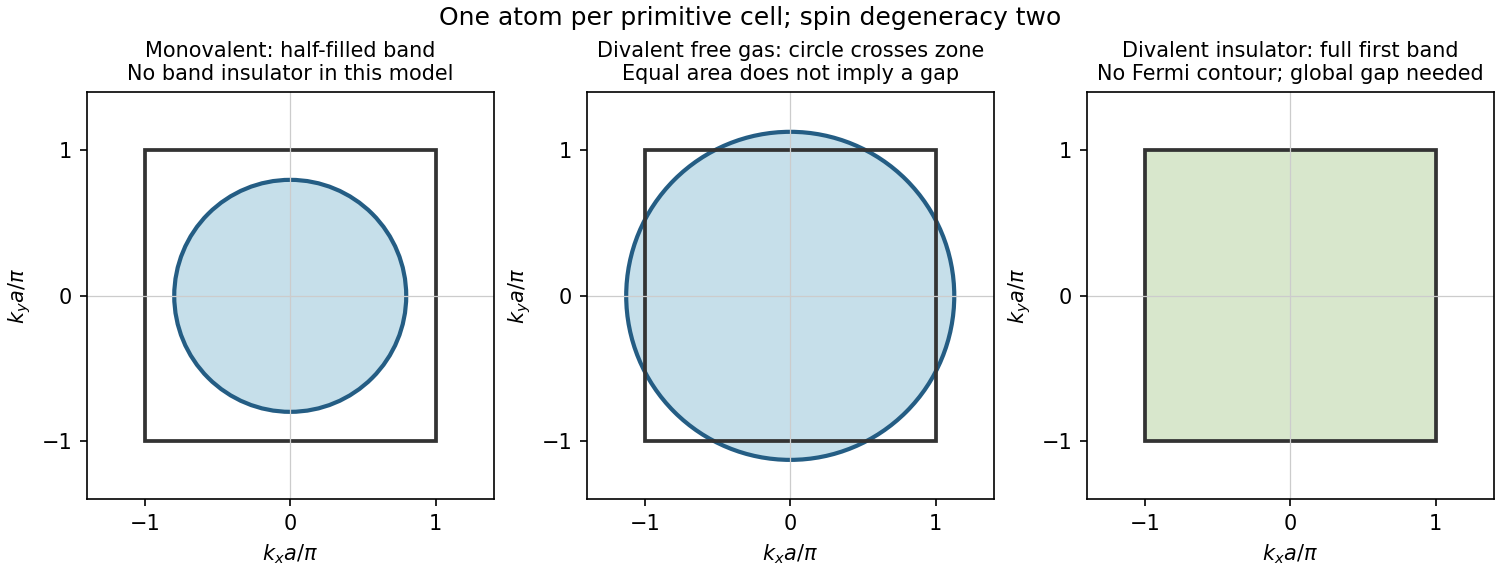
Original square-zone state counting, monovalent and divalent free contours, and insulating band filling
. Details. 
For two electrons per primitive cell,Set . In the indirect gap in a uniformly split zone-boundary model approximation stipulated here, the free boundary energies are along at and along at . Opening a symmetric gap givesThe branches bend away from the free-electron crossings and flatten at their boundary extrema. Importantly, the upper band near lies below the lower band's corner energy:Therefore the crystal is metallic despite its positive boundary gaps; electron and hole occupations redistribute across overlapping bands. positive direct gaps can coexist with band overlap.
A microscopic square-lattice corner has additional plane-wave degeneracy. The quoted symmetric boundary numbers use the question's directional gap model, not an unspecified four-state corner Hamiltonian. For the indirect gap of a separable square cosine potential, a separable weak potential with the same face gap gives the lowest corner energy , still above the upper-band face energy. This refinement preserves the metallic conclusion.
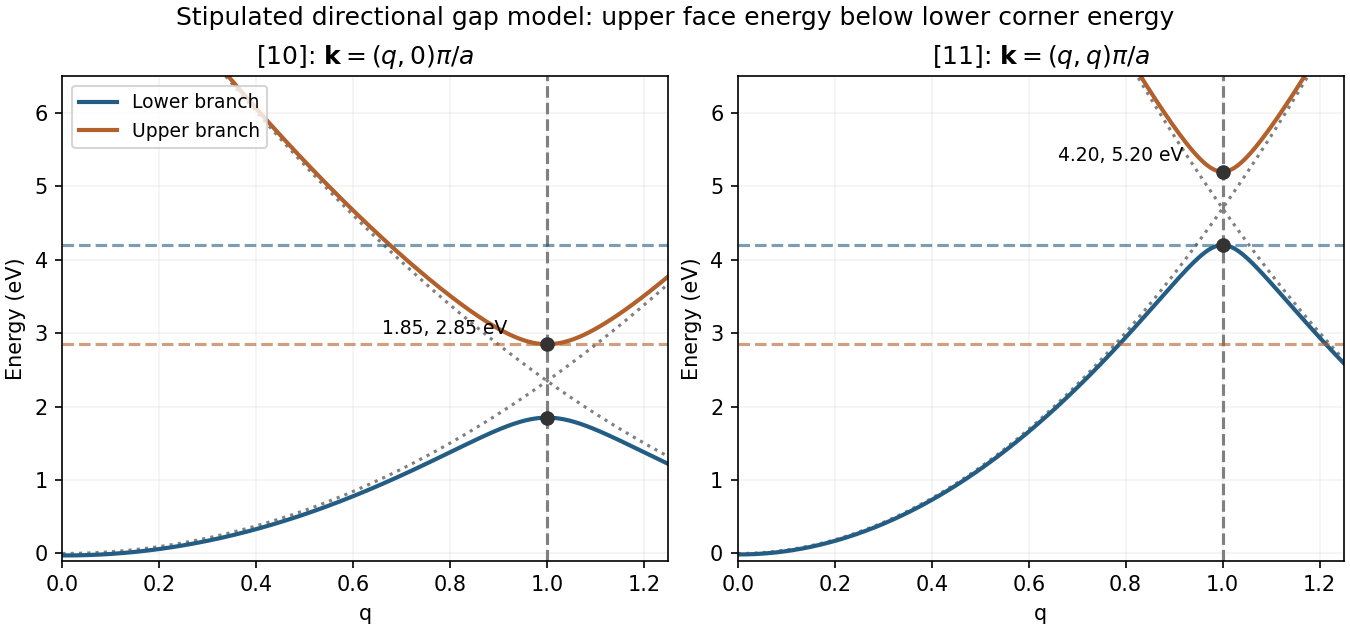
Original directional avoided crossings and the overlap of lower- and upper-band boundary energies
. Details. 
Articles by others on the same topic
There are currently no matching articles.