For distributed inductance and capacitance , a small segment obeys and . Differentiation gives and . For a forward wave,A backward voltage wave has current . This sign matters at an impedance discontinuity.
The source figure is the stacked-strip parallel-plate transmission line geometry, despite its use of the word coplanar. Gauss's law gives . Opposite surface currents give magnetic field between the strips by Ampère's law; the magnetic flux per unit length is , hence . ThereforeNo numerical is given; the impedance is appropriately left in terms of that ratio. The line is taken to be nonmagnetic and lossless.
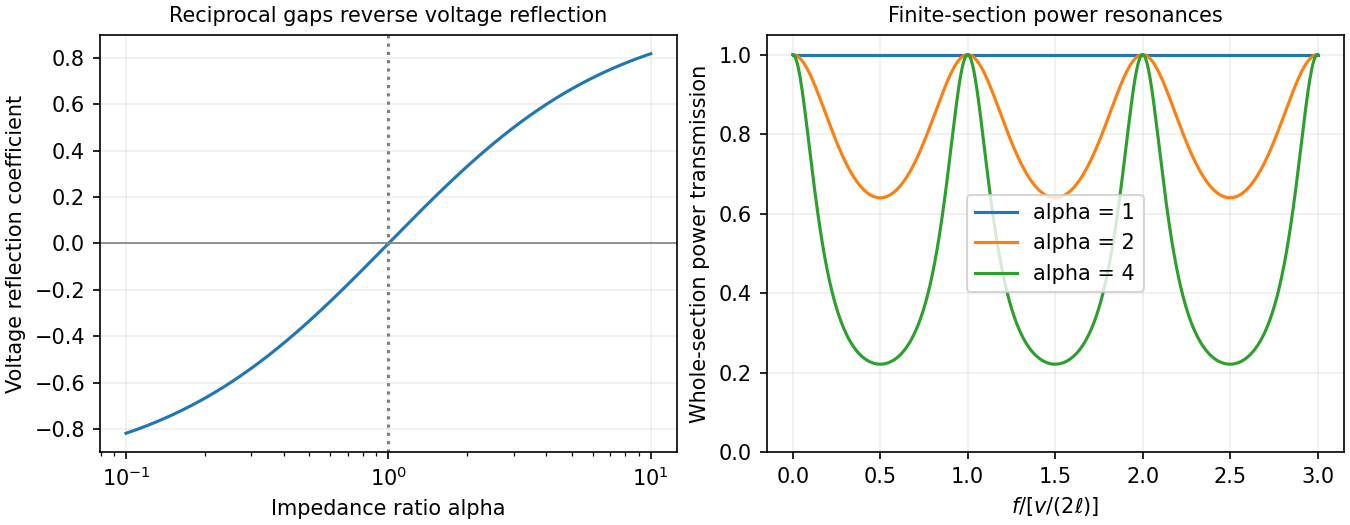
Increasing the gap by changes to and to , so while is unchanged. voltage and current continuity at the step giveConsequently the voltage and energy-flux transmission coefficients areHere amplitudes are peak voltage amplitudes, with mean power . The reciprocal gaps have : equal reflected energy but opposite voltage phase. A voltage transmission coefficient above one does not imply energy gain.
For a finite impedance section of a transmission line, put and . Multiple reflections inside the altered section interfere. Summing their geometric series, relative to the first boundary,Transmission is unity at and minimal at , with minima . Resonances are separated by ; the long-wavelength limit also transmits fully. Matching the far termination removes end echoes, not the two internal reflections.

Articles by others on the same topic
There are currently no matching articles.